DRIFTING MOUNTAIN CLOUDS

This was around 1996. Probably the fall.

I was sitting in the small library of little Lees-McCrea College in the Blue Ridge Mountains of North Carolina in the town of Banner Elk. I was just browsing, using up some time. I’ll always go in search of a library. A college library, however small, is usually rich in the better books and even richer periodicals. Under the best of circumstances, libraries are still quiet places. This one was quiet. Maybe I would learn something. I was doing a lot of thinking, too.

I was also in between broadcast jobs, thinking of leaving the business, uncertain of my next move. I’d traveled up from Florda after leaving my TV job there, and was halfway back to what I will always call home — Massachusetts, especially Boston, for better or worse. I was living with a group of people (long story) and working at a little radio station which I liked, but being required to sell advertisement in addition to being on the air. I didn’t like visiting merchants and auto dealers selling ads. I like meeting people –especially Southern people — but didn’t like or feel competent about figuring out how to convince them to spend money, then write up a contract.

Suddenly, as I sat reading and thinking, what appeared to be smoke began drifting by the window and between the library building and the neighboring campus building. For a fraction of a second, I was alarmed -but then, consoled and quietly beguiled.

For this was not smoke. These were clouds. None of the few other people in the library seemed to think the sight unusual. We were in the mountains, after all, high up among some low drifting clouds. I suddenly loved that peculiar reality, and those white ephemeral phantoms. I began to think pleasant mountain thoughts.

But my bright thoughts, at any moment, illuminated, as by the sun, often darken. Moods, like dark clouds, can drift across and block the sunshine. It was true at that moment, true always. Nostalgia, too, (in which I’m indulging now) can turn sorrowful, especially over memories of wasted time. I’ve wasted a lot of time since that day, and squandered a great deal of mental and emotional resources that should have gone into writing. (Facebook and blogs did not exist then, and are still not the best forums – or fora – for a true, which is to say, “professional” writer.)

That cloud-hidden moment was around the month I turned fifty. It was mid-life and, since I’d started my broadcast career late( at thirty-two) I was more or less at mid-career (though I’d put in prior years as a newspaper reporter).

I’d ultmately work until right around my 69th birthday in 2015. That was in the future.

But at that moment in that little college library, I wasn’t even sure I’d resume my broadcast career. I wasn’t sure what I was going to do. I knew I couldn’t stay in the mountains, among the clouds, barely getting by on the salary of a tiny mountain radio station located in a tripple-wide trailer. (Yes, it was fun, but it wasn’t the time to make a career of it.)

Either during that library visit or on another day peacefully among the stacks, I’d been reading about the writer Flannery O’Connor — about how she’d “accepted” her vocation as a writer — not easy for her, wracked by the degenerative disease lupus and destined to die at age 39.

I had pondered what it means to “accept” one’s vocation, even when it’s difficult, but when it nonetheless feels like the only path to fulfillment, or what analysts call self-actualization (whatever that means). I had read of many writers saying this about their “vocation”–that it felt like accepting its joys and burdens was the only life path forward. That’s doubtless true of any vocation, but writers of any genre at any level often speak of the trial of filling that white blank space before them out of the sometimes meager resources of their imagination or memory, nonetheless feeling compelled to do so. I once heard the writer Catherine Anne Porter, during an interview, say she’d often felt she’d have been much happier with another vocation and more than once vowed to give up writing –only to find herself writing out that vow. Jessamyn West wrote that good days practicing her craft were like heavenly bliss, while bad days were equivalent to working off any punishment she might have earned with her sins. Sports writer Red Smith famously said, with beautiful sarcasm, that writing wasn’t difficult; you just sat in front of the blank page and opened a vein.

One can too easily exaggerate those difficulties — to oneself or to others. It’s a cheap excuse for giving up.

And a writer might work forever in obscurity. Franz Kafka asked a friend to burn all his writings, many of them incomplete, after he died. Fortnately, the friend did not honor that promise.

On or about that mountain day, meditating among drifting clouds, I learned very belatedly about the necessity of “accepting” a writer’s vocation, even though I might die before I got any good at it, or got any readers.

But soon thereafter, I continued my journey north and resumed my broadcast career and mostly neglected this true vocation, making it into an occasional avocation. TV news writing was easy. Real writing is hard.

Now, in what little time is left, I must “accept” my writer’s vocation. I might even enjoy it.

And I will be grateful for that brief moment of illumination, beguiled and consoled among drifting clouds by my drifting thoughts at 3700 feet above sea level.

And I must write.

MERE BEING, MID-JULY

The 17th. Sultry

Clouds, gray, massive, wooly.

…piled and piled

Like gathered-up forgetfulness.

-Wallace Stevens

But these are storm clouds

Comes, then, the rumbling, the distant violence, the electric…

The dog Cricket can hear it all, wherever.

Distance, fearful moments, are always always

near for her.

So good that she forgets it all when

it passes, or seems to.

Mere Dog moments

speak of no future but ashes

But right now, for her, it is

Like an Army approaching.

Trembling, a spotted study in pathos.

On goes the thunder shirt, a half tab of C.B.D.

is proffered, devoured.

hidden in peanut butter

It will not matter. Terror roams the tin house.

The jacket, the drug do nothing.

Sometimes you have to pass through fear

Mortal and mere dog.

Til there is only sun again, bright, drenching air.

And the human anxious hours go on, endless

not to be hidden

In peanut butter.

I write. I must write.

____________________________

The mocking birds and their babies are gone.

They were out my window.

They have twice built nests at the end of the carport.

In the flanking shrub and palm.

Three baby beaks, massed in fuzz, turned up, begging

A mother

Nurturning them in the spikey crest of the Robellini palm.

Odd place to build a nest, eye-level, thorny.

Then there was just one, so big, timid, flapping

Ready for the sky. The last baby.

Gone all at once. What is sadder? Death is what.

They will sing and soar their hour. Be glad of it.

May their song, theirs and their fellow mockers

tails bobbing be always about us.

But we wish we knew where they were now.

____________________________

That nest. The coiled twigs of abandonment, fragile to begin with

Unraveling. A wind might take it. Or time, which

will take us

And the nest will be gone.

Forever.

But there are always nests.

______________________________

I add seed to the old feeders.

I wonder, where human life in concerned, where — from here?

Where? When? Exile. Sub-tropic exile.

And the poet wrote that…

The palm at the end of the mind

Beyond the last thought, rises

In the bronze distance.

And he wrote: The palm stands at the edge of space

The wind moves slowly in the branches.

In the fronds.

In Mid-July

Or just past it,

on the 17th.

It didn’t rain.

GOODBYE, BARCELONA

(Fourth and final installment in the Barcelona Quartet)

It was raining hard in Florida’s Panhandle the day I labored to recover these fond memories. I was staying in a borrowed waterfront cottage. It was August ,2016. Up in Massachusetts, my sister was dying of cancer, the world, then and now, was wracked by war and violence. The Gulf of Mexico was gray, roiled to the horizon, rollers breaking white against the rocks along the coastal road only fifty yards away. It was a road that, in a matter of days, was destined to be broken apart and washed away by a Hurricane Hermine.

I would be gone by then – done recalling that day, fifty years before when I left the city of Barcelona….

+ + + + + + + + + + + + + +

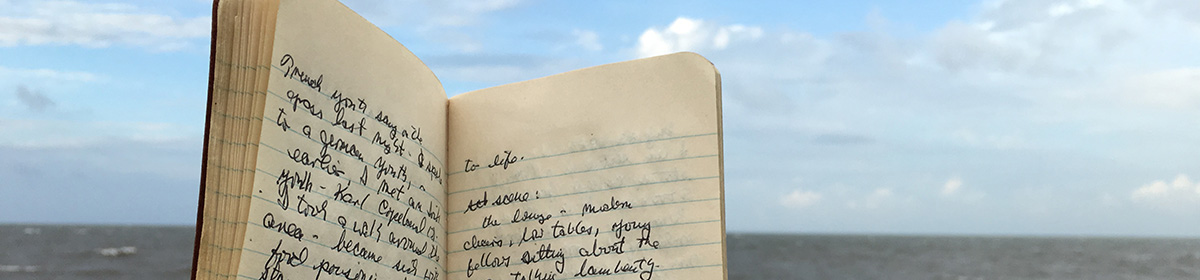
From my 19-cent travel notebook:

“The train is very dark as I write this.”

I’m 19. The train, a Spanish train, is still in the station. About to head north to France, July, 1966. It began moving suddenly….clack-clack …clack-clack…. Those old tracks that would take me to the railroad border town of Port-Bou. I’d been a stranger in a strange land.

There is a statue of Columbus in Barcelona along a wide waterfront boulevard. Columbus is high up on a thin, ornate pedestal, pointing out to sea. To the New World, presumably (although he’s actually pointing toward Algeria).

The New World was far, far away from this Old World. I was homesick.

Remembering Barcelona’s brief encounters — too brief, just two days — I wrote: The view was wonderful, the gardens beautiful. Not another word about those gardens, that view. And why no mention of Antoni Gaudi’s sacred, eccentric Sagrada Familia basilica? – “with its profusion of decorated spires and neo-Gothic arches and its bright, throbbing colors, intricately detailed sacred carvings and riotous modernists stained glass…”as one writer so beautifully wrote of it anonymously in a journal I’ve since stumbled upon. The Church of the Holy Family would have dominated any view. Did I miss it, that wild, beautiful work in progress, begun in 1882 — called sensual, spiritual, whimsical, exuberant. said to resemble sugar loafs and anthills?

Some hills I do remember from my brief tour — mounds of rubble in vacant lots. Were they lingering scars from Spain’s Civil War? Barcelona had briefly belonged to the Anarchists during those terrible times. Peaceful and equitable in many ways, or so it seemed initially to George Orwell, writing of it in Homage to Catalonia. He would become disillusioned with the Spanish Republican Loyalists.

Chance observations became indelible memories. A taxi, horn blaring, rushing a sick child to a hospital. Three family members, late for their train, spilling out of a taxi with their luggage, racing frantically into the station. I remember the heat. I feel as though I just crawled four hours through a field, I wrote as I wandered. But I have only unrecorded memories of the night before, desperately lost, unable to locate my youth hostel, wandering in darkness along a steep hill street leading up to wherever one boarded additional transportation to The Benedictine Abbey and Holy Grotto of Montserrat, trolleys noisily ascending and descending under the trees. I only glimpsed them– but that glimpse would become one of those indelible memories — children and their clerical guardians packed aboard those trolleys – nuns and young priests, pilgrims all. (I need someday, to figure out how those pilgrims on those particular trolleys were managing to make it miles away to the Abbey.)

When I was lost, I was praying, and prayer brought me back to my hostel, finally. May I always go on praying, because, I often feel lost.

I’d wandered lost for hours and will never forget that. Barcelona preserves in me the necessary sense of a lost and searching soul.

On that last day, I met a Boston University student from Connecticut. Forget his name, or how we met. He’d be sailing to Majorca. I’d never heard of Majorca. He told me about it as we walked through Barcelona’s Gothic Quarter; medieval churches, prayers in stone. He embarked for the island, said farewell. Alone, I explored the city some more, thinking of Majorca. (Thinking as I write, of him, that brief companion. I also, very briefly while alone, encounterd a couple of fellows from Wrentham, Mass.)

I wrote: Bought a post card in a shop, the woman very helpful. Finally, boldly I was navigating the city that had so intimidated me, my American smile a thin substitute for rudimentary Spanish. Had a Coke in a café. Wrote out a postcard to my godmother. I was at ease, however briefly, in the city in which I’d once felt eternally forsaken. But still undeniably a stranger in a strange land.

I wrote:

Took the ferry to the breakwater. Mediterranean very beautiful.

There was a little café out there.

Had shrimp and Vina Pomal for 173 peseta.

Light-headed, I walked along the breakwater, found a bench. Thinking of home, I watched a huge gray ship of the U.S. Sixth Fleet — possibly a light cruiser — pass close by in bright sunlight, heading for open water, all its sailors “manning the rails” in their dress whites, the U.S. Navy’s mandatory ritual of departure upon sailing out of any port. Did I wave to my fellow Americans? Did any of them wave back? Do any of them today remember seeing that lone fellow countryman on the jetty as they left? Waving goodbye?

It was time for me to leave port as well. And to say goodbye.

In near darkness on the train, I wrote: I had to buy an ice cream to get rid of the last of my change (Spanish pesetas). Not changeable across the border. The train lurching forward. The station, the city fading. Sun setting on the factories outside Barcelona….Martini Rossi billboard passes by. Fields with bundles of hay. The fields getting dark. We have come to a stop amid children’s voices in the distance. The train moving again. Luggage rocking, more dark fields….

clack -clack….clack-clack….”

+ + + + + + + + + + +

The rain had stopped at this point on Alligator Point back in August, 2016. I was done recalling and copying these memories out of my 19-cent notebook. The light was fading, wind rising. Palm trees, live oak, tossing wildly. The sky overhead a pastiche of El Greco’s View of Toledo, taking me back to Spain.

A guy in a cowboy hat, earlier that week while I was pulled up to the gas pump in a neigboring town, spotted my Massachusetts license plate and asked with a sly turn of the head, “You from Baws-ton?”

“Yup, originally.”

“You talk funny?”

“Yup. I pahk the cah.” He laughed. I laughed. Happy once again to be a stranger in a strange land, even though it was my land. Happy to be in a place where people talk to you. Sorry that time was passing so quickly.

It’s kept passing. That was nine years ago.

I must go back to Barcelona someday. Must see Gaudi’s Basilica. Filled with blessed spaces. Attend Mass there. Sanctus, Sanctus, Sanctus.

Then, maybe,I’ll also sail out to Majorca, see its cliffs, it deep blue coves….but, above all, see all of that city I barely glimsed so memorably, as in a magic lantern, when I was so young.

Goodbye, Barcelona. Goodbye.

.