This was around 1996. Probably the fall.
I was sitting in the small library of little Lees-McCrea College in the Blue Ridge Mountains of North Carolina in the town of Banner Elk. I was just browsing, using up some time. I’ll always go in search of a library. A college library, however small, is usually rich in the better books and even richer periodicals. Under the best of circumstances, libraries are still quiet places. This one was quiet. Maybe I would learn something. I was doing a lot of thinking, too.
I was also in between broadcast jobs, thinking of leaving the business, uncertain of my next move. I’d traveled up from Florda after leaving my TV job there, and was halfway back to what I will always call home — Massachusetts, especially Boston, for better or worse. I was living with a group of people (long story) and working at a little radio station which I liked, but being required to sell advertisement in addition to being on the air. I didn’t like visiting merchants and auto dealers selling ads. I like meeting people –especially Southern people — but didn’t like or feel competent about figuring out how to convince them to spend money, then write up a contract.
Suddenly, as I sat reading and thinking, what appeared to be smoke began drifting by the window and between the library building and the neighboring campus building. For a fraction of a second, I was alarmed -but then, consoled and quietly beguiled.
For this was not smoke. These were clouds. None of the few other people in the library seemed to think the sight unusual. We were in the mountains, after all, high up among some low drifting clouds. I suddenly loved that peculiar reality, and those white ephemeral phantoms. I began to think pleasant mountain thoughts.
But my bright thoughts, at any moment, illuminated, as by the sun, often darken. Moods, like dark clouds, can drift across and block the sunshine. It was true at that moment, true always. Nostalgia, too, (in which I’m indulging now) can turn sorrowful, especially over memories of wasted time. I’ve wasted a lot of time since that day, and squandered a great deal of mental and emotional resources that should have gone into writing. (Facebook and blogs did not exist then, and are still not the best forums – or fora – for a true, which is to say, “professional” writer.)
That cloud-hidden moment was around the month I turned fifty. It was mid-life and, since I’d started my broadcast career late( at thirty-two) I was more or less at mid-career (though I’d put in prior years as a newspaper reporter).
I’d ultmately work until right around my 69th birthday in 2015. That was in the future.
But at that moment in that little college library, I wasn’t even sure I’d resume my broadcast career. I wasn’t sure what I was going to do. I knew I couldn’t stay in the mountains, among the clouds, barely getting by on the salary of a tiny mountain radio station located in a tripple-wide trailer. (Yes, it was fun, but it wasn’t the time to make a career of it.)
Either during that library visit or on another day peacefully among the stacks, I’d been reading about the writer Flannery O’Connor — about how she’d “accepted” her vocation as a writer — not easy for her, wracked by the degenerative disease lupus and destined to die at age 39.
I had pondered what it means to “accept” one’s vocation, even when it’s difficult, but when it nonetheless feels like the only path to fulfillment, or what analysts call self-actualization (whatever that means). I had read of many writers saying this about their “vocation”–that it felt like accepting its joys and burdens was the only life path forward. That’s doubtless true of any vocation, but writers of any genre at any level often speak of the trial of filling that white blank space before them out of the sometimes meager resources of their imagination or memory, nonetheless feeling compelled to do so. I once heard the writer Catherine Anne Porter, during an interview, say she’d often felt she’d have been much happier with another vocation and more than once vowed to give up writing –only to find herself writing out that vow. Jessamyn West wrote that good days practicing her craft were like heavenly bliss, while bad days were equivalent to working off any punishment she might have earned with her sins. Sports writer Red Smith famously said, with beautiful sarcasm, that writing wasn’t difficult; you just sat in front of the blank page and opened a vein.
One can too easily exaggerate those difficulties — to oneself or to others. It’s a cheap excuse for giving up.
And a writer might work forever in obscurity. Franz Kafka asked a friend to burn all his writings, many of them incomplete, after he died. Fortnately, the friend did not honor that promise.
On or about that mountain day, meditating among drifting clouds, I learned very belatedly about the necessity of “accepting” a writer’s vocation, even though I might die before I got any good at it, or got any readers.
But soon thereafter, I continued my journey north and resumed my broadcast career and mostly neglected this true vocation, making it into an occasional avocation. TV news writing was easy. Real writing is hard.
Now, in what little time is left, I must “accept” my writer’s vocation. I might even enjoy it.
And I will be grateful for that brief moment of illumination, beguiled and consoled among drifting clouds by my drifting thoughts at 3700 feet above sea level.
And I must write.
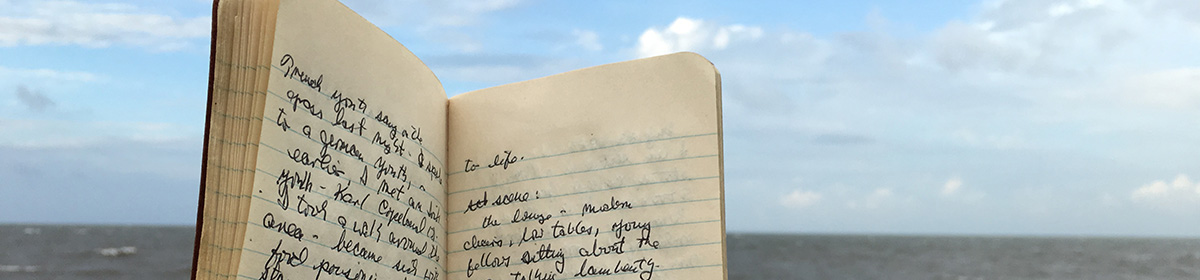
 19 Cent Notebook