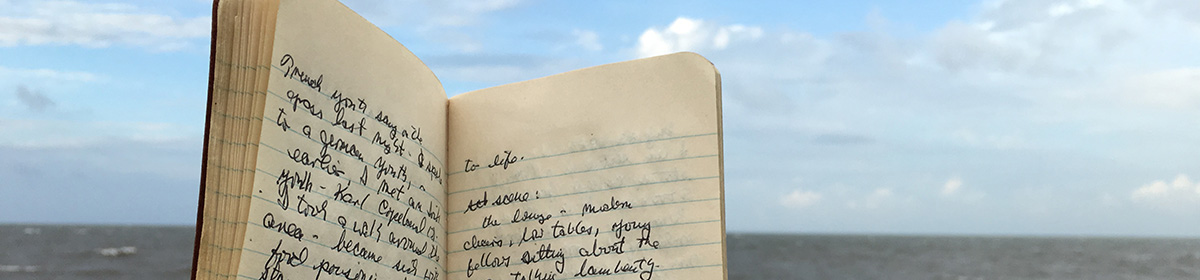
Joe Barron is heir and sole owner of a renowned little establishment occupying a square patch of earth on the East Boston/Revere, Massachusetts line, built of brick, masonry, neon and plastic and its close cousin vinyl, featuring a vintage original marble bar top, operating for 102 American years, doing business as The Last Mile (named thus principally because its founder, Joe’s great grandfather, was granted a governor’s reprieve sparing him the electric chair for the charge of 1st degree murder — and because the place was once thought to be exactly a mile from Logan International Airport (off by about 4 1/2 miles–the person making that calculation was plainly guessing while drinking). It began, given its era of origin, under a candy store, the entrance through the bulkhead in back, for it was a speakeasy until the end of Prohibition.
The Last Mile was, on October 12, 2024, the scene of a small autumn gathering for “regulars” and any souls in need of a year-end taste of what the poet Keats called that “season of mists and mellow fruitfulness.”
The chosen venue was the 30×30 patch of dirt, crab grass and rutted macadam out behind the bar. Not exactly the Tuillieries or Kew Gardens, up against the tumbling stockade fence and what litter Joe hadn’t been able to clean up stuck in the crevices. But everybody, when things were in full swing, was loving it and getting along, a kind of fall reunion and celebration of the dying year, before the only two back lot trees — a scrawny old maple and a very robust but no less old oak — become bare as old swamp stags casting November shadows.
We weren’t making much noise, but as a courtesy, Joe invited to the festivities the guy who lives in an old house on the other side of the stockade fence, a body and fender guy named Terry Garagiola who has a shop in Lynn. He came with his wife Teresa and his mother Angalina.
Joe, 77 years old, was up from his long-time permanent dwelling on Key Biscayne, Florida. He walked through life now under a grand breaking wave of silver gray hair, sometimes a little shaggy at the collar of his expensive shirts, looking a little paunchy this October, wearing his usual gold chains and wearing a couple of expensive-looking ring and a third one being his East Boston High School class ring. The shirt had orange blossoms on it, a Florida touch. He has always seemed the kind of guy you used to see hanging around the old Esquire Bar or the Squire Lounge. I found out, in fact, that he knew the famous Revere stripper named Taquila who famously used a boa constrictor in her act. We heard, many years ago,that he had dated her, and often took the snake along in a Styrofoam cooler in the back seat of his Elderado. One night while they were having burgers at the Adventure Car Hop, the snake got out and came crawling under the seat, right up between Joe’s legs. Taquila was able to get her “baby” –named Monty The Boa –quickly under control. Good thing!
We always wondered how Joe managed to operate a bar, since he’s got a belfry full of butterflies. We privately believe his lawyer in Boston handles the finances. Deano, his bartender, orders the liquor and runs the place day to day. Joe’s place in Key Biscayne is just the product of some good gambling revenue from a Fort Lauderdale casino he owned and maybe a few junk bonds and a couple of junk bars and laundromats he also owned down there and sold, and maybe old family money supplements his basically simple life. (When managing a combination laundromat and strip joint got too complicated, he sold it after making a fair profit. “Too many nuts,” he said of his sudsy lascivious clientele.) There’s rumors of a lingering Florida partnership with dubious Miami elements, remnants of the Trafficanti empire, that we all hope are false. If true, if he never stiffs them, they might come looking for him at The Mile.
It was great, looking around, seeing everybody.
Joe was accompanied by a new “companion” by the name of Pippa Goldflower. He simply wanted to be back, for the first time in perhaps ten years, for a New England autumn. The weather held for him. Pippa came with him, eager to experience a New England autumn as well.
This Pippa was an interesting, slightly mysterious, decidedly sophisticated lady, said to have been born in Nevada, raised in Latin America and England, daughter of a flamboyant diplomat, and a little flamboyant in her own right. She was younger than Joe, but had long white hair with magenta highlights — yes, I made so bold as to ask and she confirmed that that was the color — flowing floral skirt, lavender top — a riot of colors for every season and every state of life! Whether she was Joe’s girlfriend or not, we don’t know. Joe told us he met her in Key West while taking one of his periodic excursions down from Miami to watch the sunset at the nation’s southernmost point and drink at Sloppy Joe’s. Along the ledge over the back of the bar now, you see an array of conch shells Joe collected on the Key’s shoreline over the past year. We think this was Pippa’s idea, and probably her collection. We assumed therefore that Pippa, habitue of the world’s dazzling ports and stylish avenues didn’t find the Last Mile and its dumpy back lot too low rent for her tastes — not if she was willing to decorate it with shells. And we further figured that Joe must have charmed her nearly to death (Joe had that effect on a certain kind of woman) — or she was just slumming.
There was no champagne or vintage beverages for this confab. The cooler was full of Model, Budweiser,Miller, Bud Lite, a few Heineken. Nothing too fancy for wine, either — Almadine, Yellow Tail rose’and chardonnay, and four jugs of apple cider and a little lemonade. These were on three card tables along with what passed for hors de’oeuvres — cheddar cheese and crackers, salami, pepperoni, little wieners, pickles, pastry. Stuff you could get at Stop&Shop up the street, and Dunkin Donuts. Anything fancier would have ruined it. Keep it Simple is Joe’s motto.
Knox, the artist, came down from his apartment above the bar with his usual alcohol concoction known as a Blushing Monk. He was probably breaking Joe’s rules, drinking the hard stuff on the property out of doors. But this was a special occasion. Joe had put out folding beach chairs, about a six or seven.
This back lot was all that The Mile had for a parking lot, but everybody parked on the street on this Saturday.
When I arrived, Kenny Foy was there, Athena Leroy, the Greek American realtor from Lowell who had her little epiphany at The Mile and always came back, usually on Saturdays. Bo Cherry Burkhardt was there with Charlie Simmonetti. And, of course, Sticky Sammartino and Jackie The Crow Kantner. Willy Hartrey who walked up from his house a few blocks away.
A nice little gathering. Very modest. Cozy.
Technically, Joe Barron needed a permit to do it, because serving food and beverages outdoors was not part of his Massachusetts common victualers license. He got a quick permit from Revere City Hall, where he has connections. As noted, The Revere/East Boston line runs right through the little bar, one of its charming claims, entirely verified, that put it in some guidebooks. I never noticed the white town line that ran wall-to-wall across the old tile and well-worn pine planks of the Mile’s well-oiled floor.
Also Joe could have rented the Lithuanian Club hall. But this was happily working class impromptu, Joe’s surrender to a small, romantic impulse. He just got a little sentimental about autumn and his childhood memories of Columbus Day and all that — playing halfback in high school football over at Chelsea Stadium in autumns of yore –and every autumn memory you can think of (the old “cool, crisp days” thing and the early darkness and scuffing through the leaves). For him, it was perfect just to be in good company under the scrawny little maple out there, which had just enough foliage left to spread some color. The oak was doing okay, but very autumn looked like it would be its last for that maple, but the leaves –you could probably count them — kept sprouting green in spring. Thank God for that.
As for the oak tree, not a lot of color, as oaks go. But the leaves were turning dull yellowish brown and would fall and still be around on the snow all winter, and Joe stood under it and recited “The Village Blacksmith,” by Longfellow. (“Under the spreading chestnut tree, the village smithy stands….”) He intoned it in a grandly resonant voice for everybody to hear! Twice, in fact, after a requested encore from the Garagiolas. ( Once was enough for most of us.) And there were plenty of acorns in the dirt crunching under foot and on the macadam to make it feel, if you used your imagination, like we were in Concord or Lexington — or some little village in northern New England. Joe happened to know through his mother that the gas station up the street had once, in fact, been the site of a blacksmith’s stable until the mid-Twenties. He cherished those memories of old geography.
Joe told us he learned that Longfellow poem as a kid, at the bidding of that same mother who loved it, and he had recited it before his 7th grade class at St. Anthony’s elementary. In fact, he’d made himself look a little like a poet at this gathering, wearing a tweed jacket over his Florida regalia. At one point he had his arm around The Man Outside which is what we call this guy who was kind of the resident poet — and all we can ever get from him in the way of a name is the Man Outside because (as I once told you) he stands outside the Lounge all the time smoking French cigarettes, then comes inside, sits at a back table and write his poems.
A week before the event, Joe pinned up a notice about the gathering in the hall by the bathrooms where people like to keep adding flourishes to Knox’s portrait of the Maltese Hairdresser. GOLDEN GLORY TIL THE GLOAMING, the poster read. OCTOBER 12, NOON TIL DUSK (or the gloaming) OUT BEHIND THE BAR. We initially speculated that this Pippa Goldflower looked like the type to come up with word “the gloaming.” That definitely wasn’t in Joe’s vocabulary, even if he liked watching the sun go down — a habit probably born of watching sunsets on Revere Beach.
Joe had invited an Irish guy who played the concertina along Revere Beach Boulevard all year long, earning enough to keep body and soul together to get a little food at Kelly’s Roast Beef. He brought his own folding chair and sat and played. We all put copious donations in the guy’s overturned cap. I think Joe dusted him off pretty good, too.
Folks in those folding chairs, or standing around the card tables were also drifting over by the dumpster when they wanted to talk politics or sports or smoke. The dumpster was green and relatively new. Knox had long ago declared it to be a work of contemporary art. A Motif #1
“I wish I’d designed it,” he said. “Full of civilization’s refuse.” For the rest of us, it was just a dumpster. I lifted the lid at least once to deposit some of the trash we were generating that didn’t go in the recycle bin Joe had set out. Joe was very environmentally conscious.
Somebody noted that The Outside Man had posted his latest work, as he always did, over the urinals in the men’s room. He’d written an autumn haiku:
Puddles golden reflection
Grackles at the gloaming
Their blackness
Sticky Sammartino read it out loud as he emptied his bladder.
“They call this a ‘ hey you,’ right?”
“A haiku,” I said. I was taking care of business at the adjacent cracked and ancient vertical porcelain trough. I decided then and there that it must have been the Outside Man, not ole Poppa, who gave Joe the word Gloaming for his poster. I’m pretty sure of that now.
“I don’t get it,” Sticky said of the haiku.
“Me neither,” I said. “But it’s art. And you know what, Sticky? A famous artist named Marcel Duchamp once made a work of art out of a urinal”
“Now that I can appreciate,” Sticky said, zipping up.
The Last Mile may not be much, but it does have two urinals. Hence, two works of art; three, if you include the dumpster.
“This poet of ours got a thing for birds?” Sticky ask. “Maybe he’ll write something for Jackie the Crow.”
We went back outside to the gathering — to the Golden Glory til the Gloaming. I had another cider. It was good stuff — from New Hampshire.
There was a breeze, no wind. Just fine. Clear skies, a few puffy clouds. A nice Autumn Saturday.
“What do we know about poetry or art? “I said to Sticky as we both downed our cider (I’m pretty sure Sticky had put some rum in his.) “We’re just guys on our Last Mile.”
And pretty soon, I was thinking –don’t ask me why — about beauty…of poetry and Keats’s “mellow mists and fruitfulness..”, of that scrawny little maple with its scarred trunk, leaning against the stockade fence. We wish our poet laureate would take that as a subject, too. We all love that tree. A Charlie Brown maple.
Sticky, doing another cider, took a crack at a haiku, and said out loud:
Skinny, crooked little goldie,
waiting for a big, fat bird.
Haiku don’t come any worse than that.
The scrawny, sickly maple was an old but surviving remnant of the walking trees (as Joe Barron called them) — the maples that, years by year, he claimed had marched –yes, marched, or walked — away from this very neighborhood where he grew up a block away, not far from the beach. Trees uprooting and marching away!! A childhood reverie of the kind that could only pass through Joe’s noggin.
“I swear that’s how it happened,” he said. “I saw them one midnight, leaning out my window on Blarney Street. I was maybe five. Maybe it was Christmas Eve and I was waiting for Santa Clause. They just up and march away, probably to Vermont, to be with relatives, right?”
Yeah, right.
I said, “Don’t the gospels say something about a man regaining his sight from Jesus and seeing people who look like walking trees?”
“Yes! Yes, indeed,” said Joe, who, I knew, was reading the Bible these days, getting, as it were, ‘right with the Lord.’ He believed in miracles. And walking trees.
Amen to that. Meanwhile…
Joe, after three beers, shared a few more childhood visions too strangely complicated to relate. He was enjoying his cider (definitely spiked.)
Owning a little bar straddling a town line probably just seemed to Joe as a young man like a romantic way to keep the family heritage going for his father and grandfather who had owned the joint before him, going back to 1922. He’d run it as a luncheonette but there was a speakeasy around the back, down the bulkhead and in the basement. Now Great grandson Joe fought every effort to close it or buy it. We were glad for that.
Meanwhile, for this son of an Irish mother and Italian father, telling tales, having vision, fantasies was a way of being. Not a bad one, either.
Everybody who was coming was out there by two o’clock, under the scrawny maple and spreading oak (or chestnut), including a couple of local boxers and wrestlers, including a female wrestler known as Christy the Crusher, last seen talking to The Outside Man. The cheese and crackers and cider donuts were going fast. Lots of good conversation.
I asked Joe what drew him away from Boston to Florida back in his thirties.
“I loved the song, ‘Moon Over Miami’,” he said. I go down there, and sure enough, there’s a big bright moon over Miami. I fell in love, had a nice girl and put down roots.”
“So why didn’t you get married?”
“She took off. And the moon took off, too. Every time I looked up, she wasn’t there anymore.”
I was drinking some cider, sober, being a non-drinker, but enchanted by the moment. I said, “maybe they’re up in Vermont, the moon and the girl. They ‘ve got moonlight and ladies up there.”
Joe nodded. I don’t think he wasn’t exactly sober anymore. He probably figured I was drunk, too. I was talking like a drunk, that’s for sure. “You’re probably right.” he said. “And all them walking maples.”
“Up there with all their relatives,” Joe said. “How’s your life these days, Wayland?”
“It passes gently,” I said.
“Drink up,” Joe said, and tipped back his little plastic cup of cider. I saw him and Knox –after he polished off his Blushing Monk –freshening their cider with the bottle of Captain Morgan right inside the back door. Just as I suspected.
Pippa Goldflower was drinking wine and cranberry juice.
The Glory went on until, as advertised, the gloaming –when we set out a few candles in the cool purple remnants of daylight.. The Irishman and his concertina had departed by now. All was silence save a little rustling in the two threes.
Total darkness, typical of autumn, came early. Joe Barren and Pippa went inside, arm-in-arm. Everybody left, one by one. I watched a leaf twirl down through the dark from that lonely little maple. I wondered if, after its long life, it might finally walk away that night. Walk up to Vermont to be with all the other maples. I sat in the last folding chair and drank the last of the cider. The light was on in Knox’s apartment upstairs.
Joe Barron’s autumn celebration — and homecoming — was in the memory book.
I blew out the candles.
 19 Cent Notebook