THE CALM BEFORE THE STORM

That’s not a metaphor. There is a storm coming, meteorological not political in nature.

And it is calm out there. Now, anyway, at 3:57 p.m.

This will be a tropical storm, brewed up over very warm; far away tropical waters. It will march north and west and then, who knows? It is like a witchy homeless soul, looking for a place to sit and complain while forcing us to listen and get wet or run away, far away, to where it’s dry and will remain calm.

That would be very far away tonight. Too far.

I must take down the red trellis I set up out back to bear hanging flower. It has blown down before. There will likely be wind, perhaps a lot of it.

I look out back and see, at mid-afternoon, the trellis proudly standing, the grackles, sparrows, bluejays and a female cardinal busy at the feeders, fluttering and alighting and contending at each little seeded aperture.

Do they know there is bad, wet, damaging weather coming? Is this last-minute shopping on their part? I get the sense birds can foretell everything of an atmospheric nature, even if it’s far away. And they can fly away –or hunker in trees. But they will get wet. It can’t be pleasent for them, either. Bad wind can break a wing, blow them to the ground.

In this neighborhood, there are egrets, ibis, woodstorks and moscovey ducks in great numbers. What are they up to now? Conferring, perhaps, about the coming weather.

Bird knowledge at this hour of anticipation would be fascinting to tap into. I sit on the west coast of Florida, as you may already know. The storm is working its way toward the Gulf of Mexico. It could be relatively mild; could be severe. That’s weather for you. Wild in temperment, unpredictable in nature, like the most capricious of gods. Like that old homeless soul, destined to just dissolve somewhere overland as if she never were.

Rain. There will be lots of rain. We’ve been assured of that.

It will be heaviest in the dark when it can be mosts frightening — that incessant wind-driven pounding on the roof and splashing of rainwater rushing out of the neighbor’s drain pipe. And I’ll wonder, will something fail? some part of the roof? Some window….? Am I safe? Are my belonging safe?

That’s weather for you. And the rain….

Torrential, and of long endurance. Perhaps as much as nine inches will fall on already saturated ground. There has been a great deal of rain lately, coming on rolling thunder, mostly though not always in the late afternoon. those massive Florida clouds building up like mountains, then the light dimming to silver-gray. The the thunder begins, gets louder and louder, and closer. The rain starts.

And I always think: well, how about those memories of Florida summer’s past? Is it possible I’ve spent so much of my life down here where I always feel l ike a visitor?

But often, I want the freedom of a bird to fly away from it. ( Yeah, be a “snowbird.” But when you move to Florida, you can’t be a “tropical storm bird.” It’s grin and bear it.

But…

Why am I in a kind of weather mailaise? It is cocktail of anxiety, dismay, darts of fear, like little jolts to the head and heart — and boredom. Weather happens. Ho-hum. Get used to it. Get used to life.

But will my house be damaged? Will I lose precious things? One is always inclined to ask oneself those things in a Florida summers. And, to a large measure, you are helpless. What comes, comes. You can’t do anything about it.

At least it’s not a hurricane.

In Florida, you DO fear weather in summer — the threat of damaging winds, of storm surges, though I am safely far from the coast. Those coastal area have been warned of a likely surge — and of likely flooding.

I might go north several miles to a friends just to break the isolation, but I am reluctant to leave this place and then have to wonder, is everything here safe?

And I could use a little isolation. A little solitude.

My little dog is terrified of thunder. Lately, CBD tabs seem to be calming her. Thanks for that. Hemp for dogs.

And we have slipped into August.

August makes me sad, even early August. I like to be at the beginning or the middle of things, not the beginning of the end, which is what August is for summer. And in Florida, August brings the higher probability of serious storms, even hurricanes. Hurricanes can be the end.

Let me stop there, anxious, feeling displaced.

Let’s go take care of the trellis.

DRIFTING MOUNTAIN CLOUDS

This was around 1996. Probably the fall.

I was sitting in the small library of little Lees-McCrea College in the Blue Ridge Mountains of North Carolina in the town of Banner Elk. I was just browsing, using up some time. I’ll always go in search of a library. A college library, however small, is usually rich in the better books and even richer periodicals. Under the best of circumstances, libraries are still quiet places. This one was quiet. Maybe I would learn something. I was doing a lot of thinking, too.

I was also in between broadcast jobs, thinking of leaving the business, uncertain of my next move. I’d traveled up from Florda after leaving my TV job there, and was halfway back to what I will always call home — Massachusetts, especially Boston, for better or worse. I was living with a group of people (long story) and working at a little radio station which I liked, but being required to sell advertisement in addition to being on the air. I didn’t like visiting merchants and auto dealers selling ads. I like meeting people –especially Southern people — but didn’t like or feel competent about figuring out how to convince them to spend money, then write up a contract.

Suddenly, as I sat reading and thinking, what appeared to be smoke began drifting by the window and between the library building and the neighboring campus building. For a fraction of a second, I was alarmed -but then, consoled and quietly beguiled.

For this was not smoke. These were clouds. None of the few other people in the library seemed to think the sight unusual. We were in the mountains, after all, high up among some low drifting clouds. I suddenly loved that peculiar reality, and those white ephemeral phantoms. I began to think pleasant mountain thoughts.

But my bright thoughts, at any moment, illuminated, as by the sun, often darken. Moods, like dark clouds, can drift across and block the sunshine. It was true at that moment, true always. Nostalgia, too, (in which I’m indulging now) can turn sorrowful, especially over memories of wasted time. I’ve wasted a lot of time since that day, and squandered a great deal of mental and emotional resources that should have gone into writing. (Facebook and blogs did not exist then, and are still not the best forums – or fora – for a true, which is to say, “professional” writer.)

That cloud-hidden moment was around the month I turned fifty. It was mid-life and, since I’d started my broadcast career late( at thirty-two) I was more or less at mid-career (though I’d put in prior years as a newspaper reporter).

I’d ultmately work until right around my 69th birthday in 2015. That was in the future.

But at that moment in that little college library, I wasn’t even sure I’d resume my broadcast career. I wasn’t sure what I was going to do. I knew I couldn’t stay in the mountains, among the clouds, barely getting by on the salary of a tiny mountain radio station located in a tripple-wide trailer. (Yes, it was fun, but it wasn’t the time to make a career of it.)

Either during that library visit or on another day peacefully among the stacks, I’d been reading about the writer Flannery O’Connor — about how she’d “accepted” her vocation as a writer — not easy for her, wracked by the degenerative disease lupus and destined to die at age 39.

I had pondered what it means to “accept” one’s vocation, even when it’s difficult, but when it nonetheless feels like the only path to fulfillment, or what analysts call self-actualization (whatever that means). I had read of many writers saying this about their “vocation”–that it felt like accepting its joys and burdens was the only life path forward. That’s doubtless true of any vocation, but writers of any genre at any level often speak of the trial of filling that white blank space before them out of the sometimes meager resources of their imagination or memory, nonetheless feeling compelled to do so. I once heard the writer Catherine Anne Porter, during an interview, say she’d often felt she’d have been much happier with another vocation and more than once vowed to give up writing –only to find herself writing out that vow. Jessamyn West wrote that good days practicing her craft were like heavenly bliss, while bad days were equivalent to working off any punishment she might have earned with her sins. Sports writer Red Smith famously said, with beautiful sarcasm, that writing wasn’t difficult; you just sat in front of the blank page and opened a vein.

One can too easily exaggerate those difficulties — to oneself or to others. It’s a cheap excuse for giving up.

And a writer might work forever in obscurity. Franz Kafka asked a friend to burn all his writings, many of them incomplete, after he died. Fortnately, the friend did not honor that promise.

On or about that mountain day, meditating among drifting clouds, I learned very belatedly about the necessity of “accepting” a writer’s vocation, even though I might die before I got any good at it, or got any readers.

But soon thereafter, I continued my journey north and resumed my broadcast career and mostly neglected this true vocation, making it into an occasional avocation. TV news writing was easy. Real writing is hard.

Now, in what little time is left, I must “accept” my writer’s vocation. I might even enjoy it.

And I will be grateful for that brief moment of illumination, beguiled and consoled among drifting clouds by my drifting thoughts at 3700 feet above sea level.

And I must write.

MERE BEING, MID-JULY

The 17th. Sultry

Clouds, gray, massive, wooly.

…piled and piled

Like gathered-up forgetfulness.

-Wallace Stevens

But these are storm clouds

Comes, then, the rumbling, the distant violence, the electric…

The dog Cricket can hear it all, wherever.

Distance, fearful moments, are always always

near for her.

So good that she forgets it all when

it passes, or seems to.

Mere Dog moments

speak of no future but ashes

But right now, for her, it is

Like an Army approaching.

Trembling, a spotted study in pathos.

On goes the thunder shirt, a half tab of C.B.D.

is proffered, devoured.

hidden in peanut butter

It will not matter. Terror roams the tin house.

The jacket, the drug do nothing.

Sometimes you have to pass through fear

Mortal and mere dog.

Til there is only sun again, bright, drenching air.

And the human anxious hours go on, endless

not to be hidden

In peanut butter.

I write. I must write.

____________________________

The mocking birds and their babies are gone.

They were out my window.

They have twice built nests at the end of the carport.

In the flanking shrub and palm.

Three baby beaks, massed in fuzz, turned up, begging

A mother

Nurturning them in the spikey crest of the Robellini palm.

Odd place to build a nest, eye-level, thorny.

Then there was just one, so big, timid, flapping

Ready for the sky. The last baby.

Gone all at once. What is sadder? Death is what.

They will sing and soar their hour. Be glad of it.

May their song, theirs and their fellow mockers

tails bobbing be always about us.

But we wish we knew where they were now.

____________________________

That nest. The coiled twigs of abandonment, fragile to begin with

Unraveling. A wind might take it. Or time, which

will take us

And the nest will be gone.

Forever.

But there are always nests.

______________________________

I add seed to the old feeders.

I wonder, where human life in concerned, where — from here?

Where? When? Exile. Sub-tropic exile.

And the poet wrote that…

The palm at the end of the mind

Beyond the last thought, rises

In the bronze distance.

And he wrote: The palm stands at the edge of space

The wind moves slowly in the branches.

In the fronds.

In Mid-July

Or just past it,

on the 17th.

It didn’t rain.

GOODBYE, BARCELONA

(Fourth and final installment in the Barcelona Quartet)

It was raining hard in Florida’s Panhandle the day I labored to recover these fond memories. I was staying in a borrowed waterfront cottage. It was August ,2016. Up in Massachusetts, my sister was dying of cancer, the world, then and now, was wracked by war and violence. The Gulf of Mexico was gray, roiled to the horizon, rollers breaking white against the rocks along the coastal road only fifty yards away. It was a road that, in a matter of days, was destined to be broken apart and washed away by a Hurricane Hermine.

I would be gone by then – done recalling that day, fifty years before when I left the city of Barcelona….

+ + + + + + + + + + + + + +

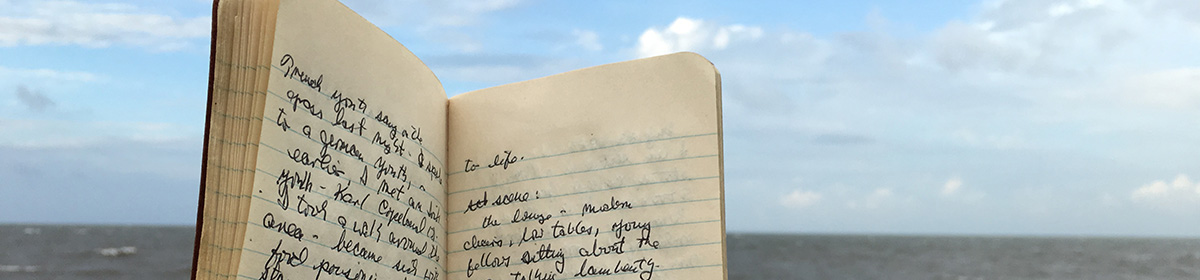
From my 19-cent travel notebook:

“The train is very dark as I write this.”

I’m 19. The train, a Spanish train, is still in the station. About to head north to France, July, 1966. It began moving suddenly….clack-clack …clack-clack…. Those old tracks that would take me to the railroad border town of Port-Bou. I’d been a stranger in a strange land.

There is a statue of Columbus in Barcelona along a wide waterfront boulevard. Columbus is high up on a thin, ornate pedestal, pointing out to sea. To the New World, presumably (although he’s actually pointing toward Algeria).

The New World was far, far away from this Old World. I was homesick.

Remembering Barcelona’s brief encounters — too brief, just two days — I wrote: The view was wonderful, the gardens beautiful. Not another word about those gardens, that view. And why no mention of Antoni Gaudi’s sacred, eccentric Sagrada Familia basilica? – “with its profusion of decorated spires and neo-Gothic arches and its bright, throbbing colors, intricately detailed sacred carvings and riotous modernists stained glass…”as one writer so beautifully wrote of it anonymously in a journal I’ve since stumbled upon. The Church of the Holy Family would have dominated any view. Did I miss it, that wild, beautiful work in progress, begun in 1882 — called sensual, spiritual, whimsical, exuberant. said to resemble sugar loafs and anthills?

Some hills I do remember from my brief tour — mounds of rubble in vacant lots. Were they lingering scars from Spain’s Civil War? Barcelona had briefly belonged to the Anarchists during those terrible times. Peaceful and equitable in many ways, or so it seemed initially to George Orwell, writing of it in Homage to Catalonia. He would become disillusioned with the Spanish Republican Loyalists.

Chance observations became indelible memories. A taxi, horn blaring, rushing a sick child to a hospital. Three family members, late for their train, spilling out of a taxi with their luggage, racing frantically into the station. I remember the heat. I feel as though I just crawled four hours through a field, I wrote as I wandered. But I have only unrecorded memories of the night before, desperately lost, unable to locate my youth hostel, wandering in darkness along a steep hill street leading up to wherever one boarded additional transportation to The Benedictine Abbey and Holy Grotto of Montserrat, trolleys noisily ascending and descending under the trees. I only glimpsed them– but that glimpse would become one of those indelible memories — children and their clerical guardians packed aboard those trolleys – nuns and young priests, pilgrims all. (I need someday, to figure out how those pilgrims on those particular trolleys were managing to make it miles away to the Abbey.)

When I was lost, I was praying, and prayer brought me back to my hostel, finally. May I always go on praying, because, I often feel lost.

I’d wandered lost for hours and will never forget that. Barcelona preserves in me the necessary sense of a lost and searching soul.

On that last day, I met a Boston University student from Connecticut. Forget his name, or how we met. He’d be sailing to Majorca. I’d never heard of Majorca. He told me about it as we walked through Barcelona’s Gothic Quarter; medieval churches, prayers in stone. He embarked for the island, said farewell. Alone, I explored the city some more, thinking of Majorca. (Thinking as I write, of him, that brief companion. I also, very briefly while alone, encounterd a couple of fellows from Wrentham, Mass.)

I wrote: Bought a post card in a shop, the woman very helpful. Finally, boldly I was navigating the city that had so intimidated me, my American smile a thin substitute for rudimentary Spanish. Had a Coke in a café. Wrote out a postcard to my godmother. I was at ease, however briefly, in the city in which I’d once felt eternally forsaken. But still undeniably a stranger in a strange land.

I wrote:

Took the ferry to the breakwater. Mediterranean very beautiful.

There was a little café out there.

Had shrimp and Vina Pomal for 173 peseta.

Light-headed, I walked along the breakwater, found a bench. Thinking of home, I watched a huge gray ship of the U.S. Sixth Fleet — possibly a light cruiser — pass close by in bright sunlight, heading for open water, all its sailors “manning the rails” in their dress whites, the U.S. Navy’s mandatory ritual of departure upon sailing out of any port. Did I wave to my fellow Americans? Did any of them wave back? Do any of them today remember seeing that lone fellow countryman on the jetty as they left? Waving goodbye?

It was time for me to leave port as well. And to say goodbye.

In near darkness on the train, I wrote: I had to buy an ice cream to get rid of the last of my change (Spanish pesetas). Not changeable across the border. The train lurching forward. The station, the city fading. Sun setting on the factories outside Barcelona….Martini Rossi billboard passes by. Fields with bundles of hay. The fields getting dark. We have come to a stop amid children’s voices in the distance. The train moving again. Luggage rocking, more dark fields….

clack -clack….clack-clack….”

+ + + + + + + + + + +

The rain had stopped at this point on Alligator Point back in August, 2016. I was done recalling and copying these memories out of my 19-cent notebook. The light was fading, wind rising. Palm trees, live oak, tossing wildly. The sky overhead a pastiche of El Greco’s View of Toledo, taking me back to Spain.

A guy in a cowboy hat, earlier that week while I was pulled up to the gas pump in a neigboring town, spotted my Massachusetts license plate and asked with a sly turn of the head, “You from Baws-ton?”

“Yup, originally.”

“You talk funny?”

“Yup. I pahk the cah.” He laughed. I laughed. Happy once again to be a stranger in a strange land, even though it was my land. Happy to be in a place where people talk to you. Sorry that time was passing so quickly.

It’s kept passing. That was nine years ago.

I must go back to Barcelona someday. Must see Gaudi’s Basilica. Filled with blessed spaces. Attend Mass there. Sanctus, Sanctus, Sanctus.

Then, maybe,I’ll also sail out to Majorca, see its cliffs, it deep blue coves….but, above all, see all of that city I barely glimsed so memorably, as in a magic lantern, when I was so young.

Goodbye, Barcelona. Goodbye.

.

THE DANISH KID

(Part 3 of the 4-Part Barcelona quartet)

Mid-summer, 1966. Sparse, elliptical entries dot my flimsy 19-cent travel notebook from that period. Especially entries about my two-days in a broken down Barcelona youth hostel: Voices in the barren dusty hall below…. (sound of) a broom against the hard floor…children’s voices outside…it is cool and cloudy….I must write some letters and determine how I will get back to France….

Thereafter, unaided memory and only a few random, barely legible pen scratches help me reconstruct the moment in the wee hours when I woke to find a leg dangling by my bunk, then another, then both legs wiggling down to the floor below, using, if I recall accurately, my small suitcases for a stepping stone. Whoever’s legs these were had obviously missed curfew – probably a midnight curfew — and was climbing into the dormitory through a window. This particular window, right by my bed, had a broken screen, flapping loose, making possible this stealthy, illicit entrance. (Small wonder the dormitory was hungry with mosquitoes.) My initial annoyance was tempered by the memory of wandering lost in the city the night before. I could just as easily have missed curfew. A tolerant sense of fraternity seemed in order.

Presently one, perhaps two other youths slipped through the same window and quickly found their bunks. But the original arrivee, a lean and frenetic youth, circled briefly and restlessly in the dark, the hot red dot of a lighted cigarette arcing occasionally up to his mouth.

Someone smoking? In this fire trap? Again, tolerance, compounded by exhaustion, must have overridden outrage or alarm. I dozed off. Everyone else was snoring.

I met this smoker and curfew-breaker in the morning over the hostel’s meager bread and hot cocoa breakfast. He was a Danish boy about my age, his name forgotten. I don’t recall him smoking again, in or out of the hostel. Indoors, in sight of hostel proprietors, this would have violated strict rules – though this fellow seemed the kind of soul who was careless about rules: high-spirited, affable, dark blond, about nineteen. I don’t recall anything we spoke about, nor do I remember asking him the reason for his peculiar late night entrance. He was outgoing and lively in conversation, an ice-breaker among strangers. At some point, both of us must have befriended a young Scottish hostel guest. My notebook says: The Dane and Scot rode with me to the Placa Cataluña. I’d doubtless heard of the Placa’s splendor and decided to invite a hostel guest – the Scott – to travel there with me for lunch. By now, the Dane had gone off somewhere.

Sadly, I have no memory of this Scot. It’s obvious he struck me as a congenial travel companion. But once again, the Danish boy made himself memorable by rushing toward us as we headed for the door. Where were we going? He was eager and curious to know. Could he go, too? I realized then that, for all his sociability, this Danish kid was a solitary, perhaps lonely, traveler. He urged us to “wait a minute, will you?” speaking that axiomatic English phrase clearly and deliberately, making it unintentionally sound like a demand.

We must have traveled by taxi. I’m sure we had lunch. Sadly, I have no memory, written or otherwise, of the Placa Cataluña’s grand, storied ambiance and architecture or of my conversation with these newfound friends. Tweaking my subconscious, however, I believe I can see us in flashes – three strangers at an outdoor café table, the Danish boy doing much of the talking. Or did he become more reticent as the hours wore on?

Later, packed up, briefly idle, ready to depart the hostel for a final walk around central Barcelona before catching a night train to France, I was again approached by the Dane. He asked if I’d join him for a (quick) game of chess, if such a thing were possible. I agreed out of courtesy. We pulled chairs up to a ping-pong table and he removed a square plastic novelty from his belt where it had hung by a little chain. It was essentially a puzzles — a chess puzzle — with sliding black and white pieces designated as kings, queens, bishops, rooks, knights and pawns. He put this minute chessboard between us at one corner of the table. Then, speaking of puzzles, there followed a puzzling deliberative silence of a mere second or two. Without looking at me, the Dane suddenly asked, “do you like boys or girls?”

A very peculiar question at a time such as this. “Girls,” I answered quickly and with considerable emphasis, still puzzled, but suspicious — whereupon the Dane, giving a little chortle, abruptly flipped the tiny chessboard so that the tiny white squares faced me and the black squares faced him. He muttered something to the effect that his inquiry was merely a means of determining who’d play with which colored chess pieces.

Really? Why not just say, ‘do you prefer black or white?’

Was this just another among the multitude of trans-lingual misunderstandings or trans-cultural vagaries I’d occasionally encountered during my European travels? Musing over this antic moment after many years, I can’t say for certain, naïve as that sounds.

But, no matter. Only one or two rooks or pawns had slid about the miniature plastic board before we both, with a glance at our watches, declared it time to move on – I to the heart of Barcelona for a final look; him to wherever wild Danes went in that wide open decade.

His was among my briefest human encounters of that summer, although also among the more memorable. I now and then think of him – even say a little prayer for him — whenever I see a window with a broken screen.

LOST IN BARCELONA

(Sequal to NIGHT TRAIN TO BARCELONA)

On a Spanish morning fifty-eight years ago, in my nineteenth year before God, in a ramshackle European youth hostel, a Danish boy asked me if I liked boys or girls. And my mind, lifted up in a prairie whirwind, instantly flew off to Oz. And I thought: No, Dorothy, you and I are definitely not in Kansas anymore.

But let me begin at the beginning of that particular chapter of my travel chronicles which took place during a serendipitous mere 48-hour visit to the city with the rhapsodic name: Bar-ce-lo-na.

Among other things, I got lost there. It was July, 1966.

My Continental journey (as recorded in my 19-cent notebook) had brought me to the French-Spanish border.

I wrote :

Night train from Paris. Traveled all night. Awoke in my couchette. We had stopped; light crept under the drawn shade. There were only a few people left in the compartment of six couchettes. The Pyrenees. Baking heat. Arrive at Port-Bou, French-Spanish border. Hungry, I buy a ham sandwich, chips, and a coke in the little station. The gauge of the tracks changes. Therefore I must change trains. The Spanish train bumps rhythmically, slowly, along…clack-clack…clack-clack….Glimpses of the vivid blue Mediterranean. Stony remains on a hillside. They resemble castle ruins. Long, slow, bumpy ride continues. The train was very old. I kept hoping we’d pass by the sea again, but there were only the hills and dusty fields, small villas, seemingly abandoned, sitting in the baking sun. Farmers working the fields with horse-drawn plows, women driving donkey carts over narrow, winding roads.

There’s a young Swede in my compartment. Bound for the home of a wealthy Spanish family. He’ll tutor their young daughter.

clack-clack…clack-clack….

It’s getting hotter. Barcelona’s poverty-stricken environs roll by. There were dumping areas and factories and rows of shacks. Midday clouds darken crooked rows of scarred, broken rail side houses. Laundry hangs limply from sagging lines, lifts gently in some filthy breeze. Grim factories come next. Odors like cheap perfume, then like medicine. They roll into our open window on waves of hot air. We lurch to rest in the station. It is dark and gloomy. I bid the Swede goodbye and good luck, get a taxi to my youth hostel. I’d written down the address from a hostel directory. Tip the driver. (Grossly over-tipped him. His good fortune. I’m just learning the deal with the Spanish peseta.)

Imagine the Alamo after the siege. That is a tiny exaggeration. But to this day, recalling its stucco exterior and abysmal state, it’s how I remember that hostel on the Avenida Virgen de Monserrat. For about 10 peseta. It was home for two nights.

Once settled, I took a long, long walk, all the way into the center of the city. Evening in Barcelona changed my mood. She glowed as Paris had glowed. I had found one of the central squares where the people, all in all, seemed ripe with Mediterranean amiability and the city itself bustling and happy. Then as evening arrived and the lights came on, I came upon a playground filled with children and their mothers watching over them. Oh, how I would soon need a mother watching over me….

I rode the Metro, walked some more. But I’d failed to take the hostel’s address, or even note its location, except to remember that it was up a hill. Could there be more than one hill in Barcelona? (Dozens, you idiot!)

Darkness found me walking up one hill, down another, lost, my Spanish shamefully limited to “si” and “no”. The word “hostel” meant nothing to anyone I met. The hostel had a curfew. As I walked I began to face a terrible prospect: locked out once I found the hostel, or sleeping on the street. I simply had no idea where I was and, ast noted, I spoke no Spanish.

Rain was threatening as I walked. Two rats pursued one another on a gravel patch. Cat’s eyes gleamed in darkness. People stood in the pallid light of doorways. I pass houses both lavish and poor. Heard a child crying, saw women laughing in a brightly lighted kitchen. Does no one speak English? I saw a couple kissing in the dark. I wasn’t going to bother them. (In my notebook I have written, “the Spanish women and girls are the most beautiful I have ever seen.”)

Some streets were paved, others were dust and dirt. Trolleys squealed slowly down one tree-canopied hillside avenue bearing nuns, priests and children from their visit to the Montserrat Benedictine Abbey and Holy Grotto at the top. (Seeing them, hearing them, I believe I prayed. I was becoming oh, so disoriented, isolated and desperate.)

The rain began, softly. I came upon police lining a wide, bright boulevard. Some dignitary would be passing (was Franco visiting?) I approached one cop; a friendly face under the menacing visor and chin strap. The language barrier frustrated us both. The rain was suddenly heavy. The cop must have directed me to a taxi. My notebook says the (taxi) driver was whistling an American tune. He took me to a police station. A kindly desk sergeant, gesturing, suggested a route. Seems I was mercifully close to my hostel at last. More walking. The rain stopped, another mercy. The streets gleamed.

Finally! I came upon a dark tree-lined passageway. My broken down Alamo of a hostel was at the end of it, looking like Shangri-La to me at that moment. I drank Orange Fanta from a vending machine, found peace and, ultimately, sleep in a bunk bed, though I was preyed on by mosquitoes.

The following night I would wake in darkness to find a leg dangling by my bunk. Someone climbing through a window.

This would be the aforementioned Danish boy.

But that’s another story.

And it will be my next story from those Spanish moments during those long-ago hours in that unforgettable summer of 1966.

NIGHT TRAIN TO BARCELONA

I arrived in Paris 58 years ago on June 17, 1966, the first stop in a summer rambling via rail or by any other available means, including hitching rides with acquaintances. So far, it has been my only full-scale trip to the Continent. It began with a voyage aboard a Norwegian freighter out of Red Hook, Brooklyn. (If you aren’t adventurous when you’re 19, you never will be.) The name of this blog is taken from the little 19 cent notebook I carried with me that summer.

I have many Paris memories from my three-week stay there. But below is my memory –composed previously — of a trip I took by night train from Paris to Barcelona in early July, 1966, with a serious mis-adventure in between:

Night train to Barcelona. Dusk coming on, the lights of Paris behind me, gone. The music playing in the streets of that enchanted city, still. I miss it already. Darkness spreading over fields out there, rushing by….

So begins a July 5 entry in my 19-cent notebook. It’s 1966, early in my 19-year-old continental ramble.

Boarding at the Gare de Lyon (I believe), I check two small suitcases. A porter escorts me to my sleeping quarters – middle bunk in a narrow couchette of six bunks, three to a side, window in the middle. Thin mattresses, blanket, clean sheets. I assume I’ll meet my fellow sleepers later, imagining five French ingénues, a slumber party. (Remember, I’m 19, bursting with newly acquired Parisian esprit d’amour.)

The train underway, I roam narrow, mostly unpopulated passageways, traversing rocking gangways, purchase with my remaining francs a French bier from a mid-train concession (knowing soon I must learn to call this beverage cervesa). I pour it into a stomach still unsettled from cheap snacks gobbled down before boarding. I meet two Canadian soldiers on leave from some base somewhere. Good company, at least for a few rollicking moments of military braggadocio. (Where are the girls? I’m wondering.) Boisterously gung-ho, these two fellows from the north country assure me the Canadian forces are the toughest in the world (I don’t dare doubt it) and speak of the allegedly intercepted WWII German correspondence that admiringly describes how the fearsome Canadian troops were “drunk all the time” and “always shooting from the hip.” Now, I’m no military strategist, but I’m privately thinking this sounds more characteristic of the last men standing at, say, Gallipoli or The Alamo. It’s also slightly less probable than that my couchette at that moment, is, indee, filling up with jolies filles.

Which, by this time, I’m thinking it’s high time I check and see.

I wend my way back past multiple sliding doors, slide open “my” door – and find that my middle bunk – in fact, the entire couchette has been usurped by a snoring (probably French) family – husband, wife and kids. Only a top bunk, entirely stripped of bedding, is free.

Furious, I crash the slider shut, search for a porter, wishing I knew the French word for “invaded” – until my stomach and bowels suddenly redirect me to a closet-sized train privy.

Here I encounter the fabled drop-chute toilet. Lid up, you look down at tracks whizzing by in black obscurity. Sitting bare-bottomed in the draft, I recall the ditty: “when the train is in the station, we must practice constipation…” It’s a flimsy diversion from my hard predicament, bedless aboard the night train to Spain.

Cold, exhausted, resigned, with no porter in sight, I return to the couchette, slip off my shoes, clamber — grumbling, indignantly thrashing my legs – onto the naked top bunk, devoid even of a mattress, hearing incongenial grunts from those I bump during my ascent. I lay several sleepless minutes, fully clothed, hearing in my head that new Beatles song (Yesterday, all my troubles seemed so far away….).

This won’t do!

I repel down, exit, slamming the slider shut, return for my shoes, slam the slider again, find –finally – a porter who speaks no English, but who lets me guide him back to the couchette where he flings open the door, apologizes to the occupants but commences to interrogate,in French, the father of the sleeping brood. He, from his lying position, spouts French vitriol, the approximate translation of which I imagine to be, “this little American shit kept barging in here, woke us all up, kept slamming the door….etc..”

The porter seems enlightened by the exchange. But, facing a language barrier, he takes me in tow to another distant couchette where he rouses an amicable French-speaking American to act as translator. Never did English sound sweeter.

The matter is quickly sorted out – and to my eternal embarrassment. Though stone-cold sober, being an utter rube when it came to navigating railroad sleepers, I’d stumbled into the wrong couchette. I must have had something – a ticket, a slip of paper that might have helped solve the mystery.

With unmerited paternal gentleness, the porter guides me across one, perhaps two, gangways to an altogether different car. (I guess all those damned sliding doors looked the same to me.)

My couchette is absolutely empty – of girls or anyone else – which, at this point, is absolutely fine by me. I have my choice of bunks, all with immaculate, undisturbed sheets and blankets. Deeply abashed, feeling ever so much the ultimate Ugly American, I thank the porter with a heartfelt, merci. He smiles and gives a parting glance that seems to say, ‘young man, you’ll be telling this story fifty years from now.’ (He’s right, of course. Except, make that fifty-eight years!)

In welcomed solitude, I crawl into a middle bunk and sleep deeply until a Pyrenees dawn.

ON THIS DATE…

in 1966, after a trip across the Atlantic in a Norwegian freighter, and on the same day that freighter docked at Antwerp, Belgium, I traveled by train to Paris, arriving at the Gare du Nord at dusk, arriving by taxi at 20 Avenue Victoria, Paris.

And I began a three week stay in Paris, and a stay of eight weeks or so in continental Europe.

I’ve been back to the Continent only once, to cover the death of a pope.

I see the city, Paris. Many friends have visited. Two friends have lived there. I’ve seen a picture of a woman I briefly called a girlfriend during the Seventies posing with a female companion in front of the famous Left Bank cafe Deux Magot.

The summer Olympics will open there soon.

City of Light. City of so much history.

I must get back.

“YOU WILL KNOW THEM, FOR THEY HATE ONE ANOTHER….”

That’s a 180-degree variation — in the form of an ultimate negation –of the ancient Scriptural passage telling us we will know Christians for they “love” one another.

Conversely, I say, you will know a Mafioso — unreconstructed or cooperating with authorities — because they hate one another. It must have something to do with the dark nature of their work. Obviously.

Boston Herald columnist Howie Carr noted in weekend editions that yesterday, June 9, was the 90th birthday of Stephen “The Rifleman” Flemmi who is serving a lengthy federal terms for murder, etc.. at an unspecified location in the nation. Wherever it is, it is far, far from his home of Boston. A true exile.

Carr quotes the late former Mafia capo Frank “Cadillac” Salemmi’s very hateful comments about Flemmi who was, after all, a close former business partner. He basically called him a crybaby. Others from that dark side of the tracks readily chime in when talking about Steve — and, of course, he has appeared in public rarely, and only to testify against former mob associates in an effort to lighten his own penal load. The last time was in 2018. This act, of course, is regarded as the ultimate violation of every criminal enterprise’s strict code of conduct (“ratting out” fellow members). But Steve is now on the ‘inside’ (of walls, chain link and concertina wire) looking ‘out’ (at nothing, including any prospect for freedom before the Angel of Death comes for him as he, an earthly ministering angel of murder, came for as many as fifty souls during his criminal career.) So –he probably cares little about what former associates think of him.

I wonder if he prays? I saw him, during one court apperance readily –and I dare say humbly — acknowledge his role in murders and even in the sexual exploitation of a stepdaughter. He seemed contrite — as much as any sociopath can be contrite, quietly admitting his “moral responsibility.” Does God hear the prayers of the spiritually and emotionally deformed who are genuinely sorry? Is he genuinely sorry? Even capable of genuine sorrow? God knows.

As a reporter, I once sat at a hearing in federal court in Boston in which Frank Salemmi, Steve Flemmi and Patriarca crime family soldier Bobby DeLuca sat side-by-side while a fellow Mafioso-turned-informant testified against them in a pre-trial hearing.

That informant was a strangely seemingly likeable character named Angelo “Sonny” Mecurio. In early images of him, he looks fierce, cold and hard — and overweight. In the dock, opposite his former compatriots, he seemed a paunchy, subued,even exhausted, strangely likeable old man with a wry turn of the eyes and lips. He could have been yours or my benign old uncle. He had gone so far in his effort to get leniency and break free of the mob as to wear a “wire” into a Mafia Induction Ceremony. Imagine the consequences if he’d been discovered! It was bad enough that, at the end of his criminal career, he’d been the one to lure Frank Salemmi to a mob meeting in Saugus at which there was an unsuccessful attempt on his life by fellow mobsters engaged with him in an underworld power struggle.

So, here were Flemmi and Salemmi, as I say, side-by-side — and already doubtless hating one another. Did they ever really like — or trust — one another? Is that possible in the Underworld?

Flemmi, like Mercurio, would go on, eventually, to testify against Salemmi, who, by the way, would in due course, loudly declare in open court that he was “done with the mob” only to be later implicated in the murder of a Boston nightclub owner and sent back to prison — along with Bobby DeLuca, who was forced to acknowedge his role in the same murder.

How did all these guys feel about one another? Mercurio gently upbraided one questioning attorney for referring to mob associates other than the ones sitting across from him, as “friends.”

“You keep call them ‘friends,'” Sonny complained. “At some point in time, they became EX-friends.” Subsequent to that, when asked by Federal Judge Mark Wolf if he liked the men across from him, Sonny said, “not really.” An understatement, no doubt. For some reason, Wolf decided to ask Sonny, “do you like me?”

“You’re alright,” Sonny said sheepishly.

Right answer — to a judge. But Judge Wolf was probably wondering if Mercurio, at this stage of his wayward life, liked anybody, much less loved them. Which gets to the point I’m making here about a defining mark of those who pledge their fealty, their very life to such darkness.

Did Sonny at least fear the men he’d worked among and was now betraying? At that question from somebody, Sonny shrugged and said, “look at the record. These are not Boy Scouts.”

One probing attorney asked him, “did it ever occur to you that you were acting as an agent of the government in this role as an informant (which is what Flemmi and late Irish Mob Boss James “Whitey” Bulger would offer as preposterous defenses for their efforts to undermine the Italian Mafia while carrying on their own criminal mischief. And it was Flemmi’s attorney, as I recall, who was asking the question.)

“Of course,” said Sonny. “I’m a stool pigeon.” When a barely supressed chuckling broke out across the sparsely populated courtroom, Sonny, in response, shrugged again. He seemed to be saying -wordlessly –that he was just calling a spade a spade. His candor almost seemed a form of contrition.

And, for that matter, entirely unrepentent-to-death James Whitey Bulger would never let anyone call him a “stool pigeon.” No, he insisted he was some new iteration of an Undergover Confidential Agent.

Yeah, right.

When that rationale collapsed as a defense strategy, he declared, “do with me what yooz want.”

And they did. They left him in prison far f rom home and were so careless about his incarceration — some would say deliberately so — that he became savagely and fatally naked to his hateful Mafia enemies.

Only God knows if James Bulger ever said anything like an Act of Contrition, though he insistently identified as a Catholic. Good thing God’s mercy is infinite.

Sonny Mercurio died in 2006, regretting — it was reported in his obituary — ever having taken on the role of mob informant, but resigned obviously to hating and being hated by his old crime cronies. Frank Salemmi, body scarred and punctured by the bullets of that assassination attempt (outside the Saugus, MA iHop), died in prison in 2022 at age 89. He, too, seemed resigned, at the time of sentencing to his imminent re-imprisonment; no it wouldn’t be his first tour of “the joint” and he had obviously lied when he said he was “done with the mob.”

He was, I believe, a family man, oddly enough, like a lot of these guys. But the mob came first. That was Frank’s family.

Bobby DeLuca, only 84 by my count and, so far as I know, still alive, had been serving a five-year sentence for lying about what he knew about the murder of that nightclub owner (who was, himself, a man who chose the wrong company in his life), but was released in 2022 on compassionate leave with a bad heart and kidney disease and, therefore, very susceptible (in the court’s eyes) to COVID.

All of which is to say…

Mobsters lead unhealthy lifestyles. Beyond fatty meats, pasta ,donuts, cigars and cigarettes, they also seem addicted to easy money, danger, and being feared and, ultimately, hated. Can you love hating people? We also know that it destroys the hater. So I believe. But that’s Christian psychology, currently being violated the world over.

Of course, much of what Mafiosos do to others and to one another is supposedly “strictly business” — or so the old trop goes. “Nothing personal.” Lethal amorality on steroids.

For the heck of it, I looked up an address in Boston’s Dorchester section (my old section) visible on early Flemmi crime records, and also visible as accompanying illustrations next to Howie Carr’s weekend column. It was Steve Flemmi’s address as of August, 1958 when he was just 24. I looked at the front porch. Someone had hung a rug over a second floor porch. No one’s going to put up a plaque by the chain link fence and llittle yard of shrubbery in Steve Flemmi’s honor. No one living there now, I’m sure, has any idea that, decades ago, a stone-cold murderer and mobster was being nurtered in that house along that quiet street off Washington Street. He was a Korean War veteran whose military MOS (Military Occupation Specialty) had been “Rifleman,” meaning a rifle-bearing member of a combat unit. From the time of his discharge, he entered into a life of crime. I heard him say so in court. Who knows why (Again, God knows.)

I don’t know if it was his long-ago criminal associates, impressed by the combat veteran in their midst, or Flemmi himself who decided to recycle and adopt his military specialty as the odious street nickname, “rifleman.” Reporters love to say it. It sounds so evil and so Godfather, so Sopranos. The glamour of evil.

But millions of American male soldiers and Marines, now and in times past, have borne that title through a time of war. Steve “The Rifleman” Flemmi decided to dishonorably deploy it, turn it on its head and keep it forever — wherever he is now.

How intimidating! (Once upon a time.)

How– hateful! (Now and forever.)

WITHER WE U.S. BOOMERS, AS JUNE DOTH ONCE AGAIN BLOOM ?

When we hit 35, we posessed 21% of the nation’s wealth. Millenials nearing that average age possess just 3% of the nation’s household wealth.

So says a fascinating volume noted below that broke upon the scene almost three years ago.

It has been alleged in various quarters that our bid for personal freedom ended up destroying the institutions and restraints that made freedom safe and possible.

The book containing those charges is Boomers: The Men and Women who Promised Freedom and Delivered Disaster. (Sentinel, 2021)

I’ve only scratched the surface and so cannot make a good case for or against Andrews’s dire thesis. But, being a Boomer, I’m certainly interested in exploring her less than throroughly rosie exploration of the civilizational contributions — or desecrations — of Steve Jobs, Aaron Sorkin, Heffrey Sachs, Sonia Sotomayor — Boomers all, and all, among others, scrutinized in this book . And, of course, of millions of others (including, as I’ve indicated, myself), will have to examine our own consciences and our sense of our own contributions or divigations.

To mention just one person:

Camille Paglia has always interested me, a flashy Boomer contrarian. I don’t hear much about her lately.

But I agree with those who admire her for resenting the over-elevation of pop culture and the denegration of academia — and, with critic/observer Michael Brendon Dougherty’s mordent aside about “the naivete’ of a generation that thought the worst effects of free love could be handled tidily by penicillin.”

But Dougherty concedes, “If Boomers are going to die with nearloy three-fifths of our nation’s wealth (which apparently Andrews’s book maintains), “we had better find a way to be written into their last wills.”

I’m one Boomer who doesn’t expect to reap that bonanza. So I know no one will be interested in finding their way into my will.

Not a post-Boomer soul.