THE BIRTH

It must be concluded…that Jesus was born between the years 8 and 4 –most probably in the year 6 -before the Christian era as now dated. As for the actual date of his birth, universally now celebrated on December 25th, it can be said at once that this is purely a tradition. In the 3rd Century A.D., Clement of Alexandria chose April 19th; other suggestions were May 29th and March 28th. The Eastern Church for a long time celebrated January 6th. It was only about the year 350 that our own traditonal date gained general acceptance. Some have associated it with the feast of Mithra which the Roman calendar fixed at the beginning of the winter solstice ( December 21st) and there are certainly plenty of known instances where the Christian calendar has taken over pagan feasts. Gregory the Great himself advised his missionaries to “baptize the customs of the holy places of the heathen” and our All Saints Day (November 1st) and feastof St. John the Baptist (Midsummer Day) undoubtedly originated that way. For us December 25th is sanctified forever: it does not commemorate the persian god or the sacrificial bull, nor even the sun regaining his power over the darkness of the night, but that other star of which Malachi wrote: “…unto you that fear my name shall the sun of rigthtousness arise…. (Malachi iv, 2.)

Christ And His Times,Henri Daniel-Rops ( 1901-1965)

(translated from the French by Ruby Millar), 1954.

(This is a great, much neglected treatise and history on the life of Christ by a devout former agnostic, late, prolific and renowned French historian and member of the French Acadamy, probably a genius, decidedly odd-looking( at least based on photographs — looking sort of like Alfalfa of Our Gang fame, and always with his eyelids at half-mast. In one surviving photograph, you see him lighting up a cigarette, probably one of those strong French numbers, leading me to speculate on causes leading to his death at 65.

As for Christ’s birth, and, for that matter, death…

We must consider whether, ultimately, it matter when He was born–and simply marvel at the fact that He might actually have been born and died in the same month (April). That would be a reason to think of the springtime of April as every bit as special as the cosseting twilit advent of winter in the month of December.

For all that really matters is that he WAS born. And I, like millions, prefer to mark the time of the coming of The Light within days of the nadir of light, the season of darkness ( The winter solstice). This simply seems very right. We’ve got plenty of light of a physical kind in April and May, and blooming flowers to mark and brighten the rebirth that is the Resurrection. We’ll always keep the season of birth in early winter. The Light came in Darkness.

Winter is a better for darkly meditative thoughts about who or what might deliver us from our mess. Our darkness.

And, well…Bing Crosby never could have sung about a White Christmas in spring. (A whimsical consideration, to be sure, but, I, like millions, cherish the association of Christmas with snow, sleigh rides, jingle bells, Frosty, Rudolph,etc.)

I should point out that among the religious congregation at St. Benedict Center in Still River, Massachusetts are scholarly consecrated brothers who can make a good historic and astronomical case why Christ was, indeed, born December 25th. I’m sure they’re not alone in making that case.

But, again, what does it really matter? If He was and is who He says He was and is (I Am Who Am), He is born everyday, every hour, ever minute — and never dies, unless (as in the original story) we shut Him out or kill Him.

Let’s not do that. Let’s make room at the inn.

And let’s jingle all the way!

Amen.

GOODBYE, BARCELONA

(Fourth and final installment in the Barcelona Quartet)

It was raining hard in Florida’s Panhandle the day I labored to recover these fond memories. I was staying in a borrowed waterfront cottage. It was August ,2016. Up in Massachusetts, my sister was dying of cancer, the world, then and now, was wracked by war and violence. The Gulf of Mexico was gray, roiled to the horizon, rollers breaking white against the rocks along the coastal road only fifty yards away. It was a road that, in a matter of days, was destined to be broken apart and washed away by a Hurricane Hermine.

I would be gone by then – done recalling that day, fifty years before when I left the city of Barcelona….

+ + + + + + + + + + + + + +

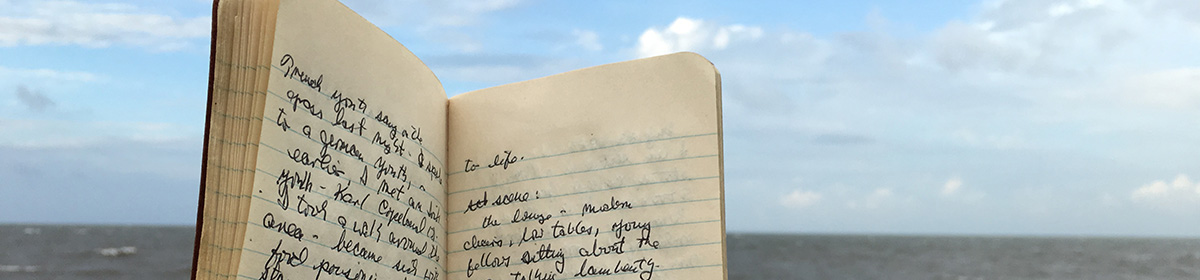
From my 19-cent travel notebook:

“The train is very dark as I write this.”

I’m 19. The train, a Spanish train, is still in the station. About to head north to France, July, 1966. It began moving suddenly….clack-clack …clack-clack…. Those old tracks that would take me to the railroad border town of Port-Bou. I’d been a stranger in a strange land.

There is a statue of Columbus in Barcelona along a wide waterfront boulevard. Columbus is high up on a thin, ornate pedestal, pointing out to sea. To the New World, presumably (although he’s actually pointing toward Algeria).

The New World was far, far away from this Old World. I was homesick.

Remembering Barcelona’s brief encounters — too brief, just two days — I wrote: The view was wonderful, the gardens beautiful. Not another word about those gardens, that view. And why no mention of Antoni Gaudi’s sacred, eccentric Sagrada Familia basilica? – “with its profusion of decorated spires and neo-Gothic arches and its bright, throbbing colors, intricately detailed sacred carvings and riotous modernists stained glass…”as one writer so beautifully wrote of it anonymously in a journal I’ve since stumbled upon. The Church of the Holy Family would have dominated any view. Did I miss it, that wild, beautiful work in progress, begun in 1882 — called sensual, spiritual, whimsical, exuberant. said to resemble sugar loafs and anthills?

Some hills I do remember from my brief tour — mounds of rubble in vacant lots. Were they lingering scars from Spain’s Civil War? Barcelona had briefly belonged to the Anarchists during those terrible times. Peaceful and equitable in many ways, or so it seemed initially to George Orwell, writing of it in Homage to Catalonia. He would become disillusioned with the Spanish Republican Loyalists.

Chance observations became indelible memories. A taxi, horn blaring, rushing a sick child to a hospital. Three family members, late for their train, spilling out of a taxi with their luggage, racing frantically into the station. I remember the heat. I feel as though I just crawled four hours through a field, I wrote as I wandered. But I have only unrecorded memories of the night before, desperately lost, unable to locate my youth hostel, wandering in darkness along a steep hill street leading up to wherever one boarded additional transportation to The Benedictine Abbey and Holy Grotto of Montserrat, trolleys noisily ascending and descending under the trees. I only glimpsed them– but that glimpse would become one of those indelible memories — children and their clerical guardians packed aboard those trolleys – nuns and young priests, pilgrims all. (I need someday, to figure out how those pilgrims on those particular trolleys were managing to make it miles away to the Abbey.)

When I was lost, I was praying, and prayer brought me back to my hostel, finally. May I always go on praying, because, I often feel lost.

I’d wandered lost for hours and will never forget that. Barcelona preserves in me the necessary sense of a lost and searching soul.

On that last day, I met a Boston University student from Connecticut. Forget his name, or how we met. He’d be sailing to Majorca. I’d never heard of Majorca. He told me about it as we walked through Barcelona’s Gothic Quarter; medieval churches, prayers in stone. He embarked for the island, said farewell. Alone, I explored the city some more, thinking of Majorca. (Thinking as I write, of him, that brief companion. I also, very briefly while alone, encounterd a couple of fellows from Wrentham, Mass.)

I wrote: Bought a post card in a shop, the woman very helpful. Finally, boldly I was navigating the city that had so intimidated me, my American smile a thin substitute for rudimentary Spanish. Had a Coke in a café. Wrote out a postcard to my godmother. I was at ease, however briefly, in the city in which I’d once felt eternally forsaken. But still undeniably a stranger in a strange land.

I wrote:

Took the ferry to the breakwater. Mediterranean very beautiful.

There was a little café out there.

Had shrimp and Vina Pomal for 173 peseta.

Light-headed, I walked along the breakwater, found a bench. Thinking of home, I watched a huge gray ship of the U.S. Sixth Fleet — possibly a light cruiser — pass close by in bright sunlight, heading for open water, all its sailors “manning the rails” in their dress whites, the U.S. Navy’s mandatory ritual of departure upon sailing out of any port. Did I wave to my fellow Americans? Did any of them wave back? Do any of them today remember seeing that lone fellow countryman on the jetty as they left? Waving goodbye?

It was time for me to leave port as well. And to say goodbye.

In near darkness on the train, I wrote: I had to buy an ice cream to get rid of the last of my change (Spanish pesetas). Not changeable across the border. The train lurching forward. The station, the city fading. Sun setting on the factories outside Barcelona….Martini Rossi billboard passes by. Fields with bundles of hay. The fields getting dark. We have come to a stop amid children’s voices in the distance. The train moving again. Luggage rocking, more dark fields….

clack -clack….clack-clack….”

+ + + + + + + + + + +

The rain had stopped at this point on Alligator Point back in August, 2016. I was done recalling and copying these memories out of my 19-cent notebook. The light was fading, wind rising. Palm trees, live oak, tossing wildly. The sky overhead a pastiche of El Greco’s View of Toledo, taking me back to Spain.

A guy in a cowboy hat, earlier that week while I was pulled up to the gas pump in a neigboring town, spotted my Massachusetts license plate and asked with a sly turn of the head, “You from Baws-ton?”

“Yup, originally.”

“You talk funny?”

“Yup. I pahk the cah.” He laughed. I laughed. Happy once again to be a stranger in a strange land, even though it was my land. Happy to be in a place where people talk to you. Sorry that time was passing so quickly.

It’s kept passing. That was nine years ago.

I must go back to Barcelona someday. Must see Gaudi’s Basilica. Filled with blessed spaces. Attend Mass there. Sanctus, Sanctus, Sanctus.

Then, maybe,I’ll also sail out to Majorca, see its cliffs, it deep blue coves….but, above all, see all of that city I barely glimsed so memorably, as in a magic lantern, when I was so young.

Goodbye, Barcelona. Goodbye.

.

LOST IN BARCELONA

(Sequal to NIGHT TRAIN TO BARCELONA)

On a Spanish morning fifty-eight years ago, in my nineteenth year before God, in a ramshackle European youth hostel, a Danish boy asked me if I liked boys or girls. And my mind, lifted up in a prairie whirwind, instantly flew off to Oz. And I thought: No, Dorothy, you and I are definitely not in Kansas anymore.

But let me begin at the beginning of that particular chapter of my travel chronicles which took place during a serendipitous mere 48-hour visit to the city with the rhapsodic name: Bar-ce-lo-na.

Among other things, I got lost there. It was July, 1966.

My Continental journey (as recorded in my 19-cent notebook) had brought me to the French-Spanish border.

I wrote :

Night train from Paris. Traveled all night. Awoke in my couchette. We had stopped; light crept under the drawn shade. There were only a few people left in the compartment of six couchettes. The Pyrenees. Baking heat. Arrive at Port-Bou, French-Spanish border. Hungry, I buy a ham sandwich, chips, and a coke in the little station. The gauge of the tracks changes. Therefore I must change trains. The Spanish train bumps rhythmically, slowly, along…clack-clack…clack-clack….Glimpses of the vivid blue Mediterranean. Stony remains on a hillside. They resemble castle ruins. Long, slow, bumpy ride continues. The train was very old. I kept hoping we’d pass by the sea again, but there were only the hills and dusty fields, small villas, seemingly abandoned, sitting in the baking sun. Farmers working the fields with horse-drawn plows, women driving donkey carts over narrow, winding roads.

There’s a young Swede in my compartment. Bound for the home of a wealthy Spanish family. He’ll tutor their young daughter.

clack-clack…clack-clack….

It’s getting hotter. Barcelona’s poverty-stricken environs roll by. There were dumping areas and factories and rows of shacks. Midday clouds darken crooked rows of scarred, broken rail side houses. Laundry hangs limply from sagging lines, lifts gently in some filthy breeze. Grim factories come next. Odors like cheap perfume, then like medicine. They roll into our open window on waves of hot air. We lurch to rest in the station. It is dark and gloomy. I bid the Swede goodbye and good luck, get a taxi to my youth hostel. I’d written down the address from a hostel directory. Tip the driver. (Grossly over-tipped him. His good fortune. I’m just learning the deal with the Spanish peseta.)

Imagine the Alamo after the siege. That is a tiny exaggeration. But to this day, recalling its stucco exterior and abysmal state, it’s how I remember that hostel on the Avenida Virgen de Monserrat. For about 10 peseta. It was home for two nights.

Once settled, I took a long, long walk, all the way into the center of the city. Evening in Barcelona changed my mood. She glowed as Paris had glowed. I had found one of the central squares where the people, all in all, seemed ripe with Mediterranean amiability and the city itself bustling and happy. Then as evening arrived and the lights came on, I came upon a playground filled with children and their mothers watching over them. Oh, how I would soon need a mother watching over me….

I rode the Metro, walked some more. But I’d failed to take the hostel’s address, or even note its location, except to remember that it was up a hill. Could there be more than one hill in Barcelona? (Dozens, you idiot!)

Darkness found me walking up one hill, down another, lost, my Spanish shamefully limited to “si” and “no”. The word “hostel” meant nothing to anyone I met. The hostel had a curfew. As I walked I began to face a terrible prospect: locked out once I found the hostel, or sleeping on the street. I simply had no idea where I was and, ast noted, I spoke no Spanish.

Rain was threatening as I walked. Two rats pursued one another on a gravel patch. Cat’s eyes gleamed in darkness. People stood in the pallid light of doorways. I pass houses both lavish and poor. Heard a child crying, saw women laughing in a brightly lighted kitchen. Does no one speak English? I saw a couple kissing in the dark. I wasn’t going to bother them. (In my notebook I have written, “the Spanish women and girls are the most beautiful I have ever seen.”)

Some streets were paved, others were dust and dirt. Trolleys squealed slowly down one tree-canopied hillside avenue bearing nuns, priests and children from their visit to the Montserrat Benedictine Abbey and Holy Grotto at the top. (Seeing them, hearing them, I believe I prayed. I was becoming oh, so disoriented, isolated and desperate.)

The rain began, softly. I came upon police lining a wide, bright boulevard. Some dignitary would be passing (was Franco visiting?) I approached one cop; a friendly face under the menacing visor and chin strap. The language barrier frustrated us both. The rain was suddenly heavy. The cop must have directed me to a taxi. My notebook says the (taxi) driver was whistling an American tune. He took me to a police station. A kindly desk sergeant, gesturing, suggested a route. Seems I was mercifully close to my hostel at last. More walking. The rain stopped, another mercy. The streets gleamed.

Finally! I came upon a dark tree-lined passageway. My broken down Alamo of a hostel was at the end of it, looking like Shangri-La to me at that moment. I drank Orange Fanta from a vending machine, found peace and, ultimately, sleep in a bunk bed, though I was preyed on by mosquitoes.

The following night I would wake in darkness to find a leg dangling by my bunk. Someone climbing through a window.

This would be the aforementioned Danish boy.

But that’s another story.

And it will be my next story from those Spanish moments during those long-ago hours in that unforgettable summer of 1966.

NIGHT TRAIN TO BARCELONA

I arrived in Paris 58 years ago on June 17, 1966, the first stop in a summer rambling via rail or by any other available means, including hitching rides with acquaintances. So far, it has been my only full-scale trip to the Continent. It began with a voyage aboard a Norwegian freighter out of Red Hook, Brooklyn. (If you aren’t adventurous when you’re 19, you never will be.) The name of this blog is taken from the little 19 cent notebook I carried with me that summer.

I have many Paris memories from my three-week stay there. But below is my memory –composed previously — of a trip I took by night train from Paris to Barcelona in early July, 1966, with a serious mis-adventure in between:

Night train to Barcelona. Dusk coming on, the lights of Paris behind me, gone. The music playing in the streets of that enchanted city, still. I miss it already. Darkness spreading over fields out there, rushing by….

So begins a July 5 entry in my 19-cent notebook. It’s 1966, early in my 19-year-old continental ramble.

Boarding at the Gare de Lyon (I believe), I check two small suitcases. A porter escorts me to my sleeping quarters – middle bunk in a narrow couchette of six bunks, three to a side, window in the middle. Thin mattresses, blanket, clean sheets. I assume I’ll meet my fellow sleepers later, imagining five French ingénues, a slumber party. (Remember, I’m 19, bursting with newly acquired Parisian esprit d’amour.)

The train underway, I roam narrow, mostly unpopulated passageways, traversing rocking gangways, purchase with my remaining francs a French bier from a mid-train concession (knowing soon I must learn to call this beverage cervesa). I pour it into a stomach still unsettled from cheap snacks gobbled down before boarding. I meet two Canadian soldiers on leave from some base somewhere. Good company, at least for a few rollicking moments of military braggadocio. (Where are the girls? I’m wondering.) Boisterously gung-ho, these two fellows from the north country assure me the Canadian forces are the toughest in the world (I don’t dare doubt it) and speak of the allegedly intercepted WWII German correspondence that admiringly describes how the fearsome Canadian troops were “drunk all the time” and “always shooting from the hip.” Now, I’m no military strategist, but I’m privately thinking this sounds more characteristic of the last men standing at, say, Gallipoli or The Alamo. It’s also slightly less probable than that my couchette at that moment, is, indee, filling up with jolies filles.

Which, by this time, I’m thinking it’s high time I check and see.

I wend my way back past multiple sliding doors, slide open “my” door – and find that my middle bunk – in fact, the entire couchette has been usurped by a snoring (probably French) family – husband, wife and kids. Only a top bunk, entirely stripped of bedding, is free.

Furious, I crash the slider shut, search for a porter, wishing I knew the French word for “invaded” – until my stomach and bowels suddenly redirect me to a closet-sized train privy.

Here I encounter the fabled drop-chute toilet. Lid up, you look down at tracks whizzing by in black obscurity. Sitting bare-bottomed in the draft, I recall the ditty: “when the train is in the station, we must practice constipation…” It’s a flimsy diversion from my hard predicament, bedless aboard the night train to Spain.

Cold, exhausted, resigned, with no porter in sight, I return to the couchette, slip off my shoes, clamber — grumbling, indignantly thrashing my legs – onto the naked top bunk, devoid even of a mattress, hearing incongenial grunts from those I bump during my ascent. I lay several sleepless minutes, fully clothed, hearing in my head that new Beatles song (Yesterday, all my troubles seemed so far away….).

This won’t do!

I repel down, exit, slamming the slider shut, return for my shoes, slam the slider again, find –finally – a porter who speaks no English, but who lets me guide him back to the couchette where he flings open the door, apologizes to the occupants but commences to interrogate,in French, the father of the sleeping brood. He, from his lying position, spouts French vitriol, the approximate translation of which I imagine to be, “this little American shit kept barging in here, woke us all up, kept slamming the door….etc..”

The porter seems enlightened by the exchange. But, facing a language barrier, he takes me in tow to another distant couchette where he rouses an amicable French-speaking American to act as translator. Never did English sound sweeter.

The matter is quickly sorted out – and to my eternal embarrassment. Though stone-cold sober, being an utter rube when it came to navigating railroad sleepers, I’d stumbled into the wrong couchette. I must have had something – a ticket, a slip of paper that might have helped solve the mystery.

With unmerited paternal gentleness, the porter guides me across one, perhaps two, gangways to an altogether different car. (I guess all those damned sliding doors looked the same to me.)

My couchette is absolutely empty – of girls or anyone else – which, at this point, is absolutely fine by me. I have my choice of bunks, all with immaculate, undisturbed sheets and blankets. Deeply abashed, feeling ever so much the ultimate Ugly American, I thank the porter with a heartfelt, merci. He smiles and gives a parting glance that seems to say, ‘young man, you’ll be telling this story fifty years from now.’ (He’s right, of course. Except, make that fifty-eight years!)

In welcomed solitude, I crawl into a middle bunk and sleep deeply until a Pyrenees dawn.

VOICES IN THE MINE

The late Scottish novelist A.J. Cronin (1896 to 1981) began life as a physician and, fresh out of medical school, took up an assignment in a small South Wales mining town. He was an atheist at the time but would eventually undergo a conversion to Catholicism. His novels included, The Keys to the Kingdom.

Among the formative experiences leading him to God were those times among the “grave, dark and silent people” in that mining town. They were isolated among bleak hills but were deeply religious. He wrote that their faith manifested itself in every aspect of their simple lives, but most especially during a moment of crisis.

Cronin writes:

Never shall I forget that occasion when, at the colliery, a heavy explosion of black damp gas entombed fourteen miners. For five days the men remained buried, while the village prayed. Than, as the rescuers hacked their way underground, they heard faintly, from deep in the collapsed workings, the strains of singing. It was the hymn Our God, Our Help in Ages Past. Thus had the entombed men chosen to keep their courage high. And when they were brought out, weak but unharmed, the great crowd gathered in the pit-yard took up the hymn which, sung by a thousand voices, echoed joyfully in the narrow valley and rose beyond the encircling hills.

It’s plain from Cronin’s account that, probably in his capacity as a doctor, he was among those lowered down with the rescuers, because he writes, As I came to the surface with the liberated men, blinking in the stark daylight after the blackness of the pit, this great volume of sound caught me like a tidal wave — as a demonstration of human faith it was moving beyond words. Although at that time I was conscious of no more than a momentary emotion, looking backward now I know that it left its mark on me.

Moved as well, but feeling the need for a few extra words, I’ll add that deep among those many long-ago humble voices raised in reverent, grateful song, the medical doctor, atheist, author and future convert probably heard that “still small voice.”

I listen for it, too, waiting for it to leave that mark on me.

I don’t know exactly when Cronin wrote this; most likely at mid-life in the mid-20th Century, about an event of his youth much earlier in that century. I choose to share it five days before Thanksgiving, 2023 — early in what for Cronin would be the next century he knew he’d never see.

This shall stand as among my public professions of thanksgiving for this season in which I so often fail to be either grateful or charitable and am often feeling buried in my own fears, concerns and failures.

These are more than usually troubled, violent, divided times in the world.

Let us, all who read this, listen for that “still small voice” the prophet Elijah heard from the cave (1 Kings 9-11)– and let us join those grand, prayerful, undespairing voices deep in that dark mine.

Pray for deliverance.

THE SAGA OF THE MALTESE HAIRDRESSER

A guy named Knox (don’t know his first name), a commercial artist, somehow started finding his way to The Last Mile Lounge on a corner of that busy, barren strip near the Lynn/ Revere line. This was fifteen years ago. He was originally from California. Someone suggested he got lost leaving the airport (a joke, of course). Then the guy who owned the woodframe block in which The Last Mile sits at street level let him rent an apartment upstairs. There was a back porch facing Revere Beach ( barely visible and only in the dead of winter) where he found light to do more “serious” work. It was a strange choice of real estate for an artist, if you ask me. He’s still living up there.

And he still come downstairs at least once or twice a week and sits at the bar nursing something called A Blushing Monk — Benedictine, Aperol, Suze, Lillet. Blanc and Lime juice. Deano, as forbearing a bartender as you’ll ever find, obligingly indulged old Knox, who is probably not a day under sixty, his rare potion. Deano had to special-order the ingredients. (Sticky Sammartino took a sip of it one once and confided to Jackie The Crow that it was like sipping terpentine and Sticky should know because, having made his livelihood as a painter, he’d regularly sniffed, if not actually drunk, toxic solvents.)

But Knox (actually, recently I heard his first name supposedly was Wilfred) is a hoary-headed, slender, tall bearded figure no one could mistake for anything but an artist.

Some weeks back, I made a rare Thursday night visit to The Mile and found Knox seated at the end of the bar over his Monk with his sketch pad. I decided to sit down next to him — I’d chatted him up before — and, over my tonic and cranberry juice, saw that Knox was working on a face — many version of a face. I’m going to go out on a limb and say it was in what I would call (remembering what little I learned from a humanities course in college) the style of the artist called Modigliani. (Pull out your college arts book, if you still have it or went to college, and look him up — or just go on-line. You’ll see all these narrow, s t range faces.) These wre just pencile sketches, with red pencil scribble. But I noticed that Knox had brought two Crayola crayons for the evening’s work (he’d found time to work his Monk down about half way — more sipping than usual) and his sketches were a shade of yellow and a shade of brown. Each of his rather beguiling female figures had hair that blended both.

“Might I make an inquiry?” I said. It was all I had to say. For he told me he was doing multiple images of a Maltese hairdresser he’d met in a Florida department store in his youth. She was in the hair salon, and was, yes, born in Malta.

“She was beautiful,” Knox said. “I was in the hunt for some interesting shirts, saw the salon on the second floor and, awary my locks had grown a bit shaggy, went in in to have them trimmed. As wonderful good fortune would have it, she was the stylist on duty. From that very moment, I just wanted her for myself — a beautiful figure, wonderful brown eyes, charming manner, hair that, given her Mediterranean liniage, was probably not blond but, given her profession, she’d managed to bring to a wonderful, albeit artificial shade of blond. It might have been the only time in my life I settled for something artificial.” He glanced at me. “Which, perhaps, should have been taken as an omen.

“We talked, oh, did we ever talk! She spoke in that wonderful Maltese accent! I went back to her in just a few days under the ruse of needing a slightly closer trim and a neck massage — she gave wonderful massages. And I think she saw through the ruse. She knew I’d come back just to be near her.”

“This all sounds very promising,” I said.

“She was unattached, but she confided that she’d been living with a fellow.”

“Shameful,” I said. He ignored thesarcasm, the false moral indignation. He was dreaming — was, in his mind, back in Florida and in love. “She shared with me that she and her paramour had parted company, utterly separated.” Again he glanced my way. “Now, you seem like a man of the world, Mr. Wayland.”

“Indubitably,” I said. More sarcasm.

“Well, then you know that a woman, a virtual stranger, does not share such information with another stranger — be it a customer and other such client — and that she would not have been telling me unless her romance was lying on the slab at Cupid’s coroner. This was clearly an invitation. She was imparting to me, Mr. Wayland, that she was lonely, that she was rid of a nuisance, that she was about to be homeless (for she’d had been living at her boyfriend’s domicile), and, most importantly, that she was, as they say,’ on the market.’

“And, of course, we can alway use someone with whom to share our room and board, correct? Especially a beautiful someone. I was quite impecunious in those day , making my living with drawings as best I could. My angelic hair stylist was also quite enthralled by the knowledge that I am an artist. I knew her to be — or, at least, claimed to be — a fan of the opera. Perhaps she had seen a Miami production of La Boheme. Perhaps she took me for a Rudolfo in search of his Mimi. On my third visit to her — not for my hair but for my heart and my aspirations to be eternally near her — I brought a finely drawn portrait in acrylics that I’d hastily but no less carefully made of her entirely from memory, a perfect but artistically rendered portrait of her. In the style of (ah! I knew it) Modigliani. She was flattered to tears, though perhaps might have hoped I’d done something with a bit greater photraphic likeness — like the pictures of herself all over her mirror (another omen) .

“Then I invited her to come share my apartment with me — my own Parisian garrett which was, in fact, a former garage tucked away in The Grove. She agreed. I was feeling a thousand miles high.”

“Well, well, well,” I said, “and as we always ask ourselves after reading each day’s installment of our favorite comic strip, what happened next?”

“Nothing comic about it,” said ole Wilfred Knox. “In fact, it was tragic from my fractured point of view. She informed me days later -after not answering her phone in all that time — that, upon hearing of her plan to move in with another man, her paramour blocked her BMW in the driveway with his motorcycle. His very unmistakable way of telling her their affair was not over, that he expected her to ride eternally on the back of his Harley Davidson. Nor was she about to resist, which surprised me. For, indeed, I took her to be a strong woman able to resist any man’s wishes.”

“Apparently she was resisting your wishes, Knox,” I said. ( I’m not strong in the consolation department for men who’ve been gulled by women and who should have seen it coming.)

Knox didn’t disagree. He let me see his sad eyes then. “I believe she used me, Mr. Wayland.”

Talk about stating the obvious. I sipped my cranberry and tonic. “I think that’s a very strong possibilty, Knox. You were leveraged for, shall we say, a healing moment between lovers — or, in this case, slave and master. She played you for a sucker.”

Then — I just had to know, I asked, “what happened to that portrait of this Venus?

“I saved it,” Knox said. ” And our esteemed landlord and prorietor here at this establishment has agreed that we shall unveil that very portrait amid great ceremony here Saturday night. ”

Wow! (Note: this was, as I said, weeks ago.)

” You see,” Knox went on,” I sat and told him this story just as I’m telling it to you. This was just a few days ago. And he was quite, ah, charmed by the whole thing.”

“You mean, amused.”

“Yes, that ,too.”

And, so, yes, ( to update things here), they did, indeed, hold a little ceremonial unveiling of Knox’s Portrait of a Maltese Viper. I made a point of being there, and seeing it. It was quite a spectacle — the gathering, that is.. There were about nineteen souls in the place — men, women, some regulars, a few visitors. But Knox assured everyone they were free to adorn his artwork with their own “expressive augmentations” (meaning everyone, women included, was free to vandalize it spitefully. I counted three different black Sharpie moustaches.)

Back to the night in question — the night on which I got to hear this story from old Knox — I spent the balance of the night catching a little of the Celtics game on the overhead Sanyo flatscreen, hardly thinking about what Knox had told me — while Knox continued his fevered sketching next to me. At some point, he abruptly gathered up all this sketches and disappered.

Then when I was walking to my car, I saw that he’d made a litte pyre out back in the dirt near the rear dumpster. It was miniscule — just a bunch of crumpled small white sheets (his sketches). I’m sure he reasoned that, since he’d created a large acrylic representation of his vanished, devious angel, he could destroy all other evidence of her. The pile burned out very quickly, sparks scattering over the ground. Good thing there weren’t any fire department jakes around that night. I know at least one of them drinks at The Mile.

I walked over to Knox. “What’s up?” I said. He said (as I expected), “one portrait of my deceiver is enough.”

Maybe I’ll grab a cellphone picture of that scribbled-over and desecrated portrait sometime and show it to you. I doubt this woman was as weirdly indescribable as that wild riot of intermingling colors would suggest — with eyes like ripe figs and brown/gold hair resembling the stuff that bursts out of old sofas after they been left out in the rain.

Stickie Sammartino, taking a turn as an art critic, described it as a waste of paint. He was a man who never wasted paint. He’d do a whole house with three gallons. But he was happy to toast to it — to the hideous Gorgon who broke old Knox’s heart. ( I suspected, somewhere on some south Florida highway, the woman whose name we never learned from Knox is still ridiing on the back of her lover’s cycle, clutching him around the mid-section, taking jobs at salons far and wide, now and then transforming herself with assorted highlights and extentions and multiplying variety in a wilderness of solon mirrors. Someone who doctored Knox’s painting (which hangs with various other framed novelties in the passageway to the rest rooms), gave her a very long, black tongue. I saw one female regular I know only at Trixie adding cauliflower ears.

Even before all the adornments, Jackie the Crow simpy called the portrait, “ugly.” A very direct soul, ole Jackie.Just what you’d expect from a bricklayer.

And I asked Knox, standing in the dark on that cool, mid-winter night as he made his miniscule bonfire three blocks from from the chilly Atlantic, ” did you ever see your dark Angel again?”

“Never,” he said. “I was told she married the fellow who barricaded her in his driveway . I trust she’s now blockaded in a very unhappy marriage.”

“No doubt about it,” I said. “She’d have been much happier parking her BMW in the dirt out here behind The Mile, living up over the bar as a seamstress to the starving artist Knox, sewing up your skivvies in a cut-rate version of La Boheme. .”

Knox smiled and said,”You are a most crfuelly cultivated fellow, Mr. W.” and, as I made my way to my old Subaru, he commenced to sing — almost certainly under the influence of a fourth Blushing Monk, a sonorous, barely in-key version of Che gelida manina…

Yeah, that was some night.

MOM AGAINST DARKNESS

Here’s a story for Easter, the Season of Light. I’ll call it Mom Against Darkness, after my late mother’s uneasy fascination with a famous 1948 magazine article called, “Man Against Darkness.” It was a Princeton scholar’s unsettling thesis that God and religion are illusions, that we’re basically riding a big dirt ball (earth) spinning in the night of space and that it’s time to get used to it and liberate ourselves accordingly. I confess I think that way sometimes. “I’m not the only one,” as the late John Lennon sang. Why else would his “Imagine” be so popular, even at high school graduations? No heaven, hell, or religion, hence, no wars, greed or hunger..yoo-HOO, ooh-ooh. Good luck, grads!

Of course, John L was romping in a dreamy Elysium. Mom was marching into a nihilistic Apocalypse. She was 55 in 1958 and subscribed to The Atlantic Monthly, that once fine journal destined to morph into a glossy monthly repository of trendy “progressive” twaddle. (My opinion.) For their 1957 centenary, Atlantic editors published a hardbound 100-year collection of “reflections on our national life.” In effect, their ‘greatest hits.’ I recently discovered Mom’s battered copy, autographed by the editors, with a penciled notation that she started reading it 1/10/58, doubtless going cover-to-cover. Mom was a reader. James Russell Lowell, Mark Twain, Walter Lippman – they’re all represented in the volume. But only the page number of the September, 1948 “Darkness” article is circled, with mom’s inked addendum, “I enjoyed this,” her note for posterity. What did she find so enjoyable in so dark a vision?

The opening paragraph would have caught her Catholic eye: “The Catholic bishops of America recently issues a statement in which they said that the chaotic and bewildering state of the modern world is due to man’s loss of faith, his abandonment of God and religion.” W.T. Stace, the author, adds, intriguingly, that he “ entirely agree with the bishops,” but for decidedly different reasons. In those cold, dark post-WWII, post Atom Bomb days, he believed our morals and ideals were “our own invention,” and the world around us “nothing but an immense spiritual emptiness.” (I see Mom reading this in her parlor rocking chair while my devout father is off at a Knights of Columbus, my teenage siblings rocking and rolling in those late 50s and me upstairs memorizing Baltimore catechism Lesson 5: Question: What is man? Answer: Man is a creature composed of body and soul, and made in the image and likeness of God….

Mom graduated from Worcester’s Commerce High, 1922 – no Princeton scholar. But she knew about darkness, being Irish-born, suffering bouts of Keltic melancholy, alternately rebellious and, retiscent, given to anti-clerical erruptions while writing light devotional verse for pious Catholic journals, all the time wondering if life really had any meaning, especially after my father died so young. She loved Robert Frost but, but, like him, was “aquainted with the night.” And here she was reading some guy telling us to “put away childish things and adolescent dreams, grasp the real world as it actually is, stark and bleak,“ give up our “romantic, religious illusions” or else “sink back into the savagery and brutality from which we came, taking a humble place once more among the lower animals.” Woe! Sounds like a joke that begins, “Nietzsche and Hobbes walk into a bar….”

So what was Mom thinking, reading this? Well, she loved toying with ideas, all kinds, but remained as skeptical of eggheads as she was of crowned and mitred heads. I believe she always wondered “why do the heathen rage?” (Psalms 1-12) In 1956, she wrote a poem called, “The Search” that ends with her in “His arms outstretched to bless!” Go figure.

“Darkness” author, Professor Stace, checked out of this “chaotic and bewildering” world August, 2 1967. Mom followed,August 5,1986. Maybe they’ve met by now. They’d have a lot to talk about. I’ll bet they know who rolled that big rock away from the tomb on Easter morning.

WHISTLING IN THE ABYSS

Christian Wimin is a talented poet and long-suffering spiritual seeker whom I discovered through his book, My Bright Abyss: Meditations of a Modern Believer.

He has forced me to do something I did not anticipate when I picked him up to read: I rejected him — or a good part of him, or, at least, what I take to be him, or, if not him, his spiritual thesis, to the extent that I understand it. I can only go by what I read, and I read the following on page 111:

The minute any human or human institution arrogates to itself a singular kowledge of God, there comes into that knowledge a kind of srtychnine pride, and it is as if the most animated and vital creature were instantaneoulsly transformed into a corpse. Any belief that does not recognize and adapt to its own erotion rots from within. Only when doctriine itself is understood to be provisional does doctrine begin to take on a more than provisional significance. Truth inheres not in doctrine itself, but in the spirit with which it is engaged, for the spirit of God is always seeking and creating new forms.

So, everything is relative, or “provisional”? Even God? Really? What use is a “provisional” or ephemeral or conditional, here today/gone tomorrow God?

Well –okay. I think I get what he’s saying. Such feelings have led me and multitudes to a kind of agnosticism in which the nature of God eludes us, or we suffer from God’s silence. Or, when it comes to orgnized religion and orthodox Christianity in particular, everything always seems, sooner or later, to ossify into stale praxis in musty old buildings or cold glassy ones, both eminating spiritual emptiness, clericalism where genuine spirituality is smothered by clostrophobic bureacracies, all supported by heaps of dry, demanding documents we call “doctrines” and “dogmas.” We’ve often been heartened by the bumper sticker slogans that proclaims them to be dubious and worthy of death (e.g., “my karma ran over my dogma.”)

(By the way, the default religion of the modern soul seems to be Buddhism –until you read the disenchanted testimonials of disaffected Buddhists disavowing Buddhist orthodoxy, or any claim that there is just One Path — or any limit to the numbers of paths to enlightment. Self-will is forever the bus running over any dogma, however orthodox or heterodox.)

What sent Wimin off on this heterodox tilt was a quote from that unendingly renowned spiritual culture hero, the late Thomas Merton. . That statement was: “The reason why Catholic tradition is a tradition is because there is only one living doctrine in Christianity: there is nothing new to be discovered.”

There is much to like about Merton. I like much about him. I once owned both his Seven Storey Mountain (read it and was moved by it) and The Sign of Jonah, his late 1940s jounal of his early monastic years. He somehow seems to maintain great popularity among self-identifying “liberal” Catholics who identify as “spiritual” but reject dogma and doctrine. Merton, before his untimely death in 1968, was plainly off on a tilt of his own, becoming topical and rather political over issues of war, peace and nuclear armament and more interested in eastern religious traditions and seemingly less willing to be bound by his once-vital vocation as a Trappist Monk happily embracing Christian orthodoxy or the centuries-old Benedictine rule.

That’s fine, to a degree. Everybody, even the best, now and then take a spiritual walk around the block. But I believe during Merton’s particular walk, his once rich vocation was sheered away as, more and more, he felt the need to become socially “relevant” but less orthodox within the silence of the cloister. That, in itself, made him popular with a less orthodox fringe of the Church eager to shake off what it percieves or experiences to be the rigidity of doctrine.

Wimin’s sour verdict on that quote of Merton’s is that it amounts to “a little bit of death from a thinker who brought the world so much life.”

Oh, dear!

Then he goes on to write, “To be fair, Merton himself certainly realized this later in his life, when he became interested in merging ideas from Christianity with Buddhism.”

Ah, sweet syncretism! A kind of srtychnine pride (to borrow a phrase from Wimin) of the agnostic dabbler. It did not, in my opinion, enrich Merton. It diverted him — pridefully.

I long ago, during a period of “searching,” read Merton’s Mystics and Zen Master. I don’t doubt that mystics (some of them Christian) and Zen Masters might find some common spiritual ground. But I would enter the exalted company of the likes of G.K. Chesterton and suggest that Christian tradition and orthodoxy has not failed but really never been tried — that the nature of our search is, with the help of God’s grace, to be more Christlike, amending our lives accordingly. And while there might be nothing truly left to discover doctrinally, there is much to learn. Our understanding of doctrine can grown and develop, just as we come to know and better understand the nature of an oak tree as it grows from a seed to a flourishing mass of branches and leaves and, organically, resists any effort to become a banana tree. And thre is, in fact, really much to re-discover in the spiritual realm, especially in the search after a greater knowledge of our individual selves and our relationship to the one-and-only true God based on the earthly actions and pronouncements of the Second Person of the Trinity. This, I submit,m is a divine adventure, full of thrills and spills, darkness and light.

I’ll own that Christian Wimin’s intense strivings toward what we might call enlightenment or even sanctity are authentic and heroic. He has long battled a painful form of bone cancer, and kept on searching and writing through pain and multiple operations. He is a most admirable and talented and insightful soul. But I just hate to see him falling, in this particular instance, back on a pedestrian agnosticism and spiritual relativism, suggesting (as he seems to) that Christian doctrine is a product of pride and is infinitely protean, as is the God who is its subject. And he does so in vivid, concrete, almost disdainful terms: we must view God as “provisional” and as ever elusive, or our faith becomes a “corpse.” Ouch! That makes us gods, right? We’ve seen this movie before — from Eden on. It is a war on certitiude that seems to sanctify doubt. Wimin might (I could only hope) profit from the admonition of St. John Henry Newman, which was offered to me at an especially painful, grief-filled, confused and doubting period of my youth — that “a thousand difficulties do not constitute one single ‘doubt’.”

But I know that’s a thesis always destined to be rejected by those who simply don’t ever want to be common travelers with observant or orthodox Christians of any stripe.

The Christian religion, being codified and administered according to the divergent practices and beliefs of infinitely splintering congregations and denomination, can turn people away. To wit:

I was just in the company of a woman who attented the Southern Baptist funeral of a friend’s son who’d struggled his whole life with drug addition and recently died of an overdose. As she tells it, there was no divine conslation to be had at the preacher’s hand or from his mouth. He spoke in roaring fashion only of the possibility that the young man, a sinner like all of us, might or might not have found his eternal destiny in heaven and hell was alway a possibility. (Undeniably true.) Disenchanted in the extreme, she vowed never again to enter a Southern Baptist Church. Well, I might point out that that stuff from the preacher (again, as she tells it) ain’t orthodoxy. That’s heresy, in my Catholic book (and catechism). It’s Calvin, Zwigli and Luther working by their dreary, benighted, human lights.

It is worth noting that Christian Wimin, a bright an inquisitive soul, had an intense pentacostal upbringing in Texas and probably didn’t encounter an unbeliever until he got to college — and realized he was faking his salvation. Wouldn’t that be a bitch? Same sort of thing happens with Catholics. To an extent, it happened to me. When I realized my faith had gone unchallenged, it nearly dissolved under pressure.

But according to Catholic belief, we must persevere to the end, through the dark valley, depending on God’s supportive grace and mercy which are always available through our prayers, the prayers of our loved ones and, especially, through the sacraments, those visible signs of grace. We are saved or condemned by our own actions and we see now only “through a glass darkley.”

Yeah, I’m talking voodoo to a lot of non-believers. But, as that old sinner Kurt Vonnegut might have said, “so it goes.”

So, again, we are various grades of stumblers, and all children of the one God who can save us, lift us up after we fall. We have only to ask and, exercising free choice. Offered for our guidance, which we are free to reject, is what comes to us through centuries-old….doctrine.We seek love, understanding and forgiveness from one another if we are functioning normally and properly according to that “bright”-ness that illuminates Christian Wimin’s abbys. Could it be otherwise with the God we claim to believe and whom we don’t, out of love, wish to offend as we find Him in other people, even our enemies? God reaches us or is defeated in us in this very frail and human way.

Of course, I often love my sins, even the memory of them, more than I love God. I admit it. So I shouldn’t mind it when conscience begins blinking its red warning light. We CAN fall from grace. And I’m not preaching here. Just whistling in the abyss, and hoping it stays “bright” for me. And for you. For all of us.

Christian Wimin has written a short poem that reads:

My God my bright abyss

into which all my longing will not go

once more I come to the edge of all I know

and believing nothing believe in this:

(Yes, he ends with a colon — a fill-in-the-blank ending, still, at the volume’s end, blank.)

Let me be clear:

But note: Christian Wimin’s subtitle tells us he IS a believer. And he is a poet. So much of the Christian Bible is written in poetry, much of it beautiful. And from Job to the psalm writer, there is much anguished questioning. (Any actual readers of this blog might go back to the entry called, “On Serious Earth,” a meditation on atheist poet Philip Larkin’s poetic meditations while exploring a church buiding. Read Job while you’re at it. And Lamentations….)

In conclusion: G.K. Chesterton from his classic, Orthodoxy:

The orthodox Church never took the tame course or accepted the conventions; the orthodox church was never respectable. It would have been easier to have accepeted the earthly power of the Arians. It would have been easy, in the Calvinistic seventeenth century, to fall into the bottomless pit of predestination. It is easy to be a madman; it is easy to be a heretic. It is always easy to let the age have its head; the difficulty thing is to keep one’s own. It is always easy to be a modernist; as it is easy to be a snob….

It is always simple to fall; there are an infinity of angles at which one falls, only one at which one stands.

And, really, isn’t that basically what good old Thomas Merton meant and never truly ceased meaning, even as he now and then fell — and rose again? That we arrive home and recognize it for the first time. We discover that the truest thing has already been discovered. Isn’t it the truest and worst pride to be be found in the impulse to think otherwise?

Keep searching, Christian Wimin. You are well-named. I’m with you in that abyss. Whistling when it gets dark. Listen for me. It may be that we are home and don’t want to say so. Believing nothing believe in this – that there is nothing new to be discovered, just a difficult love to be embraced. Reliable sources have told me that that way lies joy and freedom.

I’m not there yet. How about you?

FLOWERS

It’s been a long while since I dropped into The Last Mile Lounge on that stretch out of Boston (where my imagination put it), roughly the East Boston/Revere line. I dropped in recently.

There had been weather, there was a lull now. It was Friday, mid-afternoon. A few folks, men and women, have dropped in after work, probably the end of their work week. There would be more later, after five. Deano, the night bartender is already on duty.

I’d forgotten about an occasional patron named Jerry Krause; don’t know him well –not as well as I feel I know Sticky Sammartino who’d dropped in at this odd hour for a single draft. Jerry Krause, the same. These guys, believe it or not, have a book club at a place around the corner where some of the regulars live, an old apartment complex. I think they meet in Pete Garafola’s place. Occasionally they’d meet in the branch public library; occasional out on Revere Beach when the weather’s real nice. They’ve invited women to join, but so far, no takers. And they were spending about a month reading From Here to Eternity. They like military-related stuff, some of them being veterans. They surprised me when one of them told me they’d read Anna Karenina and plan to tackle War and Peace this summer. But the weather — chilly but clear — had lately pushed the Club back indoors and they meet on Wednesday nights, if I recall, probably after some of them grab a bite at a place they like over in Lynn. Pete G. provides beer, soft drinks and nuts for the actual club. What a bunch. I swear I’m going to drop by some night.

Anyway, Stickey nodded a greeting to me, Jerry (they call him Jerry K, I understand) also nodded, though I’m pretty much I’m a stranger to him.

Jerry was obviously kind of in the dumps, from what I could observe. I don’t drink, just come around The Mile, as they call it, because (inexplicably) I like the place — and I can tell you about all I hear and behold there. Deano knows me well and sets me up a tonic and a splash of cranberry. I don’t even have to ask. I’m personally thinking about how a grand nephew of mine was laid to rest last summer after overdosing on his depression medication. An absolutely terrible event in the lives of everybody who knew him. I told Stickey about this. I believe Stickey had told his Friday night drinking buddy Jackie the Crow (who’s been in the hospital for something). Jackie must have told Jerry (though I didn’t know Jerry knew Jackie, but, then I remember — they’re both in book club.)

I wasn’t sitting at a table very long when Jerry came over –made a special point of it — to express his condolences about my grand nephew. “Really sorry to hear about that,” he said. “Jesus, that’s heartbreaking.”

“It was months ago now,” I said, ” but the hurt remains — in the family, especially the parents, the grandparents… very bad.”

“It’ll never go away,” he said. And he seemed like he knew what he was talking about. He looked like a man, as the poet says, acqainted with the night. I invite him to sit for a minute. Stickie was busy talking to Deano at the bar. “You know,” said Jerry, ” I wonder when we’ll figure out what the pandemic did to us, the isolation and stuff, to the kids especially. I mean there are probably other things, other factors, but I know it got to me, the isolation. It’s why I came here more often, because Jake, the owner, kept bucking the state health people. ” He looked at me intently. “Stickie told me you’re a writer and used to be a reporter around here.”

“That’s right,” I said.

He said, “Like I say, I was coming in here a lot during the lockdown, at least when this place was fighting the lockdown– I’d come off hours, like early in the morning when the place opened up and I could get an egg sandwich from Jenny, the Sunday bartender. I liked talking to her. I’m single, you know.”

“So’s Jenny,” I said. I must have done something like wink, because Jerry proceeded to say, “I’m single but I’m a confirmed bachelor. I just like talking to people and I wouldn’t be talking to a woman who was married and I wanted Jenny to know I wasn’t flirting with her and that I hoped she had a boyfriend.”

“She’s got a few,” is said, and thought how unhappy Jenny, knowing Jenny, must have been when a guy told her he wasn’t flirting with her, because I was guarantee she was flirtiing with him — though he was obviously older than thirty-something Jenny. Men and women like to flirt. I do, anyway. But Jenny’s a tough girl, don’t get me wrong. She just likes men, which isn’t a crime yet.

“Good,” Jerry said. “I’m glad to hear she has a boyfriend.”

“Probably several,” I said.

He finally sat down at that point, but didn’t act like he intended to stay, just to get off his feet. But he also seemed especially eager to engage another human being who might, I suspected, be a little more receptive to his tender observations than old Stickey.

“I don’t know what going to happen to the world when somebody so young can be so down in the dumps,” Jerry said. (And wasn’t it interesting that he used the same adjective that had floated into my mind when I beheld him and his somewhat sorrowing countnance on the bar stool.) All at once his whole complexion went dark. Really down to the dumps, which he, plainly, intended to sift. He had reddish blond-to-gray hair, with a scumble of wiry gray hair at the brow, blue eyes and freckles and some wrinkles you might see on a guy in his late forties who’s putting on hard years. I didn’t ask, but I learned later from Sticky that Jerry works overnights at the post office and always seemed to like the isolation that overnight work can afford a person. (Now, isn’t that strange! Here was a guy concerned about how isolation might have affected kids during the long lockdown — and he (allegedly, anyway) prefers isolation.) He liked nights, too. Sticky wondered if he slept hanging upside down during the day, like a bat. He laughed when he told me that (this was a month ago, after Christmas, when Sticky was talking about Jerry before I finally met him. And he told me more about him in this particular day day after Jerry left, which he plainly was getting ready to do, in a little while. But he wasn’t going to leave until he leaned on the table, looked at me earnestly and told mehe prays for the world, the Whole WORLD, especially for young people.

“I grew up in Lynn,” he said, on Chatham Street. I’ve seen the city change. I love it just the same.”

“Where do you live now?,” I asked him.

“I’ve had an apartment in Saugus for about a year but I’m not going to renew the lease. I used to come here to this place after I finished my rounds — I used to deliver mail tostreets around here and delivered packages. This was when I was first working for the the P.O. I got to know Jake, the owner. He used to serve more food then. Sometimes he didn’t charge me. I heard he was going to start serving more food.

“The license says he has to,” I said. The city’s been on him about that. Jenny, some of those people, they can make sandwiches, cook burgers. out back. They’ve got a kitchen,as you know. Deano and the owner just had it remodeled, fireproofed, all that. They had to put sprinklers in here, too,.”

“I know that,” said Jerry. But he was clearly wasn’t folling my mind into the kitchen. He was pondering his life now. “I guess I’m thinking I could retire pretty soon with a little pension at some point in time.” He’d been looking around the room. Now he looked at me. ” Stickey tells me you’re retired. Your name is Greg, right?”

“Right.”

“My brother’s name was Greg.”

“Not living?”

“Died like your grandnephew, an overdose.”

“I’m sorry.”

“Oh, it was years ago, way back in the eighties when we were young. Same stuff going round and round.”

“Yeah, but, like you said, you never….”

“No, never,” he said. You never get over it. How old was your grand nephew?”

“Twenty. It was the day after his birthday.”

Jerry shook his head. “So your grandnephew wasn’t even born when we started going through so much stuff in the world, 9/11 and all that.”

“No,” I said, “he wasn’t.”

He had me thinking now, pondering this tragic episode in my family and how there’d been a young guy, millions, probably –especially Iraq and Afghanistant war soldiers and Marines, who’d come, then gone. And as I said, “Born in this century. Gone in this century.”

Jerry sat back. I said, “Can I buy you a drink of something?”

“No, I’ve still got my beer at the bar. I don’t drink much, really.” He’d grown noticably morose with the information that my grandnephew’s entire life was enclosed in this still-young century.

“I’m thinking about just how sad things can get,” he said. That seemed like stating the obvious, maybe a little shallow. I wondered, his this guy a little weird? But ultimately, no, I decided — not weird, but intensely and simply human. That thought also seemed shallow and trite as it rolled around my head. But, I thought, so what? Then Jerry said,” I work in this big, big noisy, bright room overnight with a lot of good guys and I’m making people’s loveletters and bills and packages go on their merry way like life going on its merry way and sometimes I think I can see these people who are sending this stuff. I mean people don’t write love letters or anything like that anymore, they just send emails.” He folded his hands, like a kid at school. He spoke like a kid at school, young — simple. Perfect. He was looking up toward the TV where there was no sound but images of a fire, storm destruction. I knew this, because I’d swung myself around a bit when Deano arrived with my tonic ( he didn’t have to bring it out to the table, but Deano’s good to me) and I kind of wanted to see what Jerry was looking at so intently. But disaster just seemed to be a backdrop for everything that was pouring out of him. Something to prime the pump of sentiment and fond reflection.

“It’s really a good place to work, the Post Office,” he said. ” I just wish there was more handwriting and not labels, more handwrapped packages, more handwriting on letters coming down the conveyer. Not plain gray cold typed stuff….and, y ou know, the Fedex and UPS guys, they get to do a lot of the delivering of good stuff. Maybe no letters, but packages. I envy them.”

“Why don’t you go back to delivering packages,” I said, sensibly. He smiled. Something came rushing into that forty-something head– though actually I now realized he had to be fifty-something — fro that face, and if he had a brother who died of an overdose in the Eighties.

“Christmas, I love Christmas in the Post Office.,”Jerry spouted. The room almost seemed to light up when he said it. (The Mile did have some Christmas lights and a tree, but they’d come down in the first dreary days of the month. “It makes me sad that it’s January, that it’s over,” Jerry said. I guess I had to agree with that.

So that was it. That was what was making him sad. A Post-Christmas World.

“I mean they bring in extra people at the P.O., so you get to meet them and get extra help, but you can see all these packages coming down the conveyers that you know are gifts trying to get to somebody across the country someplace. And then all the cards — people still send cards, not as many as when I started at the PO.. But they send them — and they are in these colorful envelops sometimes. You see them coming. It makes me happy. “

I decided to ask him something that was at the back of my mind. “Jerry, how old was your brother when he died?”

“My age,” he said. “We were twins. Identical twins. We were eighteen.”

So — this Jerry WAS older than he looked. Weren’t we all, I thought. No, I thought, again. Some look positively whipped and ancient at fifty. But I took in the news that Jerry Krause had a twin…..I took it in, knowing now that I was looking at the face of another man who never made it to this century or this year of 2023, except in the identical face of the sanquine, pensive twin soul across the table from me.

“He was a very beautiful person,” Jerry said of his brother.

“What was his name?”

He looked at me a little quizzically. In fact, a lot quizzically. “I told you,” he said. “Greg, like you.”

Boy, did I feel stupid. “Yeah, sorry, I said, and then wondered how I could forget my own name. “My folks told me Greg was named for a Church. I was named for a prophet. ” He smiled broadly at that.

“Jeremiah,” I said.

“That’s me,” he said.

Stickey was suddenly standing over us and putting Jerry — that is, Jeremiah’s– half-drunk pilzner of beer in front of him. ” It’s getting worm, my friend.”

“Join us, Stickey,” I said.

“After I go to the boy’s room, and I gotta make a phone call.” He had his cellphone in hand as he walked off toward the hallway leading to the bathrooms.

“You know, please apologize to Stickey when he comes back,” Jerry said, and took another drink of his beer, leaving a full finger of amber. “I’ve got to get home and get ready for work. Plus I’m at a meter. ” He got out a dollar, stood, walked over to the bar, slapped the dollar down as a tip for Deano who smiled at him and picked it up as he was coming back from dropping of a draft in front of a guy who’d just walked in. Dean’s suave and polished that way. Jerry came back to the table and said, “You know, I’m planning on moving back to Lynn. It’s got problems, but it’s home for me.” He sat and, it became clear, had one more piece of information for me. But it came as kind of an odd wind out of nowhere.

“It was like demons came down upon him, darkness,” he said. He was talking about his brother — Greg. ” It was the drugs, but it was life, too. No pandemic to bring it on back then in ’85. . Just that big darkness. “He looked around the bar that had only two other patrons at a table nearby. I hadn’t noticed that about four people had walked out while we were talking. I was looking over toward what must have been one of the last phone booths in the country — wooden and vintage — that Deano told me still got used regularly once a month by a well-known bookmaker.

“It’s nice meeting you and it’s been nice talking to you,” Jeremiah (after the prophet) Krause said to me. “I’m going to pray for your grandnephew. Is he laid to rest near here?”

“Not far . In Winthrop.”

“Someday maybe you and me can go pay a visit, drop some flowers and a few prayers. And you know what?”

“What?” I said. Since I wasn’t going to be seeing him in a few moments, I took note for the first time of his clothes — his blue pull over V-neck sweater, a gold chain and some kind of medal around his neck. His coat still hung on the back of his stool at the bar. It was maroon and had some kind of a patch on it. It looked well worn.

“Now, Greg, I’ll tell you what I was telling Stickey and that is, that I’ve decided I actually WILL be retiring soon. I’ll have a pretty good pension. And you know what I’m going to do?”

“What’s that?”

” I’m going to get a job delivering flowers. Packages are great, but I love flowers. That would make me very happy – flowers for wedding, flowers for funerals, birthdays, anniversaries, flowers from lovers, delivering them to other lovers. That’s how I’m going to spend a rest of my life, as long as I can drive or walk. I’ve never had a garden, either. I may get one. But I’ll deliver flowers. What do you think?”

“I think it’s a great idea.”

“Brighten up the darkness,” he said. He stood up. “See ‘ya again sometime, ” he said, and offered his hand, which I took and which he shook warmly. Then he grabbed his jacket off the back of the stool and was out the door. Stickey was behind me, under the TV, talking to somebody on his cell phone. He had loads of people in his life. I was hoping he’d tell me more about this Jerry when he was done. (And, as indicated, he did.)

I guess Jerry Krause seemed “down in the dumps” just from the look about him — the look on his face. Okay, like a kid, he missed Christmas. But maybe he’s just a serious, solitary kind of guy who occasionally, having no wife or kids or any prospect or desire for such things, feels obliged to take on other people’s loads from time to time. I felt I knew him better now, and, thanks to him, I suddenly knew all I needed to know to make my January afternoon a little warmer and brighter, as if somebody had just delivered flowers to my table.
THE TASTE OF ASHES

At the 1st Synod of Westminster held at Oscott, England in 1852, St. John Henry Newman preached his famous sermon called, The Second Spring. It was delivered during a period of rabid religious persecution and controversy. It was a beautiful appeal for peace and tolerance.

What follows are the sermon’s rhapsodic beginning lines:

We have familiar experience of the order, the constancy, the perpetual renovation of the material world which surounds us. Frail and transitory as is every part of it, restless and migratory as are its elements, never-ceasing as are it changes, still it abides. It is bound together by a law of permanence, it is set up in unity; and, though it is ever dying, it is ever coming to life again….one death is the parent of a thousand lives. Each hour, as it comes, is but a testimony, how fleeting, yet how secure, how certain, is the great whole. It is like an image on the waters, which is ever the same, though the waters ever flow.

So the subject here is obviously of a historical religious nature. But Newman’s words amount to a longing for spring, rebirth, peace and order — and they have an eternal ring and application. In 2022, we are ever so much in need of a Second Spring on every mortal front, from your house to the Ukraine.

It might seem a trite sentiment on the tongue — saying we long for spring. But, then, abiding natural truths when we voice them, or, if you will, taste them, in contrast to their evil opposite (like all spoken supernatural truths AND evils and ALL benevolent realities that struggle to life like spring blossoms despite threatening tangles of malign, poisonous vines) — yes, these, put into words, often DO sound trite. Yes, they do.

But forgive, please, me while I torture another metaphor and say, as this difficult winter in the world draws to a close, that we are longing for that old taste of spring. We fear it may have a stale taste. We like to think it would taste much better if we could only truly bite into it.

In the Ukraine, however, our fear is that it would taste like ashes.