JUNE, SOON GONE AGAIN

Summer, oh, summer. 2023

Another June is almost gone. Summer’s prelude, almost gone again. So fast. Florida, not New England. No special blooms here.

My June’s spent in the early times of this century at the conferences at Portsmouth Abbey — they were fine, blessed times, solitary times in which I was being the person I was meant to be, pursuing the kind of interests….spiritual….where, while wandering a beautiful campus at the edge of Narragansett Bay, I was called to contemplate the good, the true, the beautiful…where Our Lady was in her shrine before candles, where it was plain life was real, earnest, because to live is Christ, ( so they tell me) and I will reject and then again embrace that truth hour by hour as I approach the edge of the bay. The Great Bay. The temptations never relent, the sins, too, even as the opportunities to sin deminish. But there are always opportunities, pride being the temptation that never relents, and the greatest sin.

It rained often during those conferences, forcing us indoors. But it was a divine rain. Or so I chose to see a June rain.

If I leave you with one thing, my late mentor told me, it is –to pray!

Pray contantly. Never lose hope.

I will take to the road soon, planned trip, a month away. But still immersed in sin. July away. I’m always anxious, never totally happy.

Another late mentor told me always to remember the two most important questions: who am I, and what am I doing here?

I pray for the intercession of lost mentors, the fever of life long over for them. I pray they are happy and with God. (I am always teasingly tempted to think of death as ‘lights out’, oblivion, and therefore, all this human nonsense precisely that, absurd nonesense. All is permitted, if only we could shake off the ghosts of theological machinations being worked in our midst by hypocrits. And then I realize the constant unsatisfying groping after justice and love and peace by the very people who would earnestly tell us this is all an empty spectacle, sound and fury, signifying nothing. I heard the parents of a murder victim say the death penalty was too good for their son’s murderer. They plainly must conceive of divine justice beyond this life — and, therefore, a divinely just and good Judge. And a source, untapped, of consolation for their and remedy for their anger.)

I must embrace and enjoy what grace comes wrapped up — in the fever of life, and in my fellow mortals whom I must love endlessly as they love me, and love my enemies.
God is Perfect Love. Try getting your head around that. Don’t despair. Believe.

THAT RAINY DAY IS HERE….

German Catholic priest, philosopher and theologian Romano Guardini (1885-1968, born in Verona, Italy) wrote the following in the 1950s after the 20th Century’s dual cataclysms of world wars. It appears in his prescient 1955 short work called, The End of the Modern World (translator unknown):

Monstrosities of such conscious design do not emerge from the calculations of a few degenerate men or of small groups of men; they come from processes of agitation and poisoning which had been long at work. What we call moral standards – responsibility, honor, sensitivity of conscience – do not vanish from humanity at large if men have not already been long debilitated. These degradations could never have happened if its culture had been as supreme as the modern world thought.

Thus Guardini realized circa seventy years ago what he felt we all should realize: that the modern world is coming to an end.

He further believed that the non-God believer will cease to reap benefit from values and forces developed by the very Revelation he denies and that Loneliness in faith will be terrible. Love will disappear from the face of the public world, but the more precious will be that love which flows from one lonely person to another…

But, one what you might call ‘the bright side,’he believed the world to come will be filled with animosity and danger, but it will be a world open and clean.

I’m thinking Johnny Burke and Jimmy Van Heusen may have put it well when they put it another way — and put it to song:

Where is that worn out wish
That I threw aside
After it brought my love so near
Funny how love becomes
A cold rainy day
Funny
That rainy day is here

CATS ON A HOT TIN BEACH

Darkness in daylight.

Location: Treasure Island (I think)

Hello, Robert Louis Stevenson

The Chamber of Commerce probably came up with the name long ago during early Florida boom times — Treasure Island. After old R.L.S., of course. The Indians probably had a better name for it. No matter. It’s — The Beach. Every long, cluttered, hot mile of it. The Gulf Beach. Less of the Gulf. More of that hot, blacktopped abstraction called…The Beach.

I was waiting outside — Pirate’s Cove.

And the cove, if it really were a cove, would be lovely, pirate or no pirate. Trees, blue water, piers, cottages….mirror smooth water. But that is not this place. This is the unnatural realm of commerce and its chambers. Hot and blacktopped.

Let me invoke, in an interlude, the spirit of a departed, double-hearted, long-suffering ghost of our time who gave himself the name of a state, and always seemed in a state of alcoholic angst, God love him….

Tennessee Williams, in the Notes For The Designer at the beginning of the print version of his play Cat on a Hot Tin Roof, writes of wanting a light for his drama like the light in a faded photograph he’d seen of the varanda of Robert Louis Stevenson’s home on a Samoan island where he spent his last years. “There was a quality of tender light,” Williams wrote, “on weathered wood, such as porch furniture made of bamboo and wicker, exposed to the tropical sun and tropical rains.” The playwright speaks of “the grace and comfort of light, the reassurance it gives, on a late and fair afernoon in summer, the way that, no matter what, even dread of death is gently touched and soothed by it.”

Grace. Dispelling the dread of death.

The Sacrament of Sunlight, that visible sign of invisible grace. The playwright knew of grace, wanted his characters to experience it, knew they stumbled about in darkness despite the bright footlights. Wanted grace for himself, died, I fear, longing for it. I pray he has it.

Williams wrote that — when, early fifties? Light is light. Darkness, darkness. Always and forever.

But this was early summer, June 12, 2023. There was dread in the burning humid air alright. Dread of death and all its dark companions, stalking us like that faux pirate in the doorway of Pirate’s Cove. There was boredom. There was anxiety in boredom, touched with despair.

Diane had gone into Pirate’s Cove to see her friend the clerk. I was left sitting in an idling car with Cricket, the little dog sitting morosely in the back seat. Bored. Anxious. Angry. At one point, I got out and sat in the back seat with her, petting and comforting her; comforting myself, my inveterate, unbroken, unnameable, ungrateful discontent smeared, it seemed, all over me like a lotion. We were both bored.

Williams was looking for light for a play about “human extremities of emotion.” (I wonder why the Samoan light would be the light he was looking for, since it bestowed, as far as he was concerned, peace?)

The light of this moment, this Beach moment — sun beating down on motor oil-stained concrete and heaped up plastic and rubber inflatables in front of Pirate’s Cove–suited the extremes of tawdry human malaise and amorality. Of boredom.

The light fell on the blacktop clutter that is called Beach though any beach and all nature (waves, water, sand, blue, distance, breezes) was two hundred yards away, beyond more tar, touched with traffic fumes (thinner now, paradoxically in Florida, now that summer’s here) and steel and mortar cliffs of high-rise real estate. You can’t see the Gulf of Mexico or the blue water. There is that iconic Pirate outside the cluttered storefront windows of Pirate’s Cove. The pirate stands by the door as noted, made of something like apoxy no doubt, or maybe clay, a kitchy memorial to all lawless mauraders “exposed to the (sub)tropical sun and (sub)tropical rain…” Unmoving, unflinching. Fake.

On either side of the entrance and all around our pirate were stacked plastic or rubber inflatable sea turtles, plastic or rubber inflatable birds, rubber or plastic inflatable ducks, rubber inflatable rafts all stacked across the front of the store. The Pirate has (of course): a three-cornered hat, a parrot on his shoulder, a patch over his eye, etc. etc. I guess this is Long John Silver. He stares all day. Would Robert Louis Stevenson be pleased that in 2023 outside a cheesy beach shop and in miniature golf courses throughout the nation his fictive pirate is evoked in effigy? He’d be amused, I suspect.

Anyway. I just wanted to capture this. I’m not doing a very good job of it…and will do no better when I tell you about the girl and boy who came idly wandering up to the Pirate’s Cove …Tourists, probably — those eternal wanderers.

They were maybe in their twenties, maybe late teens, idling in the heat, licking ice cream cones they’d bought at the little emprioum next door. She had a bathing suit top that barely, just barely, cupped her lilly white breasts. There was a tattoo across her chest. She had dark hair, an unpretty face that frequently moved between smirks and frowns and giggles. They strolled, stood, licked, strolled. (How can I describe it? Why do I feel the need to? )She and the boy seemed to align with some dry, empty emotions overtaking me, along with anger at being left in a car that needed to be cooled by a running engine with a sad, bored-looking little dog in the back seat.

How did this day’s journey begin? As a diversion. That’s what life can be on a Sunday — a grand, hot diversion.

I had offered to go see a guy about donating our two gold fish to his Wet Pet Store that, upon arrival, was close and cleaned out and gone. I was sad to see this. The guy was an affable young Asian, knowledgeable and cheerful. Guess his tropical fish business failed — or moved. Whatever. And our gold fish will remain.

Also:

I’d offered to bring Diane to the little village of Gulfport for ice cream, but the ice cream shop was closed and the whole little village was pretty much hot and closed except for a somewhat busy open bar around the corner, and the old casino looked out on a little inlet and it was all hot and mostly empty and begged for the Hemingway in me to describe it like some Caribbean port, all as I’m describing the girl and boy now I encountered at our next and final Sunday destinaton, but I am failing. (Ernest, this needed you.)

Or it needs Kafka. Gulfport was like the silent little port where the long-dead Hunter Gracchus comes to shore. Where boys are sitting on the seawall, playing dice (or playing games on their Androids), and a man is sitting on the steps of a monument reading the newspaper (or scrolling through his iPhone). A girl is filling a bucket at the fountain…or, since there is no fountain at Gulfport, washing her sandy feet of at the beach shower nozzle.

Maybe you get the scene…

We went on wandering in my Subaru. Gracchus and his girl, I now just wishing to be here, quiet and cool in my room…and we wound up on either Treasure Island or St. Pete Beach looking for Diane’s ice cream — and found the open shop right next to Pirate’s Cove.

Back to the couple outside Pirate’s Cove…

She wore a skin-tight, dark, see-through pull-on gossimar covering to from ankle to waist –essentially a pair of pantyhose, studded, like as some hose are, with little decorations, that did not disguise her very brief thong underneath tucked in her rectum and her basically bare very large buttocks. The impression was of something ugly and unpleasant and of a soul unawares. The boy, by contrast, was dressed very conventionally — bermuda shorts, button-up, shortsleeve shirt. Don’t know if they were boy friend/ girlfriend. Doubt they were sister/brother. They stood and licked. They were both pale, as tourists often are, if not burned raw.

They worked the ice cream down, strolled back and forth in front of the shop, maybe waiting until they finished and then would go inside. They were among the colorful inflatables with their fake animal faces. Inside there would be bags of seashells, t-shirts, sweatshirts, bathing suits, postcards, costume jewelry, lotions.

So they were: the plain girl whose nakedness was barely concealed without evoking anything resembling the normal reaction of lust, the boy dressed in shorts and shirt, content, perhaps not to be alone and to have a companion, however she was clad, and an ice cream.

But some French word is needed to describe their…ennui? And mine. The English words would be — insousiance? Boredom.

Malaise. Yes. Malaise.

For me….Invisible, unreal, inflatable sunbright birds from a deceptively sunbright plastic ea of wretchedness –denatured and odious — seemed to have descend and roosted, filled with the air we craved, preying upon us, feeding on our souls and minds, even on my dog’s canine consciousness. Air conditioning didn’t help. Was it Henry Miller who wrote of the air conditioned nightmare?

And it was so hot. Almost indescribable. And humid. (And, come to think of it, I believe it was at that hour that a little titanium and fiber capsul was being crushed in the far depths of the Atlantic and five subaqueaous sightseers were vanising in darkness near the ruins of the greatest of sunken human aspirations and dreams of leisure, diversion, and travel, the HMS Titanic. )

Hear us, O Lord

And it was ice cold at that depth where they vanished like human bubbles. Cold and dark. And here on the beach, we were so cold, all of us, though it was hot. And I was so empty.

One good thing came of it: Diane had gone next door and gotten her ice cream. She had found it too sweet and too much. She gave it to me. I finished it.

Life after a the sweetes ice cream is still life.

This, outside the Pirate’s Cove, was Still Life. Tennessee Williams, I hope you have found that sunlit veranda and that you and Robert Louis are together and with God.

We are still here in this Still Life with rubber inflatables. Toys and capsuls and promises of diversion all around us.

And the fake pirate, as he has done for hours and days and years, stares with his one good but no less blind eye.

MUST A BRILIANT,BEAUTIFUL VIRTUOSO INSIST ON BEING EYE CANDY WHILE SERVING US FOOD FOR EAR AND SOUL?

Yuga Wang is a brilliant young pianist and artist, also a beautiful Asian woman. Why does she insist on taking to the concert stage dressed, very often, skimpily and thus distractingly and in ways that draw as much attention to her dresses as to her most flawlessly executed playing of the world’s most beautiful music? (How much do I feel like a puritanical, hopelessly square nudnick for even asking the question? And at this stage, I acknowledge that experienced music-lovers and concert-goers are probably quite inured to –and dismissive of –Yuga’s wardrobe and might even rush for tickets to see just how sexily and colorfully clad Yuga will emerge from back stage on her way to the piano bench, then forget all about it as she crashes down on the first chords of Beethovan.)

She has lovely legs, which I appreciate. Her short, revealing dresses often let us see a good deal of them well up on the thigh. But I, for one, want nothing to distract me from the appreciation of the beautiful music. Okay, the average cabaret chanteuse might be dressed provocatively while singing Cole Porter. And what female rock star doesn’t give us pounds of fleshly eye candy? But…can’t there be a sedate,”classical” distinction made for the concert hall?

Who cares anymore?I shouldn’t, I suppose. Perhaps it’s that I’m chagrined see the norms-smashing spirit of the age invading one of the last sanctuaries of classical culture, i.e., that same concert hall.

And in an age in which we all vye for attention and boldly shout our body image and in which people asking questions such as I just asked are shamed for “body shaming,” I guess I’d better take the hint and go back into my 17th Century cloister.

And who of us, male or female, is fortunate enough to know we could fall back on being a model if the piano thing doesn’t work out?

And I guess this is the Age of Marketing. Talent isn’t enough. You need to Stand Out.

Our age might also come to be known as an age of E.I. (Expressive Individualism) and (SEPS) Sartorially Excentric Public Statements , and most especially, TSOEIOFOA (The Sexualization Of Everything In One Form Or Another).

I don’t question Yuga’s artistry. I’m no prude, puritan or saint but rather see sanctity in the work –or artistry –of modest people (in every dictionary definition of that word) who go about their diurnal tasks conscientiously , calling attention, not to themselves, but to that artistry or other products — abstract or concrete — of their hands, be it an exquisitely well-made cake or a brilliantly played concerto.

If it’s not a ballet, opera or broadway show, why is a “costume” required?

But maybe I’m risking being cast into the outer darkness with all the other cultural rubes and cranks by failing to note the eternal tendency of artists to shatter norms. Perhaps the stodgy atmospherics of high culture were doomed to be dispersed by gusts of supposedly fresh air.

Maybe the banner over Yuga’s Steinway should read, T.E. (That’s Entertainment).

The banner over all our lives should read V.V.A.T.A.V(“Vanity, vanity, all things are vanity.”)

And let’s not forgot the words of the poet (T.S. Eliot, being that poet who never lived to see his Cats in costume under the bright lights): “With pungent sauces multiply variety/ In a wilderness of mirrors.”

Yuga herself just says with a thoroughly ingenuous shrug that she simply likes to wear certain kinds of stuff. She actually seems oblivious to the norm-shattering. And while they can mandate dress code at places like a golf course, who ever said venues of public performance should impose such a code? I guess someday someone will go out there naked. Expressive Individualism probably knows no limits. So be it — I guess.

And I guess I should go see what further things Yuga herself has had to say about those signature non-musical elements of performance and about her insistence on making bold fashion statements.

This is from her after a September, 2018 performance in Houston when asked about her choice of outfit:

“I don’t have anything to say, really. I like looking good. I love heels. I love a concert dress that matches the piece I’m playing.” ( I wish I knew what piece she was playing and how she dressed for it). “I thought in Houston,” she went on,” I just wanted to be sparkly.”

I bet Houston, hub of oil and aerospace, has never been more sparkly.

When she played the Hollywood Bowl in 2012, she said,

“I can wear long and black too. I like being versatile … I wanted to do the shock value.”

Ah, so she does like having shock value in her repertoire. (Did I seriously doubt it?) As she ages, her legs might begin to lose the taut shapely tone that she now believes compliments her Steinway’s tone but is far more likely to excite the likes of ZZTop who do a whole song about legs.

She was a prodigy and I’m told there’s video of her at the piano at age seven in pigtails and a sweet little white dress.

Ah! Perhaps that’s the purity for which I long.

Shock us with radical innocence, Yuga. Wrap yourself in flowing whiteness and modesty and let us concentrate on Mozart, not your yams.

MY NAME IS CHANCE

So begins a glossy little note inside the latest mailing for someone named Charles Harrison who must have lived at this address once upon a time. He apparently gave money to many causes (as I’ve noted before, though in the past, choosing not to give his name, and now thinking, ‘what harm could it do?’ Perhaps someday he’ll stumble on my blog and see that I’ve been receiving mail for him, all of it solicitations from charities far and wide. This one is from Navajo Nation, of which Chance is a member.

What a great name! Who of us, from time to time, doesn’t feel like our name is Chance?

Chance is a recent college graduate with a degree in Kinesiologya and is an apsiring Doctor of Physiotherapy and a first generation college student. There’s nice color picture of him, smiling, with a beautiful Navajo blanket slung over his shoulder. He looks like a great person.

The appeal is from the American Indian College Fund.

Maybe I should send them a few bucks.

But if I responded and contributed to every solicitation received in absentia (or, sadly maybe even posthumously) by Charles Harrison, I’d go broke.

So be it. Congratulations, Chance. Peace to you, Charles Harrison, wherever you are. I may only be able to stand in for you with prayers – for you and Chance, whose appeal I received — by chance.

MAY 30th

My father’s anniversary. William Douglas Wayland, only 54, nearly 55. Such a long seige of cancer surprising such a young man. It was, I’m now realizing, so terrible for us, who have now lost our sister and have a brother languishing in a nursing home, the very brother who came out of the house as I was clipping the hedges and said, “I think we’ve had it. They can’t find a pulse.”

It was the day after my triumph, a speech, a big speech. Dad never knew about that, me in front of 2000 people 69 years ago.

This day, this May 30th, a Tuesday, is waning. That was a Friday.

I’ve talked to Doug and Ron today. I’ve been told Bill saw a priest for communion. I saw to that. I’m so glad.

Family thoughts and all manner of thoughts going through my head.

I gave my speech in front of all the city, state and national dignitaries and with the assassinated President’s mother at my elbow as I spoke. Had his tragic death not occurred that November day in Dallas, there would have been no occasion for this speech, and so much in the world might have been different.

But it was, it did happen. I’ve wasted 42 years of my life drifting in a quasi-world of non-marriage marriage, of dissipation, of wasted talent. I’m 76 and can’t quite fathom that. Frozen in life, that must change. No pity, self or otherwise.

The following noon, 24 hours later, the bells were ringing at noon at the Mission Church down the hill from the hospital. My mother heard it. He went to God at noon. So much to think about.

That still, small voice, we must hear it, and those bells.

Dad, we are thinking of you. I’ve thought of you all this mostly idle day of my seventies.

It is 10:34 p.m. in Florida.

You were never here, Dad. But — you are here now….

THE SCIENTISTS OF TODAY…

The Scientists of today think deeply instead of clearly. One must be sane to think clearly, but one can think deeply and be quite insane.-Nikola Tesla (1856-1943), a Serbian-American inventor, electrical engineer, mechanical engineer, and futurist best known for his contributions to the design of the modern alternating current (AC) electricity supply system.

So, if you’re driving a Tesla these days, in addition to the likely possibility that you have done materially well in life, you are paying four-wheel, petroleum-free homage to an obviously very wise man who died amid the great mechanized insanity that was World War II. Nikola didn’t invent the electric automobile, but I’ll wager he was both a clear thinker and sane and just didn’t get around to it. Today, the world is full of deep thinkers who are arguably insane. They never fail to get around to making the whole world’s mental current AC/DC insane in their wild finger-in-the-electric-socket image and likeness.

A VISION OF PEACE AT THE LAST MILE LOUNGE

I call it a bar more than a lounge. I’m not sure if what’s-his-name, the guy who owns it (I should know that name, just having an intermediate senior lapse) gave it the name, The Last Mile. And I guess from the name you know it’s not primarily a restaurant or sandwich bar or ice cream shop. Maybe a funeral parlor. LOL. The Last Mile — chills.

Anyway…

I stopped by in the daytime. As I told you before, it’s right on the East Boston/Revere line, not a whole lot more then one mile from the airport, 1887 miles from the farthest place visited by any of its patrons in its century existence. ( I just remembered where the name came from: the original owner had once–before his commutation and aquittal based on new evidence in a murder case back in the early 1900s — sat for a while on death row at Sing-Sing, or was it the old state prison at Charlestown? I think it was a New York crime, hence, Sing-Sing. Hence the “Last Mile” name.)

There was an Australian WWII vet who used to be a regular who fought in Borneo in 1945, the last campaign of the Pacific War. They once wrote a tribute to him on the wall: Aussie Phil Wantuck came 1887 miles for a drink at The Last Mile when it was over over there. And, of course, there was a picture of him, a substantial, golden-haired, moustachioed man, smiling and holding a pilsner of Narragansett lager (he drank cheap) in the Last Mile doorway. I think he died in 1992, but his kid used to come in here and when I was still drinking I spent a night chatting with him at the bar right up til closing time. He was a pressman at the Boston Herald. Haven’t seen him in a while. A fun guy to talk to with lots of stories about his father.

Anyway…

This was a rare daytime stop for me, just thinking I’d catch up with regulars like Jackie the Crow and Stickie Sammartino and the daytime bartender Tashtego Silva, a full-blooded Wompanoag Indian. I met Kenny Foy coming out the door, smiled and shook hands with him. Kenny is Chinese American and he’s always having to smile through a session of rabid international political sound and fury from Jimmy “Jibberish” Jamin, a drunk who starts talking politics, loudly, the second he walks in the door. Kenny warned me that the place was unusually busy because the women who attend the dance and aerobics class down the street decided to drop in that day, about seven of them.

Sure enough, I walked in and Tash Silva at the bar is having to try to figure out the exotic drinks they were ordering. He was too proud to have them stand at the bar coaching him with the jigger and shaker, so he had the Mr. Boston barside handbook out, first time I’d seen that in years. (Deano, the night bartender, know how to make all those silly concoctions. Tash looked like a guy sneaking studious glances at his lawbooks while on the job.)

It looked like the a few guys from the book club were there, too. They usually meet up in the evening up the street on Wednesday nights, either at the branch library, under cover at Revere Beach or at one of the guy’s apartments around the corner. But I guess a few of them had evening conflicts, so they met for lunch — and there they were. But a guy I don’t see that often, Bill Kirner, a younger member, told me they’d paused reading some novel they were working on to read a book about mass shootings. “Topical,” said Bill, ” guy’s a lefty who wrote it but he has some good ideas about seeing these things coming, figuring out who the next perpetrator might be, at home or on the block, if you know what I mean.”

That caused me to take a quick look around the room in paranoid fashion. These were regulars, none looking morose or suspect. The women had just been dancing and exercising and showered off and looked clean-smelling and at peace. I’m a firm believer that anybody who dances and showers works off any desire to shoot anybody. But then, I’m an idealist.

I realized there was a guy in the corner, sitting at a table by himself near the old, still-working relic of a phone booth ( that thing’s going to be in a museum someday). I believe his name is Joe. That’s all I know. I’m on good enough terms with Tash Silva, believe it or not, to go behind the bar, pour myself some tonic, spike it with a splash of cranberry juice, drop a lime wedge in it and go find myself a seat. I chose to go join this Joe. But first I said,

“It’s Joe, right? Mind if a join ya?”

(I knew from past experience that he — and nobody — comes to The Last Mile excpecting to sit alone.) Joe, didn’t say a word, just pulled out the seat near the phone booth for me. That’s the best way ever to be affirmed in a request to give somebody company. If they give a weak smile and say, “sure” or “no problem,” I feel less welcomed.

We chatted about stuff for a minute. He works for a sheet metal shop in Lynn. He knows I go around calling myself a writer. Then he told me what was bothering him.

“I just came back from a visit down in the Florida Panhandle. Real peaceful down there, not like Miami or Tampa. Quiet, remote, peaceful.”

“Great, I said. And now you’re back at work and back in the madhouse?”

“Tomorrow.”

“Bummer.”

Joe ( I think his last name is Cassidy) got real thoughtful and, yes, morose.

“It was the kind of peace that makes you hear noises more, out in the world and in your head. Down there, the birds — chickaees, house wrens, cardinals, doves, and this woodpecker — funny as hell, coming back and back for the seed at my friend’s feeder. And you could see out into this little quiet bay and the house was at a point in a little canal among other houses up on stilts to protect them from hurricane surges. I mean there were boats lifted out of the water but ready for the summer, thought you can boat year round down there. You could fish right off the dock, too. I caught a nice redfish, let it go, but snapped a picture. What to see it?”

He pulled the picture out of a breast pocket. I looked at it. Very nice fish, probably fourteen inches.

“How do you know these people?”

“Children — grown children — of a guy I worked with when I first started at the shop. We used to fish together, boat together off Nahant.”

He got quiet again, like he was down there on the Panhandel again in all that peace.

“The only sound was some hammering from people buiding there dream house across the canal. You build solid stuff down there, but there’s always the hurricanes. They can wreck that area. The Gulf was sparkling down the street, but still, there’s that danger.”

“Yes,” I said. “That’s a danger.”

Now he was really quiet, didn’t say anything for a fu ll minute. Then:

“There were no storms, not even a cloud. My plane flew into Logan and I look out the window. Okay, the weather is nice here, too. Spring is here, I guess. But it was crowded and ordinary-looking down below.I swear I saw a patch of snow.”

He looked at me. I guess I probably looked ordinary, too.

“You know — your Greg, right?”

“Right.”

“Well, it’s not about geography, Greg. There are lots of peaceful places — the mountains, the seashore, by the Gulf or by a lake. Down the Cape — the parts that aren’t built up which are few and far between — or, at the right time of day, right in the Boston Public Garden. No, it’s how I need peace and right now I have no peace, no matter where I am. I’ve been in a relationship over forty years, never married, kind of feel like we took each other hostage.” He looked at me. “You’re a single guy, right?”

“Right.”

“I’m with somebody, but I’m not with them, if you know what I mean. And suddenly her and me — we’re having a little trouble hearing and we yell at each other even when we’re not mad at each other.”

“Did your…’friend’ go with you to the Panhandle?”

“Yeah. And she’s a good person, don’t get me wrong. In fact she knows these people we were staying with better than me. Much better. Everybody was great. They made food. I tried to help but mainly they just treated me like a king. Treated her like she was a queen. But I felt like a slave just the same. A slave to conditons I made in my life. Only when I got off by myself, or when I was with them but NOT really with them and they let me be quiet and kind of alone, maybe picking up a magazine, or –I don’t drink like you it got to be a problem — but I might have had a glass of water or ice tea or a ginger ale. I was at peace.

“But it was just the birds and me, and the wind chime. And the wind, and the view of the water. And I could imagine being free.”

He smiled, then laughed. “Like the birds.” He laughed some more.

I said what was on my mind after a minute when he was quiet again. “You sound depressed.”

“Yeah,” he said. “Nothing serious. Nothing you medicate. Just that longing for freedom. Peace and freedom, like people feel after a war and that they can’t feel while they’re in the war. I’ll feel better, and maybe feel a little of that freedom when I get back to work tomorrow, get working in the noise and with the sheet metal. Sometimes noise is good, I guess. And maybe I get talking with the other guys and the few women who work there. It’s a good place. We work hard. It keeps my mind and my hands occupied. You don’t like it, though, when the only way you can be at peace and feel free is when you’re isolated by noise.”

He looked out toward the door, which Tash, breaking away from his complicated bartender duties, had just propped open. It wasn’t warm enough for air conditioning, but an open door might let in an April breeze with the car exhaust from the fairly busy street out there. Of course, it’s dark in The Last Mile.

Now I said something that was on my mind.

“Joe, it’s a real nice day out. Spring time. Why do you suppose guys like us or any of the people here come into a dark place like this in the middle of a nice day full of sunshine?”

“Well, I’m not staying long.”

“Neither am I.”

Joe turned thoughtful. “But it’s company I guess. Human voices,” he said. “Close quarters. This place is intimate in its own crazy way.”

“That must be it, I said. And it’s familiar.”

“But I have this vision of peace,” Joe said. “Nature — maybe a place where God can talk to me.”

I took that in.”That’s heavy,” I said. “I suppose it’s a little like a church in here. Or a chapel.”

“Yeah, I guess. Or maybe it’s not heaviness of it, it’s the lightness. And the company, the voices make a kind of — light. Light in the darkness.” He looked at me. ” What are you drinking?”

“Tonic, a little cranberry, bit of lime.”

“Nice. Sounds refreshing. Can I guy you another one? ”

“No. No thanks. I’ve got to be going after this.”

It was then I noticed he was drinking ice water. Tash had given him one of those blue transparent cups. “Just water for you, eh,” I said.

“Life,” Joe said. Water is life.”

We left it at that — and left about the same time.Outside I watched him walk off toward his car. It was noisy. I walked all the way up to Revere Beach, each street a little quieter as I approached the cold April sand and the surf. I felt like I needed to see water. And maybe find some more peace up there, even without human voices. Just the gulls and me. Those gulls, I figured, were distant cousins to all those wild birds down in the Panhandle that became Joe’s friends. I’m sure there are gulls and sandpipers down there.

As you can see, my occasional bar friend Joe had got me to thinking — about everything; mainly about how you hold onto a vision of peace. How to find that peace.

I guess you pray for it.
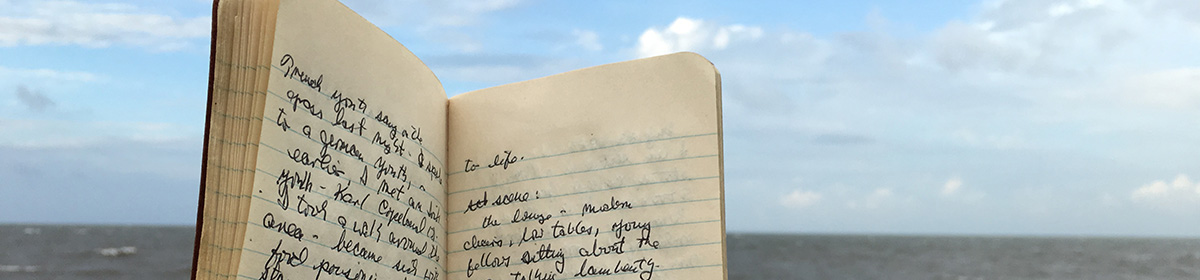
MY CATECHISM

In or around 1957-58, I was a 5th grader at St. Ann’s parochial school on Neponset Avenue in the Dorchester (specifically, the Neponset) section of Boston. We were learning our catechism. I still have my Baltimore Catechism of Christian Doctrine, as it was called. Millions of Catholic children across the nation were instructed from the identical volume which was in a question-and-answer format.

I still have my copy. The Sisters of St. Joseph were our teachers — our catechists.

In our class — 5B– we were asked to protect our catechism copies by stapling on a sturdy light red cover made of material like oil cloth, which has helped preserve my copy’s deeply yellowed, fragile and flaking 131 pages these 65 years.

Sadly, my catechism has survived far better than the Sisters of St. Joseph, which was among those Catholic religious orders sadly decimated by its wayward, culturally conforming superiors in the seductive post-counciliar period of the 1960s and into the 1970s. It was those more senior St. Joseph nuns (though I believe “nun” is supposed to refer to cloistered not teaching orders) who insisted the order’s legions of devout women uniformly come out of their uniform, which was the “habit” — from the Latin habere, or habitus, referring to “condition or state of life.”

I’d wager that the majority of the subordinate sisters of that era still embraced their “condition of life” and welcomed its centuries-old outward manifested of a white linen coif and wimple and black full-length black tunic. It certainly set them apart, and they knew it would be their sacrifice. I once interviewed three aged St. Joseph sisters — forget just why — and they told me they didn’t want to give up their traditional dress but were ordered to do so. The habit had been their visible message to the world of their complete devotion to Christ. Sounds corny to modern ears.

Now, of course, we don’t need a “uniform” to tell the world we are Christian. But priests, nuns and sisters are consecrated religious. It had long been understood and accepted that religious garb identifies the individual’s consecrated state. Clothing is such an identifying mark across religions. Consider the Buddhist monks. (Get a bunch of tattoos and dye your hair purple and you’ll have declared outwardly your inward conversion to our age of expressive individualism that is no longer quite so individual.)

For sisters and nuns, I submit that the shedding of the religious habit began the outward manifestation of a different, more worldly theology and, ultimately, of inward conversion to a multitude of secularized, “liberalized” attitudes and beliefs. They often came, if they remained in the order, social workers more consecrated religious. The ranks of confused, disoriented sisters and nuns commenced to expand disastrously. The world welcomed them, but did this calm their inner storm? Some adjusted, many left. It was not a happy time for the rest of us who were once inspired by their visible sacrifice.

Things also went morally, socially, culturally disastrously awry for multitudes of plain Catholics and their children throughout the same period. I count myself in that number.

The first chapter of that Baltimore Catechism is The Purpose of Man’s Existence. (Guess that should be a Person’s Existence, if we’re to be political correct.) The last chapter is Prayer.

It’s almost Holy Week.

Keep praying.

THE PALM AT THE END OF MY MIND

March is speeding to its end. In Florida one cannot usually exerience the “in like a lion, out like a lamb” effect. I can say that I miss the seasons in all their varigated harshness and unpredictability — and langorous summer days or colorful autumnal glory and moods of mortality and early gloaming, or snowy, icy midwinter beauty and chilled, sparkling distances and warm isolation. I miss the degree to which climate invests life’s passages with their own character. I recall, too, how so often the anticipation and longing for spring and her flowers goes unrequited when winter seems to go seemlessly into summer and springs temperate, moderate interval is blighted by cooler than normal temperatures — or rain. I recall serial Junes in which rain seemed constant, only to end in July’s dank or scorching discomfort. Then, all too soon, the earth’s rotaton was plunging us back into fall.

But, seasons are life. And life often feels more like life if there are those external passages we feel against our skin and within our souls.

Then there is Christmas — the Yuletide. Joy for many, torture for many. Emotions are at their apex or their nadir. Darkness, either cosseting and comforting or alienating and unbefriending. The colorful lights festoon the world — and make January all the darker and colder.

Summer in New England can offer variations unlike anything anyone will ever experience in Florida or the southeast or subtropics, at least so far as I know and based on my own long exposure to the subtropical seasons. In New England, it can be blisteringly hot and humid one day, up into the nineties, then, the next day, be cool and dry. I recall mid-Julys that felt, at least a little, more like a green October.

Haven’t all of us experienced a curious sense of sweet disorientation in those periods of the fall known as Indian Summer? For one thing, they occur only periodically. Sometimes, chilly autumn descends and never looks back. We have felt resignedly the natural shift into cool temperatures, said goodbye to summer, braced ourselves for the coming winter — then, suddenly, though the golden leaves lie redolently all around us and the branches have become partially bare — it is summer again and the dry calm or the warm breezes can plungeus unexpectedly into a confused, complex moods of longing — and, longing for what? Not, I would suggest, for the lost summer but for all that has happened in our lives, all hopes, all fears. (And it is sad to know that this name we gave to this lingering breath of summer has its origin, at least from what I read, in Native American raids of settlers’ farms when good weather continued into fall. It makes it, then a very insensitive, politically incorrect term. And even more insensitive term, still used apparently, in England, is Old Wives’ Summer . Frankly I love the term Indian and am sorry the current long winter of grievance and retribution that has descended on us has staged a raid on terms that have long lain neutered and harmless. But so it goes.)

I recall that the early days of November have through the years been a time of sudden temperate days, even a little humid. I recall a terrible, accidental death of a child in my neighborhood one November 9. And I recall that the early darkness was warm. And every early November day of damp, dark warmth takes me back to that evening I’d prefer to forget.

And, living in Florida, where the seasons are subtle though seemingly seamless and the emotions and temperments the weather evokes and the sense sometimes of being in a room where the lights are never out, like a prison cell and the topography is flat and the vegitation vivid or scrubby and rough and the earth sandy and the weather always threatening to be electric and violent and destructive but also simply “nice” and inviting to half the nation half the year — here I’m inclined to write a whole long, different meditaton.

But now I am thinking of the metalic reality of northern climes where there has been both horrors and delights and, in the case of New England, remarkably mostly mild weather. ( Perhaps winter and snow-lovers are sorrowing). But my brothers lie aging and ill up there, and my grand nephew is several months gone at only twenty, and the mourning is unrelenting.

And as I move toward the end of this sponteneous Friday morning meditation, I go looking for something by the late Hartford insurance executive who also enjoys the reputation of being one of our nation’s greatest poets, though I might find Robert Frost more accessible, especially on the subject of weather. But I’ve taken down, instead, Wallace Stevens who, the short poem, “Of Mere Being”, writes,

The palm at the end of the mind,

Beyond the last thought, rises

In the bronze distance,

(stanza)

A gold-feathered bird

Sings in the palm, without human meaning,

Without human feeling, a foreign song.

(stanza)

You know then that it is not the reason

That makes us happy or unhappy,

The bird sings. Its feathers shine.

(stanza)

The palm stands on the edge of space.

The wind moves slowlyi in the branches.

The bird’s fire-fangled feathers dangle down.

(end of poem)

Yes, I’ll conclude saying, it is not the reason that makes us…whatever.

Perhaps, it is –the season.

It is the end of March.

Yes, I’ll end here, though, of course, I could write on endlessly –through season after season comes,and goes.

But I’ll end.