His name was McClure and he came in The Last Mile once in a while. He’d usually sit by himself in a corner near the front window. He’d drink a Michelob, occasionally had a burger. He dressed like a guy who worked a few jobs, managed to get by. He wasn’t bad looking; it seemed like he should have more life prospects. He looked to be about late thirties, maybe forty, dark blond hair, average build, blue eyes if I’m remembering accurately. The closest I ever got to him was when we both found ourselves sitting side by side at the bar and he was playing Keno and doing well — until he wasn’t. He had on a dark jacket over a white shirt. He had his Michelob. Deano, the bartender brought him his second bottle. That was his limit, two and out — then, he was off to no one knows where.
That night sitting at the bar next to me he mumbled something and smiled sadly. I thought he was talking to me, so I said, “what was that?”
He said, “take care of yourself. Saddest words in the world.”
I smiled. “I guess they could be,”I said.
“No,” he said. “They are. And he mumbled the words again, “take care of yourself.” At that moment, Sticky Sammartino came up and started talking to me about something, damned if I can remember what. Whatever it was, it was funny enough to make us both laugh. Then, when I swung around on the barstool again, the guy was gone. His second pilsner of Michelob had a half finger of beer left in it. Deano came up at that point to ask me if I wanted a second tonic and cranberry with a slice of lime (my whimpy drink), and I said, no just a glass of quinine, then I had to be going. But I said, “Deano, this guy who was sitting here who usually sits over there (I gestured toward the front windows.) “What’s his name?”
“McClure,” said Deano.
“He got a first name?”
“Carl.”
“Carl McClure. He live around here?”
“Don’t know. I never got past his name. And I didn’t get that from him. Vinny Gianetti was talking to him one night, sat right down at his table, decided the guy looked lonely. You know how Vinny is. But he didn’t get much in the way of a biography, either. Vinny says they talked about sports.” Deano collected my empty glass and said, “did he tell you about the saddest words?”
“Funny you should ask. ‘Take care of yourself.’ What up with that?”
Deano leaned across the bar. “If you’d asked him, and he’d had a little extra to drin, he might have told you. Vinny never heard anything about that from him. Like I say, it was sports or stuff about the old days around Wonderland or over the the Downs. For Vinny, as you know, that was his life for a long time, and Carl McClure wasn’t much interested in any of it, I’m sure, or interested in sharing anything personal with Vinny, God bless Vinny for trying to open him up a little.
“But the first time I asked him about himself, he’d drunk more than his quota. He was at four beers in just an hour and I suggested maybe he slow down or I give him some coffee or a Coke. That’s when he says to me the saddest words, and I asked him, Why? why’s that so sad?
“He surprised me then. Because he kind of started rolling out a load of personal stuff. I wasn’t sure how much I wanted to hear, but, you know how it is with bar tenders, like everybody’s heard Sinatra singing, ‘set ’em up, Joe, and all that ‘quarter to three’ stuff. Ole Carl kept it relatively short and sweet and it was mainly about a girlfriend — a short-lived episode. He says this new girlfriend woke up with him one morning and told him she wouldn’t be coming around for a while. I think he figured this was her trying to figure out whether he wanted her to come around anymore. She lived a long way off and flew in to be with him after originally meeting him someplace like Vegas or Reno. They’d gotten to gether a number of times like that. He was living in Arizona at the time, around Phoenix, I think he said. So he says he wasn’t totally sorry the relationship was coming to big crossroads. He knew it had to happen sooner or later. She was the first woman he’d really seriously dated for any length of time and really liked. She was good looking and, yeah, he liked her alright, but still didn’t know her that well (although from the evidence, I’d say he knew here REAL well. I my book getting intimate is REAL well and you don’t go there unless you’re serioius. But I guess he’d been seeing her just about as long as he thought he could show her any real attention before crawling back into his shell — maybe a couple of months, and I guess he figured it might be best if they separated or at least cooled things off. We’re talking about a real loner here — never married, family history a big mystery. I don’t know anybody who ever cracked the shell around here and Vinny was the only guy who tried — except, come to think of it, I DID see at least one woman walk over to him one time — a friend of Brenda Finch, you know that nurse who comes in here after her shift. It was one of her friends. I mean, the guy’s not bad looking, so she got bold, but maybe a half hour after a whole lot of chit-chat sitting at his t able, she gets up and goes back to the table with Brenda and her other friends, having tried and failed at mission impossible.”
At this point, a couple guys started getting loud over a Bruins game up on the TV over the bar, so Deano leaned in closer. “So here’s this Carl with a woman who says she’s going to go away, and he pretty much shrugs, but he figures he should ask why or where she’s going, but he knows she’s just gently breaking up with him. So he asks why she’s going away. She says it’s because she’s going to be a mother. Carl was surprised by that, but not real concerned. But that’s how she put it, not that she’s pregnant, but, ‘I’m going to be a mother.’ It kind of shows how she felt about that state of affairs. She was happy aboute it. Carl, for h is part, just didn’t know there was another guy in her life. And he thought it was real nice she’d found somebody and also knows they’re parting company alright, but, just out of curiosity, he says, “who’s the father?” Carl says the woman looked at him kind of strange and says, ‘why, you are.'”
Things had settled down in the Bruins game but the reconditioned old juke box suddenly starts up with “Born to Run” and I’m thinking that’s a little too on the nose for what I’m hearing, but I say, “what’d was Carl’s reaction to that?”
Dean didn’t answer right then. Three weeknight regulars came in from their bowling night over in East Boston and Deano squared them away with their usual drinks. Then Jackie the Crow was asking him something about plans to expand the kitchen, then he was back with my glass of quinine, crossed his arms on the bar again and says to me, “I kind of can’t believe how things when down from there, at least as old Carl tells the story. He says he got up out of the bed, went to the window and realized his life had just changed in a big way. But he didn’t want it to change. It was all pretty sudden, and he didn’t know if this was the right woman for him or any of that, because this definitely forced that issue. But, no, he was feeling mainly he didn’t want any life changes that morning. It was, as it happens, close to Christmas, and he’s figuring he’s going to have to call his mother for the first time in a long time, and this wasn’t the kind of news he wanted to have to be telling her. And the woman sensed that, sensed his reluctance, and probably was heartbroken, not getting the happy reaction she expected from the baby’s father. But then, he remembers she did say she was going away for a while, like back to St. Louis or Chicago or wherever, probably to tell her family or whatever. And at the same time, Carl’s beginning to think that maybe he liked her more than he thought. He didn’t mention her name or anything, but he’s probably thinking he’s being all kinds of intimate with her, so maybe they’d been seeing each other long enough, longer than he’d seen anybody else and maybe she’s the one — if there was ever to be a ‘one.’ I think he was deciding if he was in love with this woman. — I mean, like I say, it’s pretty plain from news like that that he’d gotten to know her real well whether he realized it or not. I mean we’ve all been in situations where we have to decide whether to hold on or let go, right? So here he’s thinking he held on longer than he wanted or expected — and now he’s about to be a daddy.
” But, then, his thoughts changed directions, and I mean — you saw the guy tonight — I mean I can’t figure him out, really. But I’m picturing him standing there in the bedroom and saying nothing and so the woman — I mean she must have been upset at this point, since she didn’t get the reaction she expected, so she says, ‘what do you think I should do, you don’t look like you’re happy.’ Carl says he just stood there and didn’t say anything. Nothing! He thinks maybe he was in shock. “
I asked Deano, “how did he know this woman wasn’t, you know, lying? Just trying to….”
Deano said, “I asked him that. He said he knew she wasn’t that kind of person, wouldn’t lie about something like that. I guess he felt he knew her that well.
“But she just sat on the edge of the bed. And I imagine the silence in the room was deafening, right? Until his clock radio went off. This was how he woke himself up for work — a cheap old low-tech clock radio from Walmart turned to some easy listening station that wouldn’t blow him out of bed, just wake him up slowly. And out of the radio came a chorus singing, ‘let it snow, let it snow, let it snow…’ You know that main verse from, the weather outside is frightful’ and all that. Yeah, it’s Christmas time. Carl says he wasn’t religous or into the holidays at all, but that was when he realized it was not only Christmas time, it was the day before Christmas Eve. He hadn’t even been thinking about the date, or even buying a gift for this woman who was, like twenty years old , and was offering him a gift, you might say.
“That’s the thing he realizes all of a sudden. He says it was like the radio was telling him , let life in, let snow fall on you — rain, life, Christmas, whatever! Let life come down on you like sunlight or frost or snow — or grace or something — let it fill the room, fill your life, cover this woman and you, fill your closed little fortress of a world And all of a sudden, he was thinking about a wife, a kid on the way, then another kid, a family, a house, a good job, calling his mother, telling her the news (he didn’t have any other family and his old man had died years ago.) So, he’s thinking, this could be his big crossroads and I should choose the right fork.
“Then, he says it all went away. All those thoughts. All that was left was bad thoughts about –responsibilities, the trouble raising kids, possible health problems, money problems, arguments and the consequence of getting to know people, especially a woman, too well. Letting her into your life….”
I asked, “so the woman’s twenty. How old was he when all this happened?”
“I asked him that,” Deano said. ” He said he was twenty-two at the time. Just starting out. Had a good entry level job in a software start-up when the whole IT thing was just revving up.”
I asked, “so what’d he said to the woman? Not a woman, really. Just a girl with a baby? It doesn’t sound like he popped the question.”
“No,” said Deano. “He says he totally didn’t know how to handle the whole thing. He just stammered, asked the woman if she wanted some coffee or some breakfast. She didn’t. She just sat at the edge of the bed, looking real sad. So he shaved, showered and got ready to go to work, leaving the woman sitting there.”
“Seriously? That was it?”
“Well, he had to get to work, and I guess maybe he knew she knew how to ge to the airport, but, yeah, very strange. And when he came back to his apartment after his shift, maybe around six o’clock, he found a note she’d left on some paper she found. She left it right on the bed, which she’d made up as if nobody had ever slept in it. It said something like, ‘sorry this wasn’t good news for you like it was for me. And now I guess it’s just bad news for both of us.’ Then she says, ‘ someday some woman will make you the happiest man in the world with this news.'”
I smiled at that. But Deano, after telling me that actually looked like he was going to cry. And after a good little pause, he dropped the kicker. He says she’d signed her name, just he first name and added, “take care of yourself.”
I sat back on the stool, gave Deano a long look. “So, well…” I said. And that’s all I could say. Suddenly, those words did seem like the saddest words in the world. I swear, I almost cried, which sould have been strange. The guys on the stools next to us were going crazy over the hockey game again. I guess the Bruins had just scored.
I asked Deano, “Did he ever call her?”
“No.”
“She ever call him?”
“No.” He gave the bar a swab.He says this was in Arizona where, like I say, he was working at the time. I guess he’s not originally from around here. I think he said he got transferred here by G.E., then laid off. I don’t know how he found this place, to be honest. He’s not a big drinker. Maybe the name got his attention.” Deano laughed at that. I did, too, and I said it out loud: ‘The Last Mile’. Perfect.”
“Needless to say,” Deano said, “he had a pretty lonely Christmas that year, not that he wasn’t used to that.” Then he chuckled. “No snow falling on him, either. Not in Arizona. I guess nothing else ever fell into his life unexpectedly, sort of like grace.”
Grace. Now there’s something I never, ever heard Deano talk about before. I guess maybe I don’t know that much about Deano, either. Everybody’s a stranger, to a degree.
I asked, “he never heard from the woman again?”
“Never.”
“Has no idea about her or the baby?.”
“Well, not until he got curious again one day about a year or two ago. He Googled the woman’s name and her hometown, whatever it was. Some small town in Illinois. Up pops a picture of her on the Society page with the guy she was marrying. He had her married name to work with now, so he Googled that, too. Nothing. But then he goes on Facebook. And there’s the two of them about fifteen or so years ago on a cruise ship looking real tanned and smiling and with a kid, a boy about twelve years old smiling along with them and the ship’s captain, and the caption on the photo says the kid had won the cruise for them by winning a national Boy Scout science project by inventing something that helped predict weather for farmers. The kid even got the thing patented and he was sitting between them in the picture. Everybody was smiling.”
Deano put on this best, most ironic smile, and I said, “let it snow, let it snow, let it snow.” Then I asked, “did the kid look like him?”
“Funny about that,” Deano said. “I asked him, and he just stared straight ahead. My guess is he had found himself looking at himself in another, better world full of love and roses and snow storms and sunshine and proud moments at award ceremonies — and cruises. He was looking at happy people out on the ocean. And he was probably sitting in a room hanging over his laptop, all by himself.” Deano backed up, stood up straight for a second, then leaned in again, real close. “And Carl says he went deep on the woman’s Facebook page and saw they had other younger kids, a couple of girls. There were pictures of them from the cruise, too. They were a family. Then he says, he’s never looked at it again — never even looks at Facebook anymore. And nobody’s gonna find him, because he’s totally not a social media guy. Total blackout. He’s a loner every way you can think.”
“So I wonder why he comes in here,” I said.
“Right. The Last Mile. For the noise, maybe. At least there’s life here, on the last mile. I hope we see him again, to tell you the truth. He hasn’t been in since that time he talked to you, so far as I know.”
I thought about all that as the hockey fans were groaning. I guess the Red Wings had just scored on the Bruins. Deano was looking a little meditative. We were both feeling real sad for the occasional Last Mile Lounge patron named Carl McClure.
“And,” Deano says,” that young woman obviously wasn’t lying, or gold digging after a twenty-one year old IT worker. She was for real. And call me old fashioned –everybody does, as you know — but I say, don’t sleep with any woman you don’t plan to marry. In fact, marry her first.” Deano –I’d say he’s pushing thirty — was telling me this as a guy we all know is not married, though the women love to flirt with him, and doesn’t have a girlfriend, isn’t gay (guys have come in here and flirted with him, too). These are probably all reasons Joe Barron, the guy who owns this joint, hired him. And they’re probably the reason Carl McClure opened up to him. Just like Sinatra: “Set ’em up, Joe, I got a little story I want ya to know….”
And I know both of us where thinking, there’s a little ‘Carl’ out there somewhere. He’s an adult by now, probably wound up at M.I.T. or someplace, probably making money hand over fist, living large, probably got a nice girlfriend. Don’t know if he ever plans to come looking for his old man — his ‘natural’ old man, so to speak. Not likely, from the sounds of things.
“And I gather Carl never got married. That woman of his dreams every came along and make him the happest man in the world?”
Deano swabbed the bar top. “I’d says the old clock radio’s up on that one. I’m guessing he may live over in Lynn. Like I says, probably originally from out west somewhere. Maybe Arizona originally, as a matter of fact. All by himself. Works nights, three different jobs. He smiled.”So I guess he’s ….taking care of himself.”
Deano and I both pondered that. Then he went back to work tending bar. I sipped my quinine.
We haven’t seen Carl McClure for a while at The Last Mile. I hope we do. I might tell him a few places he can meet a nice woman. I’m not sure this is that place.
Meanwhile, I stayed a little longer than I espected that night, thinking about things. Deano got me a cup of coffee to go with my water, unsolicited and on the house. I guess he was taking care of me. Come to think of it, who likes to take care of themselves? Somebody’s got to bring you coffee.
Around midnight when The Mile was nearly empty, I looked out the front door.
It was snowing.
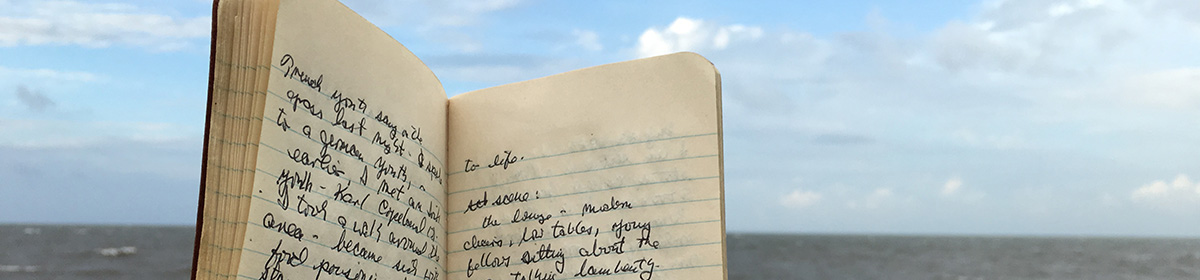
 19 Cent Notebook