HOPES AND FEARS AGAIN

The man goes out in the yard with the dog. He has turned on the only light, a green flood light that illuminates the area darkly but adequately. The small, spotted dog, after urinating, then forages a bit, then stops under the bird feeders, listening. The man is listening, too. There are just the distant sounds of the light Sunday night traffic on the road beyond the PVC fence and the warehouses beyond. The fence is draped with Brazilian pepper bushes.

And the man is thinking: It is January. Will I finish things this year? Will I persevere, or will another year just pass with nothing really done?

The dog, after a while, goes in the open door to the shed and the Florida room and waits to be re-admitted to the house.

The man stands for a moment, still in the yard, alone. It has been cool. There is a breeze.

He thinks, he fears…

He will merely think about changing, about doing things. But he will do nothing. Just hope he has another January. But for what?

And the man thinks, I cannot think that way.

The dog is waiting….

THE CROWS OF JANUARY

(f you are reading this, I apologize. It must be edited. This man named John gave me too much, and repeated himself.)

A man named John, an acquaintance, told me of his day on THIS day, Jaunary 7th, 2024. This happened on the west coast of Florida. It’s life:

Crows gather. They gather over the Culver’sburger place, a wavering black cloud. They are migrating from the cold and snow of the north. John’s long-time companion (they’ve never married)named Rosemary, loves crows. She is like a child in her love for crows. John love that she loves crows.

Seeing crows might make her happen for today. She has not been happy, and John knows he can’t make her happy. He can, however, make her unhappy, usually without meaning to.

He’s come from a rare visit to a church – he chose one, randomly, went, period. And resolved to live by the things he heard there– but instantly, as always, almost unavoidably he is in conflict with Rosemary. That’s life — January life where there is sunlight and no snow, but plenty of life.

He thinks: how did this happen? That I have made Rosemary unhappy?

Well, Rosemary is not feeling well. But he has never made her feel well, on top of her not feeling well physically. She says he does, but he knows he doesn’t.

For some reason, comforting John at this poiint, is an imaginary view across tidal flats to a little fishing village. It’s only a vision, a dream. There is no such village. This is a northern village. But, being imaginary, it is nowhere, but some imaginary cold place, probably New England from which John, like the crows, has migrated more than once.

For some reason, also comforting him, is a recurring thought of the time he traveled through Puerto Rico, alone. Or Europe, alone. He knows he may never get back. He’s in Florida. This is Florida life where people come with visions.

In his Puerto Rico dream, a woman is smiling at him, no woman he has ever known. If she knew him, she wouldn’t be smiling, or so he believes. Some women smile at everyone. The waitress at I-Hop called him, ”love.” She calls everybody “love.”

In the imagined European travel encounter, there is a smiling woman as well. She stands among the pigeons and the rain soaked stones of the Piazza San Marco. She might be the I-Hope waitress, a lovely African-American woman. She calls him “love” — just him.

But that’s good. Love is good.

But it is January 7th. Three times on this date, John, at three different workplaces, had bosses call him in. Yes, believe it or not — same date, three different years, three different jobs, three different odious summons from bosses. They had bad news for him –suddenly didn’t like his work. It never felt just. There were trumped-up circumstances. It was the beginning of the end of his time at those jobs where he’d been happy.

Rosemary wants to drive way out to a Florida strip center that has a bird shop in it, between the supermarket and the Chinese restaurant. She wants to get bird seed (that might attract those Crows over Culver’s) and eat at a little restaurant there, not the Chinese one.

John has things he wants to do. He wanted to write a book, but no one took him seriously on that. Small wonder. Besides, he feels he should want to do what Rosemary wants to do and make her happy, even if just for a while. He knows later in the day, after being miserable for a few h ours, she will be talking happily on the ph one to someone, or giving a way furniture. He thinks he’s agreeing when he nods, “yes”, though he’s unhappy inside. But Rosemary says, “why are you giving me that look?” They’ve been through this before, the ‘look.’

Standing before her, he goes off to that little New England seaside village in his mind, There is a light snow falling on the lobster pots and the roofs of the boat houses. There is no one around He approaches a pile of lobster pots. He sits on one after brushing off the snow. He is alone, looking across the inlet at a lighthouse.

His imagined fishing village and the memory of Puerto Rico and Europe and the smiling women do not coalesce with the highway and shopping malls and traffic he would have to endure to make the thirty-mile trip to the bird store and realize Rosemary’s dream. “That’s my ’Happy Place,'” she says to him, angrily, when it is too late for him to take back the ‘look’ he didn’t know he was giving her. He suggests they get bird seed at the chain hardware store. The birds have eaten itbefore. They’ll come and eat it again —maybe even the crows.

He doesn’t know what will bring the crows — maybe peanuts. He’s already put some peanuts out.

Rosemary has a $5 off coupon for the hardware store. That helps soften things.

Rosemary has things she wants to do. She saysthe woman across the street is selling a queen-sized bed.Rosemary wants a queen-sized for herself. She knows John likes to sleep at the far end of their king-sized bed. She’s resigned to that, apparently. He doesn’t want her to think that, but doesn’t want to make any changes. He wants to sleep alone, ultimately, in guest room bed. He wants to be alone allo the time. But he thinks changes like that can wait until January 8, which is what he thought last January 8th.

This is how he knows this:

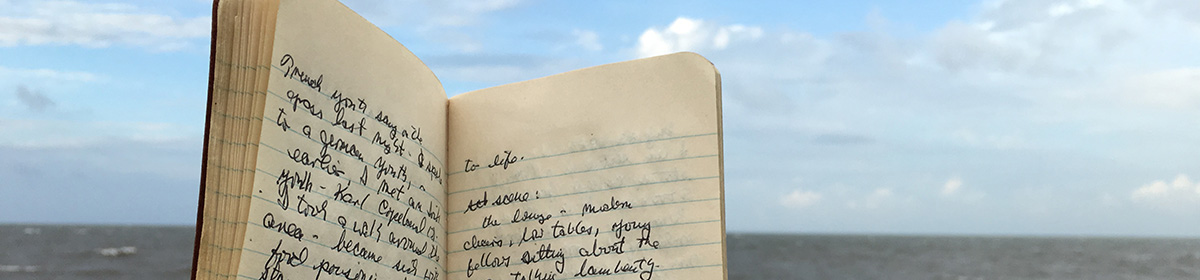
Last year on January 6th at 10:33 a.m., he wrote in his journal, “Trash out. What willl this year bring?”

Now he wonders, whatDID last year bring? He decides not to ask that question of himself anymore, that January New Year question. He’s tired of asking it. What’s the point?

It is Sunday. At the church he chose, they told him to pray. So, he’ll pray.

Last January on January 6 ( he made no entry for January 8th), he wrote, “Must take down the creche.” He and Rosemary are religious enough — or “spiritual” enough — to have put up a creche for Christmas. It’s tradition, after all. So, he could write again this year in his journal, if he were so inclined, ‘must take down creche.’ The child, Joseph, Mary, the shepherds, the newly arrived Magi from the East….

It was after he wrote “must take down the creche’ last year that he wrote, “what will this year bring?” Meaning the year just gone.

He admits to himself that he hoped he wouldn’t still be making Rosemary unhappy when he wrote that, a whole year ago. He wonders what he wrote the year before last year in January. They’ve been together more years than he cares to say. Or what did he write all those Januaries, all the way back to the turn of the century, and even before that. Early January is a rough time. The new beginning where nothing begins.

He reads poetry once in a while. He thinks of the poet who wrote….

Time present and time past

Are both present in time future…

And

In my beginning is my end…

And

I don’t know much about gods…

And

Midwinter spring is its own season

Sempiternal though sodden towards sundown,

Suspended in time, between pole and tropic.

Midwinter spring: he loves the thought of that, a sodden early spring, somewhere.

But, more than that — he thinks of a season “suspended in time.” He knows it is snowing in the north today. But sometimes spring comes for a while in midwinter. And sometimes, there are those times when time seems — suspended. Tiime present, time past, time future. He stands, suspended, in that little fishing village, in the Piazza San Marco, in Puerto Rico,and at the drive-up window at Culver’s burger place, and in the bird shop, with all its stacks of seed and bird houses and artificial bird sounds and smiling, friendly, bird-loving saleswomen who can tell you just what birds eat in what season.

What would they eat in a sempiternal, sodden season between seasons, suspended in time? Are not migrating birds suspended in time? Are there crows over the fishing village? Are there crows among the pigeons on the Piazza San Marco? Surely, they are in Puerto Rico. But no, he has read that the Puerto Rican crow, Corvus pumilis, is exinct. How sad. Gone from time. Haven’t any American crows thought of flying over there to get warm. It’s not that far.

He looks overhead and is glad to see the crows, seeming suspended in time, but real, so real. He hears their caws. Rosemary loves to hear the caws.

But he is happier in that fishing village, alone. There are no fishermen, no one, just the gulls. The crows — no they are imaginary, those crows over thar village, like the village itself, for the real crows are over his head, in Florida.

But at a time like this, he’d like to see that little fishing village, walk among the little buildings, idle for winter, gulls overhead, perhaps some crows. He would walk, in peace, alone. The village would be on a little inlet, leading out to the harbor, and then to the open sea.

He knows another one of Rosemary’s “Happy Places” is a lake in the north where she has spent some of her childhood. He has seen the home movies of her there, in the water, among cousins and aunts and uncles, and alone, the sun flashing between the trees. When they have been near that lake, he has taken her there. She found the old cottage on the little rise among the trees among other cottages on the lake. She left a little note and her address for the current owners who were absent (this was in winter). She told those strangers how much that little cottage had meant to her. She hoped to hear from them.

She heard nothing. No one ever wrote to her. John was sad for her.

They may not get that queen bed today. Maybe John will watch football. Rosemary is already watching a movie in the other room. She watches a lot of movies

She was experiencing hypoglycemia on top of her aggrivation and despair and unhappiness, so they had gone quickly to that Culver’s window and both ordered single burgers, his with pickles, lettuce, tomato and ketchup, her the same, only with onions. They both repeatedly told the girl talking to them on the speaker in the drive-thru that they didn’t want cheese on either of the burgers.

Just the same, her burger came with cheese.

He can hear her movie in the other room. He will sleep at the edge of that king-sized bed tonight. Changes can wait until tomorrow, and tomorrow. Maybe until next January 7th, 2025. At least he’s not working and so can’t get any bad news from employers today.

He has put sunflower chips bought with the $5-off coupon at Ace Hardware in the birdfeeders. Soon, he will look out and hope to see crows. He can call Rosemary to the window from her movie, make her happy on this January 7th.

They will eat leftovers for dinner. Some chicken, some pork, some thawed out frozen peas.

And tomorrow. Tomorrow he will go to the dentist.

They will be happy today. It is Sunday, January 7th.

They wonder what this year will bring.

They will look and listen for crows.
I DROPPED THE BALL ON THE ‘BALL DROP.’ WE ROLL INTO JANUARY

No, I never said much about the passage into yet another new year. Hopes and fears and all that — or anything about the old year. Old years are old, that’s all I’ll say about that.

I just remember the little dog quivered and trembled as July 4th fireworks exploded outside the home in Rotterdam Junction where I went to escape the Florida heat for that hot month. I wanted to be on the lawn watching them and hearing them, in the distant sky and the lawn across the street — concussions and flaring, hissing spectacles, great and small. But I was inside, consoling a dog — the same dog who looked so unhappy and distressed at the thud, whistle, crash and boom of New Year’s Eve incendiaries all around us as midnight crept up and over the fence like time’s predator. The dog might have thought, ‘save me from that beast!’ Or, ‘existential man, making needless noises. No wonder there are wars.’

And what more can be said of new beginnings for those of us who are never finishing what we begin?

Somehow, I remember the guy who came into The Last Mile Lounge on January 2nd, 2017. That already seems like a long time ago. (It is, after all, already a mystical seven years ago.) Oddly enough, this guy was r emembering stuff from back in 2012. Crazy, he, too, was wondering, where’s the time go? Then, he was launched on a riff about time — and eternity.

A New Year. Time Square delirium already days gone. All the confetti swept up. But, in his mind, the observances continued.

And this guy in the shadowy corner of the lounge was saying to a few people at another table — all of them strangers who’d “dropped in” for a beer and a “ball.” Speaking of balls.

And then there was this guy. He seemed a seer; seemed to sense that life sweeps us down river. And he was speaking haikus, from what I could hear (I’d just dropped in, too. The bartender’s name was Cynthia; she works Thursdays and Fridays, still. Therefore this must have been a Thursday or Friday. She could hear the guy; everybody could.)

The seer at the back table said:

“We’re bug on a leaf, floating down stream. Singing.”

Wher had I heard that?

He said:

“I will arise now, and go to Innesfree…”

I knew where I’d heard that. Or read it. Or heard it, ‘in the deep heart’s core.’

He said:

“You shall tread upon the asp and the viper; you shall trample down the lion and the dragon.”

Everybody was listening now. Crazy. But where had we heard that? Snakes, dragons, lions.

He stood now. We were all listening, worried. Would we need to call the cops?

He said:

“Shall he who shaped the ear not hear, or he who formed the eye not see? The Lord knows the thoughts of men and that they are vain.”

Then he said:

“Happy New Year!”

Then he sat. He was drinking ice water. He never said another word.

A cold rain was falling outside.

Yeah, happy new year….

CHRISTMAS GIFTS,”FOR US, LIKE SHEEP,” LONGING TO BE CONTENT, SECURE, HEALTHY, AND, ABOVE ALL ELSE, DIVERTED, AS WE SEEK A STAR IN OUR MOMENTS OF BLIGHT, WARS, ANXIETY AND DARKNESS

This day, in the city of David, a son has been born to you, a Savior….

And so, dearly Beloved, I am sending you on this special occasion…

A Black Falcon 4K drone (imagine it’s a star); a Muama Enence (turns you into a native speaker of 36 languages in seconds); Pro Power Save (cuts your energy bill by 90%) Synoshi Power Spin Scrubber (genuine Japanese inventions that cleans everything in your house); Stealth Raptor Airplane (the perfect gift for kids) Clear Pik Dental Descaler (instantly removes ugly, stubborn dental plaque);Flex Vision (If you’re over 50, try these revolutionary glasses); Adien Atom (the world’s first hearing aid for less than $100)….

..let us go to Bethlehem and see this thing that has happened.

Alpha Heat (heats up any room in minutes and saves hundreds in the electric bill); Kailo (futuristic patch that uses nanotechnology to relieve pain; The PhotoStick Omni (find and protect all your memories in one click); The Chill Pill (a hand-held device that helps you fall asleep in minutes)….

...field and fountain, moor and mountain, following yonder star…

Auto Air (car tire pressure need never again be low); VolteX Heated Vest (NASA-inspired technologogy to keep you warm and cozy this winter); SpaceScope (see everything miles away as if y ou are s tanding next to it); TurboDrive RC ( irrsistable toy car that keeps kids off their phones and computers; NuuBu (a centuries-old solution for stress, anxiety and low energy); DermaBolt IPL (the ultimate hair removal device); Flight Path (the world’s most advanced golf tee. Boosts your golf drive by a notable 10-20%.

...and behold the star which they had seen in the east led them until it came and stood above the place where the child was…

Noel!

VOICES IN THE MINE

The late Scottish novelist A.J. Cronin (1896 to 1981) began life as a physician and, fresh out of medical school, took up an assignment in a small South Wales mining town. He was an atheist at the time but would eventually undergo a conversion to Catholicism. His novels included, The Keys to the Kingdom.

Among the formative experiences leading him to God were those times among the “grave, dark and silent people” in that mining town. They were isolated among bleak hills but were deeply religious. He wrote that their faith manifested itself in every aspect of their simple lives, but most especially during a moment of crisis.

Cronin writes:

Never shall I forget that occasion when, at the colliery, a heavy explosion of black damp gas entombed fourteen miners. For five days the men remained buried, while the village prayed. Than, as the rescuers hacked their way underground, they heard faintly, from deep in the collapsed workings, the strains of singing. It was the hymn Our God, Our Help in Ages Past. Thus had the entombed men chosen to keep their courage high. And when they were brought out, weak but unharmed, the great crowd gathered in the pit-yard took up the hymn which, sung by a thousand voices, echoed joyfully in the narrow valley and rose beyond the encircling hills.

It’s plain from Cronin’s account that, probably in his capacity as a doctor, he was among those lowered down with the rescuers, because he writes, As I came to the surface with the liberated men, blinking in the stark daylight after the blackness of the pit, this great volume of sound caught me like a tidal wave — as a demonstration of human faith it was moving beyond words. Although at that time I was conscious of no more than a momentary emotion, looking backward now I know that it left its mark on me.

Moved as well, but feeling the need for a few extra words, I’ll add that deep among those many long-ago humble voices raised in reverent, grateful song, the medical doctor, atheist, author and future convert probably heard that “still small voice.”

I listen for it, too, waiting for it to leave that mark on me.

I don’t know exactly when Cronin wrote this; most likely at mid-life in the mid-20th Century, about an event of his youth much earlier in that century. I choose to share it five days before Thanksgiving, 2023 — early in what for Cronin would be the next century he knew he’d never see.

This shall stand as among my public professions of thanksgiving for this season in which I so often fail to be either grateful or charitable and am often feeling buried in my own fears, concerns and failures.

These are more than usually troubled, violent, divided times in the world.

Let us, all who read this, listen for that “still small voice” the prophet Elijah heard from the cave (1 Kings 9-11)– and let us join those grand, prayerful, undespairing voices deep in that dark mine.

Pray for deliverance.

SORT OF ORANGE

This will be short (or was meant to be short); just long enough ( too long) to clear out the sunny remains of a week (a long week.). Not too many actual memories, just the moods, and the colors.

I’ve been north. I’m back south again. Long drive, back and forth, up and down, bridges and mountains and white-knuckled (speaking of color) moments racing along the Interstate among trucks and other steel rapters, some obviously under the control of people who loosely value their own and other people’s lives.

While driving, I got to have my nerves chewed upon by another little beast that popped up on my dashboard, i.e., a warning light that my coolant was low. A car has to get cooled.

This introduced me to the kindness of strangers at a big, busy Pilot truck stop plaza in Virginia where I just happened to stop, sensing an emergency, and where a young clerk offered to fill my coolant reservoir (which was down to the minimum) with some of her own coolant from a container she kept in her jeep.

“What color is it?” she asked (meaning the coolant), trying to determine if she had a right kind for my car.

“Sort of orange,” I said.

“I’ve got some,” she said. She came out to my car and filled the clear plastic orb of a reservoir for free, helped out by a male manager who did the actual pouring under the hood. I was so relieved. They wouldn’t take any money, just wished me a safe trip to Florida. I fueled up and moved on. Yes, happier, and believing again in humanity.

I’m going to write their bosses, the local Chamber of Commerce, everybody I can think of. I’ll tell them about the wonderful young folks who helped me. Too bad I got neither of their names. I just see them, though dressed darkly, as bright colors. Smiles and good wishes.

Had I stopped at the previous exit, or waited until the next one, would my circumstances have been so blessedly altered? The odds would have been uncertain, 50-50 at best — or, to name a color, gray. Color the encounter at Pilot in Toms Brook, Virginia as bright gold, several shades above orange, and precious. (And if there’s an actual Tom’s Brook, I hope it’s silver clear in an age of murky waters.)

Speaking (again) of color — colors that are sort of orange or sort of bright….My whole trip now, in some manner (almost suggesting a state of synesthesia), lives in memory as colors. As does all of life, in some sense, right?

That’s how I see the seasons, too — as do many. As colors. White for winter, of course, but also bare earth tones with gray skies. All the colors of spring flowers for Spring. Brown and gold for fall….(the leaves, you know), it makes sense to our senses which store such tones in memory. It’s inescapable, this “colors of the day” Judy Collins thing. Even for the color blind, inner colors must draw inside the lines of the bare white outlines in the blank pages of our mental and emotional coloring books.

But, I guess I’m getting colorfully carried away — but, frankly, feeling sort of blue this Florida Sunday afternoon. Dark blue. Couldn’t tell you why except in a thousand gray, imprecise words. So, never mind….

But there was a white external moment recently…. memorable…..

I ran into a little snow in Vermont, just a squall. But as the road covered over, leaving only tire tracks in whiteness, I got nervous. There were steep hills ahead. Were these going to be my driving conditions all the way to my next stop, which was a friend’s house, many miles off, in Rotterdam Junction, New York? White felt like black, or whatever color fear is. Night for day.

But the snow stopped. A plow truck came out. The sky afterwards was a swirling, misty mix of gray, white and blue. The journey continued, and, ultimately, all I had left, besides occasionally the radio and a view of the Green Mountains, was my green thoughts turning a rich deep, melancholy undefinable shade, as if they were absorting the late fall landscape in transition. Sort of orange. (Fear can be that color too, if orange fluid is running low and your car might overheat, and your inner emotional fluid is running low as well.)

On the bright side up there in Vermont, I had stopped being worried long enough to remember how snow’s whiteness transforms trees. It was beautiful. The white wouldn’t last, not this time. But it was lovely. It was so white. Pure white on the branches for a beatific moment.

I wrote here recently of longing for an autumn festival in a small town in Vermont. And here I was, passing through small towns in Vermont — and with no time to stop, really. And, after all, the OctoberFests were over. November was coming. November is darkening brown, deepening gold, the color of downed leaves, ready for burning, or those Thanksgiving greetings, of which I intend to mail a few this year. I love November, and I love Thanksgiving. I was born the day before Thanksgiving. I wish, as I think I’ve already said somewhere, that it was not so quickly buried under Black Friday.

My nothern memories — I cling to them, even as complex as they are….

After the Christmas lights (mostly red and green –and white and occasionally blue ond gold) vanish, the grime and the grim skies and salt-streaked windshields frigid moments holding cold steel in gloves under harsh gas station lighting, filthy snowbanks sealing souls in place for the long march toward March, then April, then Spring….Winter. …

But it’s life, this alternating palette of colors. You have to love it. There has to be a winter.

Back to Vermont, to that Vermont driving moment… as somber but bittersweet as the lingering Vermont foliage, dulled down from bright reds and golds to russett, no less beautiful, and perfect for my mood during that driving moment. October was passing. Another October. (I once did a TV essay on September. What color is September? Let me think about that.)

So now, November is here. Enough. Time to pull this half-baked loaf out of the oven. Time for that Coda that ends these rambling Sunday seasonal ruminations.

But I’ll add…

I seem to write a great deal about the seasons here; too much, perhaps. But then, in Florida, it is your mood rather than the perpetually green sub-tropical landscape (at least in South Florida) that more than anything marks the seasons, and the solar cycles and the subtle turning of the earth, the earlier sunsets, the longer, darker mornings, the Gulf, when you are fortunate enough to glimpse it, a perpetual blue-green.

But driving in Vermont, I could tell November was coming. And when the trees are bare up north, there are shadows, long, sinewy shadows across lawns and walls and roads. November shadows. And it is the month on the Christian calendar when we remember the dead. Our thoughts are draped fondly — in black.

There might even be another entry here called, “November Shadows.”

But for now, I’ll end just recalling the mood that was…sort of orange.

LET IT SNOW

His name was McClure and he came in The Last Mile once in a while. He’d usually sit by himself in a corner near the front window. He’d drink a Michelob, occasionally had a burger. He dressed like a guy who worked a few jobs, managed to get by. He wasn’t bad looking; it seemed like he should have more life prospects. He looked to be about late thirties, maybe forty, dark blond hair, average build, blue eyes if I’m remembering accurately. The closest I ever got to him was when we both found ourselves sitting side by side at the bar and he was playing Keno and doing well — until he wasn’t. He had on a dark jacket over a white shirt. He had his Michelob. Deano, the bartender brought him his second bottle. That was his limit, two and out — then, he was off to no one knows where.

That night sitting at the bar next to me he mumbled something and smiled sadly. I thought he was talking to me, so I said, “what was that?”

He said, “take care of yourself. Saddest words in the world.”

I smiled. “I guess they could be,”I said.

“No,” he said. “They are. And he mumbled the words again, “take care of yourself.” At that moment, Sticky Sammartino came up and started talking to me about something, damned if I can remember what. Whatever it was, it was funny enough to make us both laugh. Then, when I swung around on the barstool again, the guy was gone. His second pilsner of Michelob had a half finger of beer left in it. Deano came up at that point to ask me if I wanted a second tonic and cranberry with a slice of lime (my whimpy drink), and I said, no just a glass of quinine, then I had to be going. But I said, “Deano, this guy who was sitting here who usually sits over there (I gestured toward the front windows.) “What’s his name?”

“McClure,” said Deano.

“He got a first name?”

“Carl.”

“Carl McClure. He live around here?”

“Don’t know. I never got past his name. And I didn’t get that from him. Vinny Gianetti was talking to him one night, sat right down at his table, decided the guy looked lonely. You know how Vinny is. But he didn’t get much in the way of a biography, either. Vinny says they talked about sports.” Deano collected my empty glass and said, “did he tell you about the saddest words?”

“Funny you should ask. ‘Take care of yourself.’ What up with that?”

Deano leaned across the bar. “If you’d asked him, and he’d had a little extra to drin, he might have told you. Vinny never heard anything about that from him. Like I say, it was sports or stuff about the old days around Wonderland or over the the Downs. For Vinny, as you know, that was his life for a long time, and Carl McClure wasn’t much interested in any of it, I’m sure, or interested in sharing anything personal with Vinny, God bless Vinny for trying to open him up a little.

“But the first time I asked him about himself, he’d drunk more than his quota. He was at four beers in just an hour and I suggested maybe he slow down or I give him some coffee or a Coke. That’s when he says to me the saddest words, and I asked him, Why? why’s that so sad?

“He surprised me then. Because he kind of started rolling out a load of personal stuff. I wasn’t sure how much I wanted to hear, but, you know how it is with bar tenders, like everybody’s heard Sinatra singing, ‘set ’em up, Joe, and all that ‘quarter to three’ stuff. Ole Carl kept it relatively short and sweet and it was mainly about a girlfriend — a short-lived episode. He says this new girlfriend woke up with him one morning and told him she wouldn’t be coming around for a while. I think he figured this was her trying to figure out whether he wanted her to come around anymore. She lived a long way off and flew in to be with him after originally meeting him someplace like Vegas or Reno. They’d gotten to gether a number of times like that. He was living in Arizona at the time, around Phoenix, I think he said. So he says he wasn’t totally sorry the relationship was coming to big crossroads. He knew it had to happen sooner or later. She was the first woman he’d really seriously dated for any length of time and really liked. She was good looking and, yeah, he liked her alright, but still didn’t know her that well (although from the evidence, I’d say he knew here REAL well. I my book getting intimate is REAL well and you don’t go there unless you’re serioius. But I guess he’d been seeing her just about as long as he thought he could show her any real attention before crawling back into his shell — maybe a couple of months, and I guess he figured it might be best if they separated or at least cooled things off. We’re talking about a real loner here — never married, family history a big mystery. I don’t know anybody who ever cracked the shell around here and Vinny was the only guy who tried — except, come to think of it, I DID see at least one woman walk over to him one time — a friend of Brenda Finch, you know that nurse who comes in here after her shift. It was one of her friends. I mean, the guy’s not bad looking, so she got bold, but maybe a half hour after a whole lot of chit-chat sitting at his t able, she gets up and goes back to the table with Brenda and her other friends, having tried and failed at mission impossible.”

At this point, a couple guys started getting loud over a Bruins game up on the TV over the bar, so Deano leaned in closer. “So here’s this Carl with a woman who says she’s going to go away, and he pretty much shrugs, but he figures he should ask why or where she’s going, but he knows she’s just gently breaking up with him. So he asks why she’s going away. She says it’s because she’s going to be a mother. Carl was surprised by that, but not real concerned. But that’s how she put it, not that she’s pregnant, but, ‘I’m going to be a mother.’ It kind of shows how she felt about that state of affairs. She was happy aboute it. Carl, for h is part, just didn’t know there was another guy in her life. And he thought it was real nice she’d found somebody and also knows they’re parting company alright, but, just out of curiosity, he says, “who’s the father?” Carl says the woman looked at him kind of strange and says, ‘why, you are.'”

Things had settled down in the Bruins game but the reconditioned old juke box suddenly starts up with “Born to Run” and I’m thinking that’s a little too on the nose for what I’m hearing, but I say, “what’d was Carl’s reaction to that?”

Dean didn’t answer right then. Three weeknight regulars came in from their bowling night over in East Boston and Deano squared them away with their usual drinks. Then Jackie the Crow was asking him something about plans to expand the kitchen, then he was back with my glass of quinine, crossed his arms on the bar again and says to me, “I kind of can’t believe how things when down from there, at least as old Carl tells the story. He says he got up out of the bed, went to the window and realized his life had just changed in a big way. But he didn’t want it to change. It was all pretty sudden, and he didn’t know if this was the right woman for him or any of that, because this definitely forced that issue. But, no, he was feeling mainly he didn’t want any life changes that morning. It was, as it happens, close to Christmas, and he’s figuring he’s going to have to call his mother for the first time in a long time, and this wasn’t the kind of news he wanted to have to be telling her. And the woman sensed that, sensed his reluctance, and probably was heartbroken, not getting the happy reaction she expected from the baby’s father. But then, he remembers she did say she was going away for a while, like back to St. Louis or Chicago or wherever, probably to tell her family or whatever. And at the same time, Carl’s beginning to think that maybe he liked her more than he thought. He didn’t mention her name or anything, but he’s probably thinking he’s being all kinds of intimate with her, so maybe they’d been seeing each other long enough, longer than he’d seen anybody else and maybe she’s the one — if there was ever to be a ‘one.’ I think he was deciding if he was in love with this woman. — I mean, like I say, it’s pretty plain from news like that that he’d gotten to know her real well whether he realized it or not. I mean we’ve all been in situations where we have to decide whether to hold on or let go, right? So here he’s thinking he held on longer than he wanted or expected — and now he’s about to be a daddy.

” But, then, his thoughts changed directions, and I mean — you saw the guy tonight — I mean I can’t figure him out, really. But I’m picturing him standing there in the bedroom and saying nothing and so the woman — I mean she must have been upset at this point, since she didn’t get the reaction she expected, so she says, ‘what do you think I should do, you don’t look like you’re happy.’ Carl says he just stood there and didn’t say anything. Nothing! He thinks maybe he was in shock. “

I asked Deano, “how did he know this woman wasn’t, you know, lying? Just trying to….”

Deano said, “I asked him that. He said he knew she wasn’t that kind of person, wouldn’t lie about something like that. I guess he felt he knew her that well.

“But she just sat on the edge of the bed. And I imagine the silence in the room was deafening, right? Until his clock radio went off. This was how he woke himself up for work — a cheap old low-tech clock radio from Walmart turned to some easy listening station that wouldn’t blow him out of bed, just wake him up slowly. And out of the radio came a chorus singing, ‘let it snow, let it snow, let it snow…’ You know that main verse from, the weather outside is frightful’ and all that. Yeah, it’s Christmas time. Carl says he wasn’t religous or into the holidays at all, but that was when he realized it was not only Christmas time, it was the day before Christmas Eve. He hadn’t even been thinking about the date, or even buying a gift for this woman who was, like twenty years old , and was offering him a gift, you might say.

“That’s the thing he realizes all of a sudden. He says it was like the radio was telling him , let life in, let snow fall on you — rain, life, Christmas, whatever! Let life come down on you like sunlight or frost or snow — or grace or something — let it fill the room, fill your life, cover this woman and you, fill your closed little fortress of a world And all of a sudden, he was thinking about a wife, a kid on the way, then another kid, a family, a house, a good job, calling his mother, telling her the news (he didn’t have any other family and his old man had died years ago.) So, he’s thinking, this could be his big crossroads and I should choose the right fork.

“Then, he says it all went away. All those thoughts. All that was left was bad thoughts about –responsibilities, the trouble raising kids, possible health problems, money problems, arguments and the consequence of getting to know people, especially a woman, too well. Letting her into your life….”

I asked, “so the woman’s twenty. How old was he when all this happened?”

“I asked him that,” Deano said. ” He said he was twenty-two at the time. Just starting out. Had a good entry level job in a software start-up when the whole IT thing was just revving up.”

I asked, “so what’d he said to the woman? Not a woman, really. Just a girl with a baby? It doesn’t sound like he popped the question.”

“No,” said Deano. “He says he totally didn’t know how to handle the whole thing. He just stammered, asked the woman if she wanted some coffee or some breakfast. She didn’t. She just sat at the edge of the bed, looking real sad. So he shaved, showered and got ready to go to work, leaving the woman sitting there.”

“Seriously? That was it?”

“Well, he had to get to work, and I guess maybe he knew she knew how to ge to the airport, but, yeah, very strange. And when he came back to his apartment after his shift, maybe around six o’clock, he found a note she’d left on some paper she found. She left it right on the bed, which she’d made up as if nobody had ever slept in it. It said something like, ‘sorry this wasn’t good news for you like it was for me. And now I guess it’s just bad news for both of us.’ Then she says, ‘ someday some woman will make you the happiest man in the world with this news.'”

I smiled at that. But Deano, after telling me that actually looked like he was going to cry. And after a good little pause, he dropped the kicker. He says she’d signed her name, just he first name and added, “take care of yourself.”

I sat back on the stool, gave Deano a long look. “So, well…” I said. And that’s all I could say. Suddenly, those words did seem like the saddest words in the world. I swear, I almost cried, which sould have been strange. The guys on the stools next to us were going crazy over the hockey game again. I guess the Bruins had just scored.

I asked Deano, “Did he ever call her?”

“No.”

“She ever call him?”

“No.” He gave the bar a swab.He says this was in Arizona where, like I say, he was working at the time. I guess he’s not originally from around here. I think he said he got transferred here by G.E., then laid off. I don’t know how he found this place, to be honest. He’s not a big drinker. Maybe the name got his attention.” Deano laughed at that. I did, too, and I said it out loud: ‘The Last Mile’. Perfect.”

“Needless to say,” Deano said, “he had a pretty lonely Christmas that year, not that he wasn’t used to that.” Then he chuckled. “No snow falling on him, either. Not in Arizona. I guess nothing else ever fell into his life unexpectedly, sort of like grace.”

Grace. Now there’s something I never, ever heard Deano talk about before. I guess maybe I don’t know that much about Deano, either. Everybody’s a stranger, to a degree.

I asked, “he never heard from the woman again?”

“Never.”

“Has no idea about her or the baby?.”

“Well, not until he got curious again one day about a year or two ago. He Googled the woman’s name and her hometown, whatever it was. Some small town in Illinois. Up pops a picture of her on the Society page with the guy she was marrying. He had her married name to work with now, so he Googled that, too. Nothing. But then he goes on Facebook. And there’s the two of them about fifteen or so years ago on a cruise ship looking real tanned and smiling and with a kid, a boy about twelve years old smiling along with them and the ship’s captain, and the caption on the photo says the kid had won the cruise for them by winning a national Boy Scout science project by inventing something that helped predict weather for farmers. The kid even got the thing patented and he was sitting between them in the picture. Everybody was smiling.”

Deano put on this best, most ironic smile, and I said, “let it snow, let it snow, let it snow.” Then I asked, “did the kid look like him?”

“Funny about that,” Deano said. “I asked him, and he just stared straight ahead. My guess is he had found himself looking at himself in another, better world full of love and roses and snow storms and sunshine and proud moments at award ceremonies — and cruises. He was looking at happy people out on the ocean. And he was probably sitting in a room hanging over his laptop, all by himself.” Deano backed up, stood up straight for a second, then leaned in again, real close. “And Carl says he went deep on the woman’s Facebook page and saw they had other younger kids, a couple of girls. There were pictures of them from the cruise, too. They were a family. Then he says, he’s never looked at it again — never even looks at Facebook anymore. And nobody’s gonna find him, because he’s totally not a social media guy. Total blackout. He’s a loner every way you can think.”

“So I wonder why he comes in here,” I said.

“Right. The Last Mile. For the noise, maybe. At least there’s life here, on the last mile. I hope we see him again, to tell you the truth. He hasn’t been in since that time he talked to you, so far as I know.”

I thought about all that as the hockey fans were groaning. I guess the Red Wings had just scored on the Bruins. Deano was looking a little meditative. We were both feeling real sad for the occasional Last Mile Lounge patron named Carl McClure.

“And,” Deano says,” that young woman obviously wasn’t lying, or gold digging after a twenty-one year old IT worker. She was for real. And call me old fashioned –everybody does, as you know — but I say, don’t sleep with any woman you don’t plan to marry. In fact, marry her first.” Deano –I’d say he’s pushing thirty — was telling me this as a guy we all know is not married, though the women love to flirt with him, and doesn’t have a girlfriend, isn’t gay (guys have come in here and flirted with him, too). These are probably all reasons Joe Barron, the guy who owns this joint, hired him. And they’re probably the reason Carl McClure opened up to him. Just like Sinatra: “Set ’em up, Joe, I got a little story I want ya to know….”

And I know both of us where thinking, there’s a little ‘Carl’ out there somewhere. He’s an adult by now, probably wound up at M.I.T. or someplace, probably making money hand over fist, living large, probably got a nice girlfriend. Don’t know if he ever plans to come looking for his old man — his ‘natural’ old man, so to speak. Not likely, from the sounds of things.

“And I gather Carl never got married. That woman of his dreams every came along and make him the happest man in the world?”

Deano swabbed the bar top. “I’d says the old clock radio’s up on that one. I’m guessing he may live over in Lynn. Like I says, probably originally from out west somewhere. Maybe Arizona originally, as a matter of fact. All by himself. Works nights, three different jobs. He smiled.”So I guess he’s ….taking care of himself.”

Deano and I both pondered that. Then he went back to work tending bar. I sipped my quinine.

We haven’t seen Carl McClure for a while at The Last Mile. I hope we do. I might tell him a few places he can meet a nice woman. I’m not sure this is that place.

Meanwhile, I stayed a little longer than I espected that night, thinking about things. Deano got me a cup of coffee to go with my water, unsolicited and on the house. I guess he was taking care of me. Come to think of it, who likes to take care of themselves? Somebody’s got to bring you coffee.

Around midnight when The Mile was nearly empty, I looked out the front door.

It was snowing.

GAZA

The sin at our origin. The Lord of Filth.

Satan, which means enemy, Apollyon

Which means Exterminator

Beelzebug, which means Lord

of Flies or Beelzebul, which means

Lord of Filth

The rest are an evil anonymous

multitude.

Pre-conscious terrors.

Demons. Meanwhile,

Leaflets shower d own. Leave, abandon your home

Run

Though you may be killed on y our way.

Fortunes of War.

War is the suspension of all

Fortunes.

Hamas. Lords of Filth

In Arabic, it looks like this:

 حركة المقاومة الإسلامي

Which translates, Resistance

Or some such meaningless thing.

Right.

Lies.

Meanwhile,

We’re coming, we will scour hot rubble.

We’ll find you.

But find me an end to this.

Find the baby killers.

But find me an end to this.

An end.

The End.

But…

World’s over for a while.

Maybe forever. War Without End

Which is the Middle East, Beelzebul’s

Playground. Cradle of Civilization.

Land where it all began.

Where there is war with out end.

War always feels like the end. It never ends.

Savegery.

Maybe civilization, and the world’s

Proud self-sufficient hopes, died with the first war

The first hurled prehistorica rock. Somewhere

Maybe Times Square

But, for now…

Words. Talk. Useless

Somewhere some guy I know

Is probably sitting on the world’s toilet,

reading his iPhone, seeing the news and saying, blithely,

“This too shall pass.”

As if history were a bowel movement.

Because who can excrete

or defecate reality?

Who can ever pass that load?

The Filth in the bowl this time is called

Hamas.

__________________

Wilfred Owen, January 19, 1917, writes his mother that “No Man’s Land is pockmarked like a body of foulest disease and its odour is the breath of cancer…No Man’s Land under snow is like the face of the moon, chaotic, cratere-ridden, uninhabitable, awful, the abode of madness.

Wilfred Owen, soldier and poet, was killed in action, trying to get his men across the Sambre Canal, November 4, 1918, a week before the Armistice.

Now, tell me what that was all about?

______________________________________________

This time…

No Man’s Land is orange Gaza dust, close by the Holy Land and The Wailing Wall, where the promises of deliverance began

where the young raved

Til dawn, and the devil on scooters, came, rudely ended the party and Sara and Ira were hunted

Like animals. By animals.

On barren orange dust “like the face of the moon.”

Hunted like animals.

All sin involves following one’s own desire

And then comes The Lord of Filth

To Gaza.

__________________________________

“The bitch that bore him is in heat again.” -Brecht, of Hitler.

Gaza.

Gaza

Gaza

The Lord of Filth walks in Gaza.

HELLO, OCTOBER

I wish I were wandering the tented lanes of an October Festival. I wish I could smell apple blossoms (no, that would be springtime), smell cidar boiling, purchase for fifty cents (benefiting school children) and sip some cidar with clove, lemon and cinnemon, see oak and maple and birch along the streets bordering the town green, buy seasonal fruit, bite into a sweetly tart fruit, yes, both sweet and tart; see mountains beyond the tent-tops and rooftops, and see a fountain and statue in the heart of town, see the leaves turning.

I have seen and been such places on October days, brown and gold.

But my heart was always just a little heavy in northern Octobers. And so, too, in southern Octobers.

Now, that’s a failure of gratitude. I must be grateful. Name that sorrow that overlays everything. I can’t. As sweet-smelling macadam is laid down over dirt country roads on sultry Mondays, I can’t for the life of me recall the ‘where or when’ of a memory beneath life’s black, hot layers of ordinariness. So be it. Go on remembering. It is 5:26 a.m.. Light is coming. I prefer the dark, the quiet.

So much wasted time. So many fears. So many wrong turns, delays. But that’s life. The black, winding road to the October Festival is just a road. I wish to arrive.

There are those journal entries where we write. “Another year, nothing changed.”

But we should be glad when nothing has changed.

The leaves are changing up there. Yes, a good change, a season defining marker of mountain time within northeastern time.

Here, in Florida, the same abiding green, but a breeze yesterday, today the humidity again. But it will change. I see sun out there. I must drive across the bay to Tampa, grateful for days and weather in stasis. There will be traffic. The wind moves slowly among the palm fronds at either end of the bridge. I will find a mysterous but welcome haze ceiling off the Bay’s horizons as I flow with the death-dealing traffic across the causeway. Is it October? Where is the Festival?

Time present and time past

Are both, perhaps, present in time future,

And time future present in time past.

Wrote the poet.

I’m no poet.

But here I am. Writing. October again.

Hello, October.

Everything will change, and feel like nothing has changed.

That’s life, that’s good.

But I wish, yes, I were alone, still healthy, maybe forty or thirty again, and walking up to a smiling woman in a flannel shirt to buy her jam, the autumn breeze blowing, the mountains in the distance. The leaves crackling.

At dusk, maybe someone in the village will invited me onto their porch.

We’ll have hot tea as night falls, contented strangers.

But, in a windowless wilderness of corridors stripped bare by an infinite regression of florescent tubes of brightness, I am, in my mind before this October dawn in a foreign place, working down a green bottle of something from a vending machine. That, not the wide beautiful porch overlooking the Festival is where I spend my mind’s time.

October is outside, feeling the same as this inside of imagined people in cubicles.

There are calendars on desks. Yes, it’s October.

But it might as well be January, or July.

October, come for me. Change me. Keep me grateful.

Come for me. Greet me, whisper “hello.”

It is 5:45 a.m. now. Greet me again at 5:45 p.m.

Take me back to the Festival.

Too soon, it will be, Goodbye, October.

So, Hello.

BRUISED REEDS

Dr. Samuel Johnson, from his 18th Century Prayers and Meditations, wound up speaking to me unexpectedly tonight. I opened an old literature text book of mine, and there they were, his words — and I was hearing his voice, the voice of a giant; among the most exalted figures of his or any time, especially that brainy time in which he lived. He was speaking to me from the heart of the Age of Enlightenment in which the mind was allegedly trumping faith and civilization had at last emerged fully from the grip of the Age of Darkness or, as it is commonly known, the Dark Ages — a time before the Renaissance and High Middle Ages that we now know was not so dark; was actually rich in scholarship and the slow, cloistered but deep, relentless nurturing of Christian civilization due to blossom brilliant hearts and minds, Dr. Johnson, it seems, among them, though, as an Anglo-Catholic, he remains a product of Henry VIII’s rebellion, however knowingly.

There he was, on the page before me, in 1761, calling out to our heavenly Father, almighty and most merciful God in whose hands are life and death….

I guess, on this late rather anxious and unhappy Sunday evening, I needed to hear a smart guy saying he believes in God. He was writing in a journal, and, in doing so, must have –through his famous amanuensis and biographer Boswell — intended to share it with me in the 21st Century.

Easter Eve, 1761

Since the communion of last Easter I have led a life so dissipated and useless, and my terrors and perplexities have so much increased that I am under great depression and discouragement; yet I propose to present myself before God tomorrow with humble hope that He will not break the bruised reed.

So devout, so humble.

As I copy this, Barbara Streisand and Don Johnson are singing a duet on that little 21st Century device in which you ask an imaginary woman named Alexa to play music. Diane requested this, for dinner. Barbara and Don, of Miami Vice fame, are saying, over and over to one another, I love you….

And then, Barbara alone, there’s a place for me….from West Side Story.

Is there a place for us? Barbara and Don ask a good question. And, well, life in ours and any time can be itchy. For instance…

At the gas pump of a filthy 7/11 in Tampa this afternoon, an older guy in shorts and jersey was done pumping gas, but would not move his high-end Porsche, even as we waited in my old Forester behind him, because with sqeegee and cups of water he was methodically cleaning the windshield of his top-of-the-line sedan edition of the coveted automobile, which markets for about $125,000 new and $77.000 used.

We waited. He went on splashing water on that crystaline windshield. “I’m going to be cleaning my windshield a bit longer,” he said. He indignantly directed us to another of the four pumps, only two of which had the gas cap on the passenger side, which I need. Another one was broken, as indicated by the red plastic bag over the pump nozzle handle. Another was occupied. It had seemed exedient just to wait for our Porsche owner to move away, since he was done pumping gas. The Porsche and its owner were worth more money than I’ll ever see in my life. He probably lived in one of those palatial south Tampa mansions.

But for Mr. Porsche, an absolutely spotless windshield was salvation.

Dr. Johnson, in a journal entry of April 21st, 1764 at age 55, wrote, my indolence, since my last reception of the Sacrament, has sunk into grosser sluggishness, and my dissipations spread into wilder neglicence. My thought have been clouded with sensuality; and except that from the beginning of this y ear I have in some measure forborne excess of strong drink, my appetites have predominated over my reason.. A kind of strange oblivion has overspread me, so that I know not what has become of the last year; and perceive that incidents and intelligence pass over me without leaving any impression….Grant, O Lord, that I may receive the Sacrament with such resolutions of a better life as may by thy grace be effectual, for the sake of Jesus Chrsit. Amen.

No more singing in the other room. I have eaten a chicken dinner 262 years and several months after the esteemed Dr. Johnson wrote those words. I wonder what Barbara and Don are doing tonight?

The guy at the 7/11 pump — he finally pulled away, but I’d already had to move a bit awkwardly into positon at another pump — has no doubt stowed his Porsche in his garage with a very clean windshield and eaten his dinner.

Perhaps he’s unwisely left that Porsche out under a tree, where a seagull or one of the other many seabirds in this region will teach him the transgency of all material cleanliness and he shall be forced to go on, once again, with a profound sense of futility, seeing the world through the clouds of avian feces spattered over that once perfectly clean windshield. The same spattering will cloud his visiion — or perhaps plunge him into a deep revelation. Perhaps, after a white dove like the Holy Spirit deposits an act of grace on that glass — even white doves have to crap before they “sleep in the sand” — he might think suddenly of the people he made wait at the pump in the filthy parking lot at the untidy, malfunctioning pumps (the kid in the 7/11 had to instruct me that the REGULAR button would only work if I punched it repeatedly. I’ll bet Mr. Porsche didn’t have that kind of trouble.

But perhaps Mr Porsche, graced by bird crap that falleth on the just and the unjust alike, might, after a jolting metanoia, sell everything and….what might be next for casually elegant, invincibly arrogant, filthy rich Mr. Porsche? A bruised reed with the illusory belief that his windshield is the window to his soul might even be visited with chunk of cement off a crumbling bridge. I pray not. Lord, please protect Mr. Porsche.

Perhaps he’ll stumble on some words by Dr. Johnson. Not that they are sharply and obviously relevant. But Dr. Johnson is always relevant –for the ages, ours and his. Someone is watching, almighty and most merciful. He sees you holding up people at the gas pump. He sees you through your spic-and-span windshield. A bruised reed at the wheel.

And, on that great celestial Interstate, I see Dr. Samuel Johnson in his 2024 Porsche Macan convertable traversing the clouds…Boswell at his side with his iPad, catching every word.

Amen.