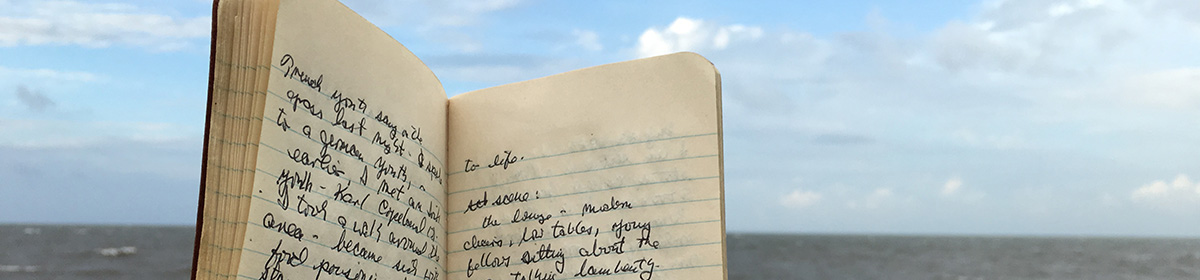
I’m remembering this from my place, a little desk in a little corner. But my mind is still back at The Last Mile. There is rain against my window, a small lamp on.
September 8, 2026. It might as well be tomorrow, or yesterday.
I’d stopped by the Last Mile. If you’ve been here before, You know everybody calls it The Mile. If you’re young enough, it could be, for you, the First Mile. But it’s just a bar. Right –“where everybody know your name.” East Boston and Revere come together there,the city of Lynn, too. You know, I’m not sure wher it is.
My little dog is at the door to my dim little room in these rainy moments. There was thunder. She’s afraid of thunder. I’ve learned she is not healthy — blood work, x-rays, all that. She’s a nice chihuahua Jack Russell mix -spotted and with a beautiful little face.
So – I’m at The Mile. And for once when I’ve been in that place, everybody DOESN’T know my name. There are seven strangers — three couples I’ve seen before but whose name I don’t know (so why would I expect them to know MY name. I found myself wishing Knox the artist was there from upstairs. I was feeling sufficiently strange enough to want to see a familiar face. Even the bartender was unfamiliar — a woman who’s a friend of the regular bartender Deano’s cousin. She looks pleasant enough.
So I watched the rain start against the front window, sitting with my ginger ale and a twist of lime, which I drank down quickly. So I was sitting across from the one strange guy — strange as in stranger, and not a young guy — and our eyes met in the silence. (Nobody even wanted to play the juke box.)
And then the guy spoke to me out of nowhere. “I worry about things,” he said. “But somehow, a rainy day helps – prayers and rain,” he said.
I realized then that I knew him, or, at least, had seen him before. I’d walked down to Revere Beach on another rainy day — it might have been a year ago, last September, in fact. And I saw him sitting by himself in one of the old pavilions. He was just looking out at the sea. I took a seat far down from him, just to get out of the rain, which had intensified. I only planned to look out to the sea, too.
But I couldn’t help see a car pull up in the nearly empty parking lot and a young woman walk over to the guy. She sat with him, they talked. They talked for a long time. I couldn’t hear them, didn’t want to hear them. Then they sat for a long time, both looking out to see. She held his hand. They were smiling, both looked — well, peaceful.
“You live around here?”
“Lynn,” he said. “Lived there all my life. I had a twin brother who died in the war — the big war.”
I thought I should ask, so I did: “What branch? Where’d he die?’
“The Pacific,” he said. “The Philippines. On a ship.” He looked off toward the bar, the wall air conditioner, another couple sitting at a table near the end of the bar. He looked back at me. “Buried at sea,” he said.
What could I say? It had probably been eighty years ago, or more. But I said, “I’m sorry.”
“I’ve got a daughter who lives nearby. She knows I like to sit by the water.” He pushed his drained beer pilsner aside, turned sideways in the seat, crossed his legs. He had gray, receding hair, wore a light jacket, bluejeans –and he seemed content. Even though he had turned toward me, I somehow knew he wasn’t looking for company — or conversation. Nor, I realized, did he want to make any further revelations.
“Soon as the rain let’s up, I’ll go down there.”
“I think I’ve seen you — you and your daugher down there at the beach.”
“We’ll, I haven’t seen her in a while.” He was looking nowhere then, off into nothing. Maybe seeing his daughter. Oddly enough, I could see her then — remember her raincoat, her hand holding his on her lap.
It was a little awkward, him and me just sitting there in a place where the other conversations in the room were the only thing to ease the awkward silence between him and me. Without a word, I got up, picked up my empty glass, brought it up and dropped it on the bar. The bartender — her name was Emily — took it and dropped in in the bar sink. The TV was off. No one was playing Keno. I went to the rest room. When I came out, the guy was gone. Why had he come here to The Last Mile? How had he found this place? But that’s the thing about The Mile. People, all kinds of people find it — and find it small and usually quiet and perfect for the moment.
I’d parked on the side street. Got in my car, started to drive home — and I was a good distance away when I turned around and headed back up Route 1A just as rush hour traffic seemed to be starting up.
I’d decided I had to go sit with that guy. I’d go, park my car just as his daughter had and sit with him, let him talk out whatever was going one with him. Had his daughter died? Where was his wife? Were there any other children? Had his late brother, lost out there at sea — had he had any children? Grand children?
I went down the long street by The Mile in the rain and came ultimately to the beach. And there was the man sitting in the same spot, his daughter sitting with him, close enough to be holding his hand.
So again, I’m remembering, as I say, back at my place at my little desk in a little corner with a little lamp, this September moment.
Rain, now a little thunder. September rain again. September again, when seasonal drift and melancholy clouds enter all my spaces.
Did I only imagine I was seeing that pavilion reunion in the rain — hoping for it?
No, I parked, watched and saw them leave together. I truly did.
I hope my little dog will finally eat and be well.